

RM declares fire emergency
Piney council meets today to consider evacuation
Advertisement
Read this article for free:
or
Already have an account? Log in here »
To continue reading, please subscribe:
Monthly Digital Subscription
$1 per week for 24 weeks*
- Enjoy unlimited reading on winnipegfreepress.com
- Read the E-Edition, our digital replica newspaper
- Access News Break, our award-winning app
- Play interactive puzzles
*Billed as $4.00 plus GST every four weeks. After 24 weeks, price increases to the regular rate of $19.95 plus GST every four weeks. Offer available to new and qualified returning subscribers only. Cancel any time.
Monthly Digital Subscription
$4.99/week*
- Enjoy unlimited reading on winnipegfreepress.com
- Read the E-Edition, our digital replica newspaper
- Access News Break, our award-winning app
- Play interactive puzzles
*Billed as $19.95 plus GST every four weeks. Cancel any time.
To continue reading, please subscribe:
Add Free Press access to your Brandon Sun subscription for only an additional
$1 for the first 4 weeks*
*Your next subscription payment will increase by $1.00 and you will be charged $16.99 plus GST for four weeks. After four weeks, your payment will increase to $23.99 plus GST every four weeks.
Read unlimited articles for free today:
or
Already have an account? Log in here »
Hey there, time traveller!
This article was published 14/05/2012 (5087 days ago), so information in it may no longer be current.
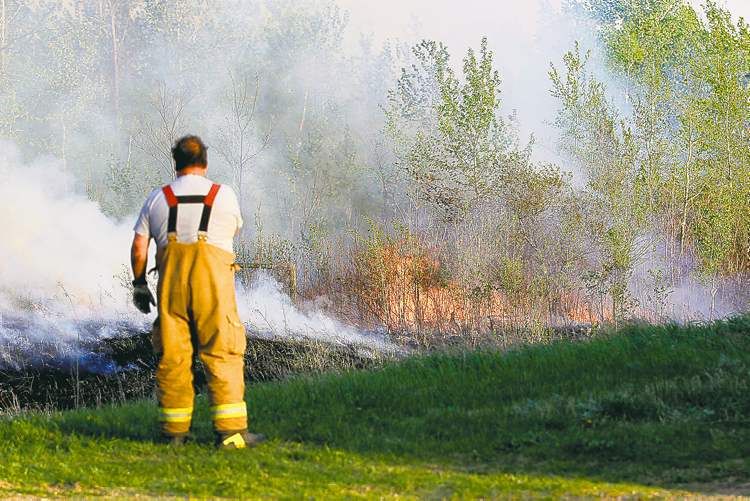
The RM of Piney declared a state of emergency Sunday to give authorities the power to close roads in the wake of two days of wildfires that consumed 3,000 hectares of forest over the weekend in the Sandilands Provincial Park.
The next step, an evacuation order, could come as early as this morning.
Coun. Donald Winnicky said the reeve and council declared the state of emergency at 4 p.m. Sunday.
“It means we’re implementing a travel ban and police are on the roads, all the roads leading into the fire. Anybody who’s travelling there will be turned back,” Winnicky said, adding police are also there “in case we need to evacuate.”
The RM will consider that step at a meeting today at 8:30 a.m.
Also in the morning, the RM expects to ask Premier Greg Selinger to throw the weight of the province behind a travel ban across southeastern Manitoba.
“We’re going to ask the premier to implement a travel ban in the east side of the province, or the southeast corner of it. That way, conservation officers can chase people out of the backcountry,” Winnicky said.
Authorities are nervous because weather forecasts predict winds will shift. Up to now, winds from the west pushed tongues of fire east, out of the range of small towns. Winds are expected to come out of the north overnight, driving the fire towards towns in the south.
“It could make a circle,” said Winnicky, threatening lives and the homes of about 1,700 people.
Smoke was visible from the Trans-Canada Highway to Woodridge, witnesses reported.
The province rushed out its forest-fire arsenal and, by Sunday, tanker planes were creating fire breaks with flame-retardant chemicals in the Sandilands Provincial Park.
Manitoba Conservation and Water Stewardship had six water bombers, three bulldozers, three tanker planes, four helicopters and 35-plus firefighters battling the flames.
“Any time you get fire in that area — it’s a homogenous stand of pines — once it gets going, it’s hard to put out,” Manitoba Conservation forest-fire Chief Gary Friesen said.
There were no evacuations and no injuries reported.
The public was warned to use extreme caution in the area, which draws hundreds of all-terrain vehicles to its flat, sandy trails.
“I encourage everyone to be safe when they’re travelling out of doors,” Friesen said.
The province asked ATV riders to pack axes, small shovels and fire extinguishers to put out fires they might cause.
Dry grass caught in the exhaust of an ATV can catch fire and spread sparks. Conservation officials urged riders to conduct spot checks, dig small holes to bury sparks or douse them in water near rivers.
At the same time, RCMP in Lac du Bonnet and Pinawa directed traffic off Highway 211 at the junction of Highway 11, after a separate fire was reported at a bridge across the Winnipeg River. Poor visibility from smoke prompted the closure, Conservation and RCMP said.
Pinawa resident Josh Powaschuk said by early evening, bush fires on either side of the bridge that links Highway 211 to Pinawa were largely out.
But there were some tense moments Sunday afternoon.
“You could smell the smoke and you could see it from town. People were worried about getting evacuated,” Powaschuk said.
Across southeastern Manitoba, it didn’t seem to matter how far away the fires were; there was smoke visible everywhere.
Even motorists on the Trans-Canada, many kilometres north of the fires, caught glimpses of smoke.
“They’re putting up big columns of smoke,” Friesen said.
Firefighters surrounded a 40-hecatre fire they’d corralled in the Sandilands Provincial Park, but two others had grown to 1,500 to 2,000 hectares each by Sunday.
Manitoba Conservation said the big fires were northeast of Carrick and southeast of Woodridge, closer to the Minnesota border than to the Trans-Canada Highway.
Officials with regional rural municipalities had their eyes on the horizon.
“I can see some smoke behind my place,” Reynolds Coun. Garry Gaetz said from his backyard in Richer.
That smoke was a cloudy haze on the western horizon, even though the fires were 60 kilometres away.
“It’s out by Woodridge,” he said.
Manitoba Conservation officials said the communities of Marchand and Woodridge were closest to the wildfires but neither community was threatened as long as the wind was from the west.

The caution about ATVs as potential fire hazards recalls history.
The province concluded ATVs caused a fire that tore through Sandilands in the spring of 2008, consuming 3,400 hectares of forest.
Another one in October 2011, which was unrelated to ATVs, chased hundreds from their homes in Woodridge, Caliento, Lonesand and Sandilands. It took 160 firefighters to beat that fire to the ground. It consumed 15,000 hectares.
alexandra.paul@freepress.mb.ca
Related Articles
Travel restrictions announced in wake of wildfires
Advertisement Advertise With Us
Advertisement Advertise With Us