

Some still charge pop-bottle levy
Grace period given to eliminate fee

Advertisement
Read this article for free:
or
Already have an account? Log in here »
To continue reading, please subscribe:

Digital Subscription
One year of digital access for only $205*
- Enjoy unlimited reading on winnipegfreepress.com
- Read the E-Edition, our digital replica newspaper
- Access News Break, our award-winning app
- Play interactive puzzles
*First annual payment billed as $205.00 + GST for one year. This annual subscription will automatically renew at $233.00 + GST every 52 weeks (10% off the regular annual price of $259.35). Offer available to new and qualified returning subscribers only. Cancel any time.
To continue reading, please subscribe:
Add Free Press access to your Brandon Sun subscription for only an additional
$1 for the first 4 weeks*
- Enjoy unlimited reading on winnipegfreepress.com
- Read the E-Edition, our digital replica newspaper
- Access News Break, our award-winning app
- Play interactive puzzles
*Your next Brandon Sun subscription payment will increase by $1.00 and you will be charged $17.95 plus GST for four weeks. After four weeks, your payment will increase to $24.95 plus GST every four weeks.
Read unlimited articles for free today:
or
Already have an account? Log in here »
Hey there, time traveller!
This article was published 08/04/2010 (5972 days ago), so information in it may no longer be current.
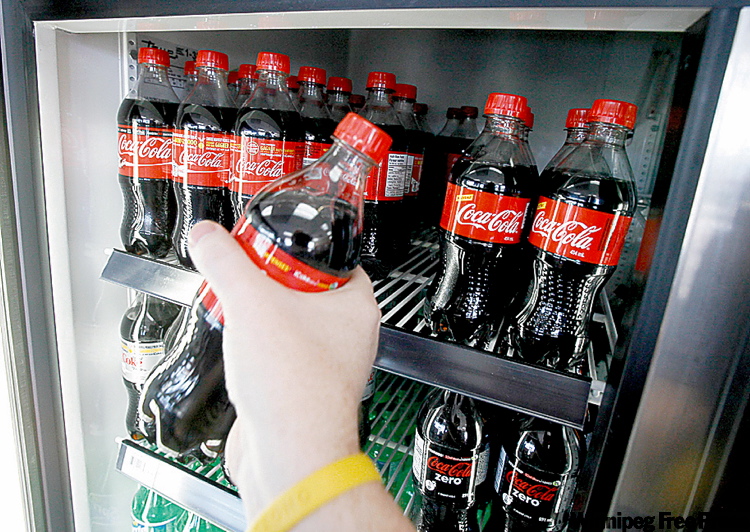
PROVINCIAL Tories are choked that some stores are still charging the two-penny pop bottle levy that the province killed effective April 1.
Party members who went shopping for soda on the weekend found some retailers were collecting the beverage container levy, Tory MLA Larry Maguire (Arthur-Virden) said during question period in the legislature Tuesday.
Maguire said the retailers who are still charging the levy couldn’t say why.
Conservation Minister Bill Blaikie said he was looking into it.
"We did send out a notice to retailers," said Laurie Streich with Manitoba Conservation. Some retailers are dealing with excess stock and have been given a two -week "grace period" allowing them to continue to charge the two cent levy, said Streich, director of the pollution prevention branch. "Technically speaking, the levy did end on March 31."
But as soon as the province killed its two-cent levy, the industry’s beverage "stewards" on April 1 started charging distributors a "voluntary" two-cent container fee.
The industry says it wants to expand recycling beyond the blue box and collect more beverage containers in more places, said Streich, who met with the beverage industry representatives last week.
"It looks like it could be a really good initiative," said Streich, who noted that the industry hasn’t been able to reach its 75 per cent recovery target for beverage containers.
If the industry is going to collect two cents a container and say it’s for recycling, it’s going to have to be accountable and transparent, she said.
"What’s on the ground? …Are their depots or bins everywhere?… We need some more information. There are some good ideas but there’s no real meat on them."
For the past 15 years, the bulk of the funding for municipal recycling came from the two-cent levy on beverage containers. Now, instead of drink containers bearing the brunt of recycling fees, the cost will be spread around.
On April 1, the new, non-profit stewardship board — Multi-Material Stewardship Manitoba – was ushered in. The has close to 1,000 industry "stewards" paying levies on a broad range of packaging materials and printed paper, including newspapers and magazines, coffee cups and other recyclable materials.
Some of the amounts levied on individual packaging and printed paper products are about 9/10ths of a cent on a cereal box, three cents on a large magazine and 8/10ths of a cent on a four-litre milk jug.

— With file from Bruce Owen
carol.sanders@freepress.mb.ca
Carol Sanders
Legislature reporter
Carol Sanders is a reporter at the Free Press legislature bureau. The former general assignment reporter and copy editor joined the paper in 1997. Read more about Carol.
Every piece of reporting Carol produces is reviewed by an editing team before it is posted online or published in print — part of the Free Press‘s tradition, since 1872, of producing reliable independent journalism. Read more about Free Press’s history and mandate, and learn how our newsroom operates.
Our newsroom depends on a growing audience of readers to power our journalism. If you are not a paid reader, please consider becoming a subscriber.
Our newsroom depends on its audience of readers to power our journalism. Thank you for your support.
Carol Sanders
Legislature reporter
Carol Sanders is a reporter at the Free Press legislature bureau. The former general assignment reporter and copy editor joined the paper in 1997. Read more about Carol.
Every piece of reporting Carol produces is reviewed by an editing team before it is posted online or published in print — part of the Free Press‘s tradition, since 1872, of producing reliable independent journalism. Read more about Free Press’s history and mandate, and learn how our newsroom operates.
Our newsroom depends on a growing audience of readers to power our journalism. If you are not a paid reader, please consider becoming a subscriber.
Our newsroom depends on its audience of readers to power our journalism. Thank you for your support.
Advertisement Advertise With Us
Advertisement Advertise With Us