

The ‘fall guy’
Head coach caught in hockey hazing storm speaks out

Advertisement
Read this article for free:
or
Already have an account? Log in here »
To continue reading, please subscribe:
Monthly Digital Subscription
$1 per week for 24 weeks*
- Enjoy unlimited reading on winnipegfreepress.com
- Read the E-Edition, our digital replica newspaper
- Access News Break, our award-winning app
- Play interactive puzzles
*Billed as $4.00 plus GST every four weeks. After 24 weeks, price increases to the regular rate of $19.95 plus GST every four weeks. Offer available to new and qualified returning subscribers only. Cancel any time.
Monthly Digital Subscription
$4.99/week*
- Enjoy unlimited reading on winnipegfreepress.com
- Read the E-Edition, our digital replica newspaper
- Access News Break, our award-winning app
- Play interactive puzzles
*Billed as $19.95 plus GST every four weeks. Cancel any time.
To continue reading, please subscribe:
Add Free Press access to your Brandon Sun subscription for only an additional
$1 for the first 4 weeks*
*Your next subscription payment will increase by $1.00 and you will be charged $16.99 plus GST for four weeks. After four weeks, your payment will increase to $23.99 plus GST every four weeks.
Read unlimited articles for free today:
or
Already have an account? Log in here »
Hey there, time traveller!
This article was published 12/11/2011 (5224 days ago), so information in it may no longer be current.
Victim or perpetrator?
In the wake of the hazing scandal in the dressing room of the Manitoba Junior Hockey League’s Neepawa Natives, little has been heard from head coach Bryant Perrier. Although it was acknowledged early on he was instrumental in referring the hazing incident to the league for investigation, he has made few comments publicly.
Notwithstanding his role in reporting the hazing, Perrier was suspended by the league and, later, vilified in the court of public opinion for allowing his players to engage in sexually degrading rituals as part of a rookie initiation process. Both the league and the RCMP are conducting ongoing investigations.
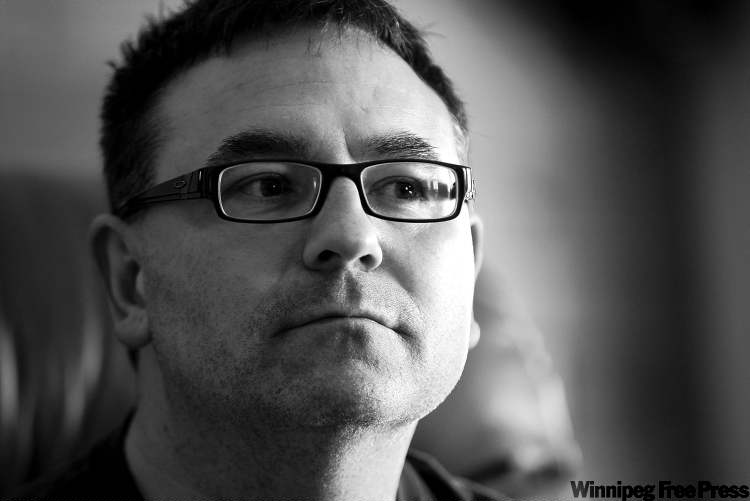
The Natives last week announced Perrier had resigned, a development the coach refutes. In an exclusive interview with the Free Press, Perrier said he had no intention of leaving the team and was given no advance warning the team would issue a news release stating he had resigned.
Perrier said he is the “fall guy” for a league and team that has botched the handling of the hazing incident from the beginning. He said it would have been much easier to, as many other hockey people have in the past, just cover up the whole incident. Perrier said he believes his suspension and the subsequent efforts by his own team to get rid of him are punishment for not keeping the entire matter internal.
“I did the right thing and now I’m being hung out to dry,” Perrier said.
— — —
Perrier said he learned of the hazing on the morning of Oct. 5. One of the players subjected to the hazing told his girlfriend, kicking off a chain reaction that led to Perrier finding out. One of his assistant coaches confirmed the hazing and identified three of the team’s veteran players as the ringleaders. Perrier immediately sought out two of his veteran players. Perrier said the two players freely admitted to the hazing, which ranged from small monetary fines, to additional cleaning in the dressing room to, ultimately, a “tug.” Perrier said his blood ran still at the mention of the word.
In the hockey world, a ‘tug’ usually refers to the act of tying some object to a player’s scrotum. This could be a water bottle or a bucket containing pucks.
That form of hazing turns out to be an extension of rookie initiations that many junior hockey teams employ. In Neepawa, rookie duties included cleaning the dressing room, weight room and showers/bathroom. Under the supervision of a veteran player, the rookies were to sweep and mop floors, clean showers, toilets and urinals, empty garbage cans, launder towels, re-stack weights and other exercise equipment, and collect stray pucks around the rink.
Failure to perform these duties could result in a trip to “kangaroo court,” where the vets would determine punishment. Perrier said his understanding was that punishment constituted fines or other cleaning duties. At no time was there any suggestion anyone was being subjected to a ‘tug’ for failure to live up to rookie duties.
When he criticized his players for the hazing, Perrier said he was shocked by the reaction. “They didn’t think they had done anything wrong. They couldn’t figure out why I was upset.”
That evening, Perrier and team president Dave McIntosh called MJHL commissioner Kim Davis to report the incident. At that moment, Perrier and McIntosh had made a very important decision to violate hockey’s code of silence, a tradition that says what happens in a locker-room stays in a locker-room. And that when there’s trouble, it’s kept within the family.
Unbeknownst to Perrier, that phone call to Davis, ultimately, would spell the end of his coaching tenure in Neepawa and put his career in jeopardy.
— — —
Perrier said the MJHL’s anti-hazing policy was posted in the dressing room and his assistant coaches were both aware of the limits on initiation and team-building activities.
Following his initial meeting with the team, at which he told them the hazing had been referred to the league for disciplinary action, Perrier said his team began to implode.
Veterans, who continued to maintain they had done nothing wrong, began to take it out on the player they believed was responsible for telling tales out of the dressing room. On Oct. 6, the day after he learned of the hazing, Perrier said he had to send a player off the ice during practice for shooting pucks at the player who inadvertently revealed the hazing by discussing it with his girlfriend.
Perrier said he confronted Danil Kalashnikov, the team’s captain, and challenged him to settle the internal strife affecting the team. Kalashnikov, Perrier said, told him the players believed the player who revealed the hazing “sold them out.”
In the forthcoming days, Perrier said, he began to sense he was also getting shunned by his own team for reporting the hazing to the league. He brought in a counsellor to talk to the team about hazing and bullying, but even that spun out of control when the team wouldn’t allow the player at the centre of the hazing incident to attend.
“I’m just trying to get them to play hockey but it’s not working,” said Perrier. “I told the organization, ‘I’ve got duct tape everywhere holding this thing together. We’ve got holes in the hull of the ship and we’re listing at 45 degrees. What are we going to do?’ ”
— — —
Perrier is forced to acknowledge things got out of hand in his dressing room. How that happened, and who is ultimately responsible, is still the subject of an ongoing investigation.
Initially, the players took full responsibility for the hazing. Both Brad Biggers and the second assistant coach, who isn’t being named because his son was one of the hazing victims, denied knowledge or involvement in the hazing. Perrier maintained from the beginning he had no knowledge of the hazing incident and reported it as soon as he found out.
On Oct. 23, commissioner Davis reported the findings of his investigation. Based on his finding that hazing had indeed occurred, Perrier was suspended two games, along with Biggers (five games) and a host of players for a varying length of time.
League and team sources confirm the continuing investigation, now being conducted by a retired member of the Winnipeg Police Service, is re-examining the actions of all the coaches, including the assistant coach whose son was one of the victims of the hazing. Davis has acknowledged the players he interviewed were not telling him everything that happened and everyone who was involved.
The sources confirm the ongoing investigation has not, to date, uncovered any evidence Perrier knew or participated in the hazing. However, the sources also said there is evidence the hazing in the Neepawa Natives organization has been going on for several years, possibly before Perrier took over the team during the 2009-2010 season.
Whenever allegations like this arise, the role of the head coaches will always be hotly debated. Perrier does not dispute the notion this happened “on his watch.” However, he is also quick to point out many more instances of hazing are never reported because coaches and other hockey officials are afraid of the grief he is now suffering.
And while the debate continues about Perrier’s culpability, it is clear the order of events has not allowed him an opportunity to make his case. Although he was instrumental in reporting the hazing, he was nonetheless suspended and then gagged by his organization. Having been suspended without any evidence he knew about the hazing, Perrier is now left in the unenviable position of trying to revive his career and reputation at a time when the overarching concern is about the teenagers who were subjected to the hazing.
Perrier says for the time being, he will remain in Neepawa and await the results of the second investigation he hopes will give him a chance at clearing his name in this mess.
“This is not what I’m about,” Perrier said. “This is not who I am. I did everything I could possible do to make sure this was dealt with properly. And now, my career could be over.”
dan.lett@freepress.mb.ca
From hockey player to head coach
BRYANT Perrier admits he was a pretty scrappy player in his day. He played one season in the International Hockey League and had a cup of coffee in the East Coast Hockey League where his penalty minutes exceeded his goals and assists by a wide margin.
A few years after leaving the game as a player, he returned as a junior coach in the British Columbia Hockey League, enjoying several outstanding seasons with the Penticton Panthers. There, he helped guide the careers of NHL stars such as Duncan Keith of the Chicago Blackhawks, Chuck Kobasew of the Colorado Avalanche and Tanner Glass of the Winnipeg Jets.
Perrier rejects the notion hazings are an essential ingredient in developing an elite hockey player. However, he cannot deny hazing is, indeed, an ingredient of hockey culture.
He said he learned his approach to initiation rituals from iconic figures such as Washington Capitals’ head coach Bruce Boudreau, who was a high-scoring forward and captain of the Phoenix Roadrunners during the 1989-90 season. On many hockey teams, the captain sets the tone for rookie initiation. During that season, Boudreau decreed the rookies would have to take the rest of the team out for dinner and pick up the tab. “That was quite a while ago and we didn’t get hazed,” said Perrier.
“I know there might be an old-school group that thinks it’s OK, but I think today’s parents don’t agree with it. I don’t agree with it.”
A timeline: Neepawa Natives’ hazing scandal
TUESDAY, OCT. 11 — Manitoba Junior Hockey League commissioner Kim David meets with members of the Neepawa Natives team and management group over a hazing incident that occurred in late September in the club’s dressing room.
THURSDAY, OCT. 13 — Davis confirms investigation is ongoing and is “unlike anything he has heard of in the league’s recent history.” Davis declines to reveal the nature of the complaint.
TUESDAY, OCT. 18 — RCMP confirm a police investigation has been launched into a hazing incident involving players of the Neepawa junior hockey club.
TUESDAY, OCT. 25 — The MJHL announces the Natives team had been fined $5,000 and some of its coaches and players suspended for hazing. Coach Bryant Perrier is suspended for two games, although it was acknowledged he had no knowledge of the hazing. Assistant coach Brad Biggers is suspended for five games along with the team’s captain, assistant captains and 12 other players. A 15-year-old player, the victim of the hazing, leaves the team, as does an assistant coach.

WEDNESDAY, OCT. 26 — The parent of the hazing victim says her son was forced to walk around the team locker room with a set of water bottles tied to his scrotum. The parent also confirms four other players were forced to perform similar acts in the Natives’ dressing room.
FRIDAY, OCT. 28 — MJHL announces it is reopening its probe into the hazing incident after learning players initially interviewed had lied about the involvement of assistant coach Brad Biggers, 21. “The assistant coach was present during some of the time the hazing went on,” says Davis. The assistant coach was handed an indefinite suspension from the league, and a special independent investigator will be brought in to handle the case.
TUESDAY, NOV. 1 — The MJHL announces Ron Bell, a retired law-enforcement professional, will oversee the investigation. Meanwhile, the parents of the 15-year-old victim of the hazing incident say they are making arrangements to have their son play in Nebraska with the Omaha AAA Hockey Club.
WEDNESDAY, NOV. 2 — Four more players leave the Natives, raising to 14 the number of players who have either been traded, released or have walked out on the club since Oct. 25.
THURSDAY, NOV. 3 — Bryant Perrier, the club’s coach and GM, resigns from the Natives.
Dan Lett is a columnist for the Free Press, providing opinion and commentary on politics in Winnipeg and beyond. Born and raised in Toronto, Dan joined the Free Press in 1986. Read more about Dan.
Dan’s columns are built on facts and reactions, but offer his personal views through arguments and analysis. The Free Press’ editing team reviews Dan’s columns before they are posted online or published in print — part of the our tradition, since 1872, of producing reliable independent journalism. Read more about Free Press’s history and mandate, and learn how our newsroom operates.
Our newsroom depends on a growing audience of readers to power our journalism. If you are not a paid reader, please consider becoming a subscriber.
Our newsroom depends on its audience of readers to power our journalism. Thank you for your support.
Dan Lett is a columnist for the Free Press, providing opinion and commentary on politics in Winnipeg and beyond. Born and raised in Toronto, Dan joined the Free Press in 1986. Read more about Dan.
Dan’s columns are built on facts and reactions, but offer his personal views through arguments and analysis. The Free Press’ editing team reviews Dan’s columns before they are posted online or published in print — part of the our tradition, since 1872, of producing reliable independent journalism. Read more about Free Press’s history and mandate, and learn how our newsroom operates.
Our newsroom depends on a growing audience of readers to power our journalism. If you are not a paid reader, please consider becoming a subscriber.
Our newsroom depends on its audience of readers to power our journalism. Thank you for your support.
Related Articles
League encourages hazing secrecy


Advertisement Advertise With Us
Advertisement Advertise With Us