

Young killers ‘are poor lost kids,’ not sociopaths
Advertisement
Read this article for free:
or
Already have an account? Log in here »
To continue reading, please subscribe:
Monthly Digital Subscription
$0 for the first 4 weeks*
- Enjoy unlimited reading on winnipegfreepress.com
- Read the E-Edition, our digital replica newspaper
- Access News Break, our award-winning app
- Play interactive puzzles
*No charge for 4 weeks then price increases to the regular rate of $19.95 plus GST every four weeks. Offer available to new and qualified returning subscribers only. Cancel any time.
Monthly Digital Subscription
$4.99/week*
- Enjoy unlimited reading on winnipegfreepress.com
- Read the E-Edition, our digital replica newspaper
- Access News Break, our award-winning app
- Play interactive puzzles
*Billed as $19.95 plus GST every four weeks. Cancel any time.
To continue reading, please subscribe:
Add Free Press access to your Brandon Sun subscription for only an additional
$1 for the first 4 weeks*
*Your next subscription payment will increase by $1.00 and you will be charged $16.99 plus GST for four weeks. After four weeks, your payment will increase to $23.99 plus GST every four weeks.
Read unlimited articles for free today:
or
Already have an account? Log in here »
Hey there, time traveller!
This article was published 01/10/2011 (5208 days ago), so information in it may no longer be current.
It was shortly after 2 p.m. Thursday and I was driving on Sherbrook Street just north of Ellice Avenue when I spotted the three teenage boys and pulled over.
I had a question.
“Are you afraid of being stabbed when you’re on the street?”
One of the boys, a 16-year-old with a cluster of love-bite bruises on his neck, answered in an indirect but telling way.
“My cousin was stabbed to death on College and Aikins.”
His cousin was Clark “Clarky” Stevenson. The street stabbing happened early on the morning of Sept. 10 and two teenagers have since been charged with killing the 15-year-old because they believed he was affiliated with a gang. One of the accused is 18, the other only 14.
I could tell the kid who is living with the death of his cousin wanted to talk more, but the leader of the group pulled him away. But he called back that we would meet later at the Tim Hortons across Portage Avenue.
“Five o’clock,” he said.
— — —
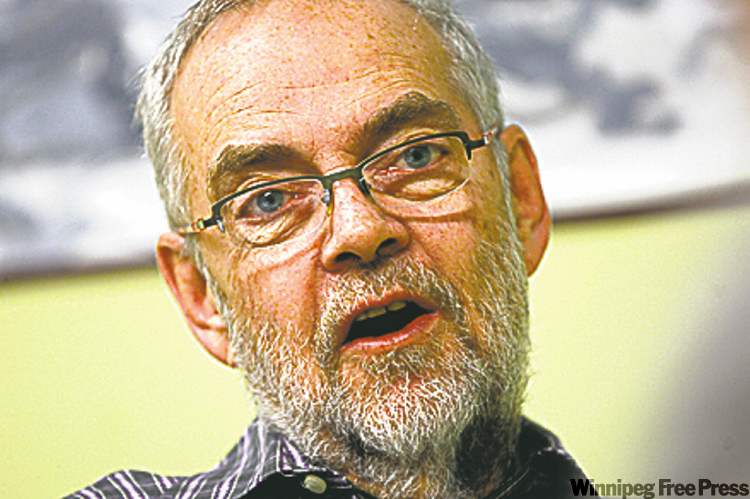
The next day, I had another appointment, this time with Dr. Keith Hildahl, the head of the Winnipeg Regional Health Authority’s child adolescent mental health program.
I had a related question for him, too.
How does a kid get to the point in his life where he can look some other kid in the eye and stab him in the heart?
Actually, I’d been thinking about that long before Friday’s Free Press story about teenagers being the victim or the accused in nine of the city’s 32 murders so far this year.
My initial curiosity came from constant police reports of people, mostly young people from the inner city, being stabbed but not necessarily dying.
Subsequently, I read about kids in what amounts to inner-city American war zones who witness and live with the threat of violence in their homes and neighbourhoods and how so many of them suffer the emotion-numbing after-effects of post-traumatic stress disorder. I wondered if that could be part of the reason kids in inner-city Winnipeg can kill other kids with such little feeling. The way soldiers are trained to, and street gang members are supposed to.
Hildahl agreed that was part of it.
“We’ve got lots of kids who come through youth justice who have had early physical abuse and early sexual abuse and massive amounts of early neglect.”
Which creates what psychiatrists call a lack of “attachment,” the emotional connections that come from being loved and nurtured as a child that help us empathize with others later in life.
But Hildahl also said this: “There are as many stories as there are murderers.”
He suggested there’s a natural tendency to want to lump the reasons into those large clusters.
“Gangs, which is a big factor. Inner city. Obviously a big deal. Poverty.”
I suggested another reason.
It comes from something published years ago in a letter to the New York Times. “Why do young black men kill other young black men?” the letter writer asked. “Because they’re shooting into a mirror.”
But Hildahl suggested that what he sees most when he looks into the souls of these mostly First Nations kids isn’t self-loathing.
“I see more emptiness. I see lots of emptiness. Kids who have nothing and understand they have nothing.”
Kids who don’t see a future.
Who lack hope.
“If you have no hope,” Hildahl said, “what is the consequence of taking someone’s life?”
Yet, after they kill, Hildahl said, some kids have deep remorse. Others express remorse as much as their limited emotional development allows.
“And once in a while we see kids with no remorse.”
Surprisingly perhaps, few in Hildahl’s experience are classic sociopaths. Instead, when they’re alone in a room without the bravado of the gang to live up to, Hildahl sees them for what they really are.
“These are poor lost kids.”
But these are the grandchildren of the kids Hildahl saw when he was working as a youth justice counsellor back in the early 1970s.
“You’re seeing a generational transfer,” he said. “And it’s growing.”
— — —

If you’re wondering about the kid who was supposed to meet me at Tim Hortons, he didn’t show up.
But then I didn’t really think he would. What concerns me far more is, other than talking tough on crime, most of our political leaders have failed to show up on the issue during the provincial election.
But then I really didn’t think they would, either.
gordon.sinclair@freepress.mb.ca


Advertisement Advertise With Us
Advertisement Advertise With Us