Email Larry Kusch & Bruce Owen
-
Energy savings: if it’s such a no-brainer. . .
8:06 AM
Interesting blog on the Washington Post highlighting the work of research group E2e.
Most, if not all, of it applies to Manitoba and the ongoing debate whether our power utility Manitoba Hydro should be building the new Keeyask and Conawapa hydroelectric generating stations, or looking at less costly, less risky ways to deliver power to our light bulbs, fridges and air conditioners.
One way is to get us to become more efficient in the power we consume, like getting rid of old appliances.
Manitoba Hydro has, in some circles at least, been slammed for not doing enough to curb energy use, what's otherwise known as demand-side management.
Critics say by Hydro being more aggressive in demand-side management, more Manitobans will use less power, making it available for export and reducing in part the demand for new dams. Plus, it would put less pressure on what you and I pay each month to Hydro.
This was most recently addressed at a recent Public Utilities Board meeting.
Ex-PUB chairman Graham Lane has raised it in a recent piece for the Frontier Centre For Public Policy.
"Reducing energy consumption and demand allows for deferrals/delays in building new generation and transmission lines (which can be very useful, particularly in times of low export demand), or, in the case of jurisdictions that have excess supply, enhancing exports and incremental export revenues," Lane said.
"Reducing energy consumption also assists in environmental objectives, which even in the case of Manitoba Hydro are furthered by energy efficiency, particularly when it is due to extreme cold, extreme heat, equipment failure, or a drought, the utility is required to import power, with most of the power coming from coal-fired generation in the United States."
But, as the Post blog points out, what's the best way to reduce energy consumption?
Seal leaks around our home's windows? Replace all the windows altogether? Insulate the basement? Outfit every light everywhere with a CFC bulb?
Get rid of the old fridge?
We all know we should be doing these things and more, but a lot of us aren't.
One reason is cost. Another is our relatively low electricity and natural gas rates.
The argument goes because we pay so little there's no incentive for us to shell out the bucks to re-insulate the entire house or buy new kitchen appliances.
The savings aren't there. Yet. And until we really get hit in the pocketbook for the power we consume, nothing will change that.
bruce.owen@freepress.mb.ca
-
Bombers: please, please, please don't suck
06/13/2013 8:49 AM
Alrighty then.
Being a Winnipegger and a season ticket holder for about 25 years, it's my right and duty to whine.
I acknowledge more things went right Wednesday night than went wrong — the pipes in the men's can didn't freeze, the field lights stayed on and the beer was actually cold — but at the same time, there are a couple of serious kinks that need to addressed, not only for the season opener June 27, but the Taylor Swift concert June 22.
Related Items
Park and ride: More like park and park. There is nothing more I enjoy than sitting on a crowded bus looking up some guy's armpit. My wife Judy and I thought we were being smart and efficient by leaving the house early and using transit's park and ride at Manitoba Hydro at Taylor and Harrow. A few hundred (if not more) Bombers fans did, too.
The number of people in line was more than transit estimated. Only seven buses were assigned to that location and they quickly filled up, only to be swallowed up in the morass of Pembina Highway at Bishop Grandin and University Crescent. Transit was to add five more buses to deal with the number of waiting fans.
We and few thousand other folks got to our seats about half an hour late. Many others took longer. Way longer. The length of time it took us to drive and take the bus to the game, I could have driven to the cottage at Victoria Beach, unloaded the car, popped a beer and watched it on TV.
To me, the traffic signals at Bishop and Pembina are ineffective to deal not only with the volume of traffic, but the type of traffic: lots and lots of buses.
Police need to direct traffic at that intersection — damn the lights — so traffic flows more smoothly onto University Crescent. Thought should also be given to turning University Crescent into a one-way street towards the stadium to deal with the bottleneck.
There's also the pedestrian traffic trying to get across Pembina towards Investors Group Field. As the situation is now, it is not safe.
The gate: I recognize the Bombers have a responsibility to deal with loogans.
I accept that, but at the same time I've always found the searches and pat-downs as intrusive. I welcome the wands. What I don't like is men in one line and women in another. I understand why the Bombers thought it was a good idea, but how it was played out Wednesday night at the northeast gate we went through was disorganized and unnecessary.
If the Bombers want to separate male and female fans into separate bag-search and wand lines, it has to be properly communicated with signage. It would also be wise to put on more search staff — yes, it costs money — and open up more entrance gates than I saw to speed getting paying customers through.
Frankly, I've seen more organization putting cattle through the chute.Concessions: Yes, the layout of the stadium, its openness and sightlines are wonderful. Yes, Wednesday night was the first real, actual test. The staff I saw worked extremely hard, were polite and cheerful and in some cases performed above what they're paid.
My only question is whether there's a more efficient way to process sales faster so lineups keep moving so that, like buses, bottlenecks of people do not build up in the concourse. Part of it, too, is fans learning what's what, such as what station they can buy beer or whatever at with minimum waiting. Next game I'm bringing my own peanuts. Call me an outlaw.
Men's can: I do not lament the trough. The washroom I used was clean and efficient. There was no squeezing between two other guys hoping, praying, their aim is true.
My seats: Excellent. Just to have legroom is a joy. A cupholder, too. I no longer sit behind the visitor's bench, I'm closer to the south end zone, but I don't think there's a bad seat in the house.
Press box: Were there people actually working in there? Do they take turns sitting on each other's laps? It looks more like a shipping container with windows cut out by some guy who bought a reciprocating saw on sale, but left the tape measure in the toolbox on the day he fired it up. Ugly. In an otherwise beautiful stadium, the press box is an open sore.
Leaving the game: Because we took the bus, we were prisoners to the end of the game, such as it was.
We found our bus back to Taylor and Harrow quickly enough. The trip down Chancellor Matheson Road towards Pembina was a faster crawl than the way in on University Crescent.Part of that, I think, was that police were directing traffic instead of leaving it up to traffic signals. Once we turned onto Pembina it didn't take long to get back to Taylor and Harrow, our car and then home on the other side of the city.
If my opinion counts for anything, police who are directing traffic have to be more visible and there has to be more of them. The car, bus and pedestrian traffic is thick and spotting an officer who is not decked out in a reflective yellow jacket isn't easy.
Chancellor Matheson does not have street lights and seeing a police cruiser also isn't easy despite its warning lights, wig wags and light bar activated — there is that much traffic.
Anyway, I never thought I'd say this, but the Bombers need more cops directing traffic in and out. Way more cops.I'm also considering loading my bike in my trunk and parking at a friend's home in River Heights and cycling in instead of using the bus. That way, I can ride in listening to Bob Irving on the ear buds without the armpits. The start time is 8 p.m., which should give me plenty of time.
Bombers: Despite these complaints and others, everything would be tolerable, even acceptable, if the Bombers didn't suck on the field. You don't lose to the Argos or anyone else on your own turf, even in exhibition, without putting up a fight. Ever.
Somewhere along the line over the past decade the Bombers have found it acceptable to lose at home.
My hope is the new digs puts a fire back in their belly. That's my biggest wish.
bruce.owen@freepress.mb.ca -
Scattering ashes
06/4/2013 9:42 AM
Picture this:
A group people gather on the riverbank to hold a brief ceremony.
There are tears, hugs and a few words before one of them opens a container to scatter the cremated remains of a deceased loved one into the flowing river current.
There are a few more words. The mourners then leave.
Then another group arrives. The same scenario repeats itself.
The secluded spot where the ceremonies take place is appropriately marked that ashes can be scattered in the river. There's a guardrail to allow mourners get close to the riverbank without risking falling into the water below, and an adjacent area where they can gather before and after the ceremony.
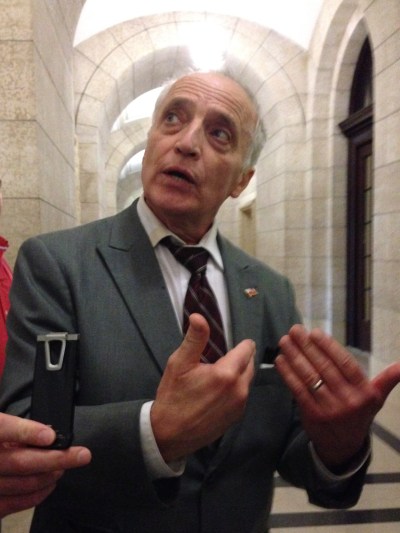
Such a spot hasn't been chosen yet, but that's the long-term goal of the city's Hindu community, NDP MLA Mohinder Saran says.
Saran says it's an issue of religious rights, particularly among Hindus whose religion mandates cremation.
In a recent resolution put forward in the legislature, Saran said cremation is controlled under the province's Cemeteries Act, but there is no mechanism to guide what can be done with the ashes.
Saran said many jurisdictions, including Alberta, Newfoundland and Labrador and Ontario, allow cremated remains to be scattered on waterways and Crown land.
Saran asked for all-party support to acknowledge the significance of the religious custom of scattering cremated remains and to consider adopting a policy similar to Ontario's. It would be the first step in the province acknowledging families are not breaking any law when scattering ashes.
Ontario has several options:
- Ashes can be buried or scattered in a registered cemetery.
- Ashes can be placed in a columbarium, called a niche. A columbarium is an above-ground structure that houses a number of niches.
- Ashes can be scattered on private property with the consent of the land owner.
- A cemetery, crematorium, funeral home or transfer service can scatter the cremated remains on a family's behalf.
- Cremated remains can be scattered on unoccupied government-owned Crown lands or Crown lands covered by water, including provincial parks and conservation reserves and the Great Lakes without government consent.
- Ashes can be scattered on municipally-owned lands, but municipal by-laws must be checked first.
Saran's resolution did not pass, but it is still being studied by government to see how to best to accommodate all Manitobans who wish to lawfully scatter the cremains of a loved one.
Manitoba's Public Utilities Board administers the Cemeteries Act, but to date has not dealt with the specific issue as raised by Saran.
The PUB only says on an online FAQ:
Q: Can I scatter cremated remains myself?
A: Yes, but only at a location with the owner's permission and discretely.The board did deal with the issue, in part, in 2006 and found that the increasing practice of the scattering of cremated human remains was not adequately addressed in legislation.
"That said, the board also concludes that the (Cemeteries) Act is outdated, and has failed to stay current with the changing preferences of consumers with respect to cremations and the scattering of ashes. The board will conclude that regardless of the definitional deficiency as to what is meant by "human remains" and "ashes", ashes resulting from cremation are, from a general understanding perspective, the remains of deceased humans. Where and how they are scattered or otherwise disposed are matters of importance to families and society.
"In short, the Cemeteries Act neither provides regulatory oversight over the scattering of ashes, nor assures perpetual care of the sites where ashes have been spread, other than, and by extension, when the site is a cemetery."
In past discussions on the matter, a number of statutes have been singled out as potentially treating cremated human remains as harmful to the environment.
The Canada Water Act defines waste as:
(a) any substance that, if added to any water, would degrade or alter or form part of a process of degradation or alteration of the quality of that water to an extent that is detrimental to their use by man or by any animal, fish or plant that is useful to man, and;
(b) any water that contains a substance in such a quantity or concentration, or that has been so treated, processed or changed, by heat or other means, from a natural state that it would, if added to any other water, degrade or alter or form part of a process of degradation or alteration of the quality of that water.
The federal Fisheries Act is similar. It defines "deleterious substance" as:
-any substance that, if added to water, makes the water deleterious to fish or fish habitat or any water containing a substance in such quantity or concentration or has been changed by heat or other means, that if added to water makes that water deleterious to fish or fish habitat. Currently there are regulations that authorize the deposit of pulp and paper liquid effluent, metal mining liquid effluent, petroleum liquid effluent, and effluents from other industrial sectors.
Manitoba's Litter Regulation under The Environment Act and Winnipeg's Anti-Litter By-law both prohibit the distribution of "ashes", but the definition of "ashes" in both laws does not include human ashes.
There is also some discussion that cremated ashes are rich in calcium and phosphorus that can affect alkalinity and act as a fertilizer, which could restrict in some circumstances where ashes are spread. More information is on the website Scattering Ashes.Taken altogether, the law is woefully unclear on the spreading of cremated human remains.
What Saran is trying to do is bring more clarity to an issue hundreds if not thousands of Manitobans will participate in in their lifetimes.
And rightfully so.
-
Closure and Bill 20 — who’ll blink first?
05/9/2013 1:43 AM
One of the more clever moves Opposition Progressive Conservative Leader Brian Pallister has made is making Steinbach Tory MLA Kevin Goertzen his party’s house leader.
Goertzen, a lawyer by trade, has proved extremely adept at using procedural rules to gum things up for the ruling NDP.
Pallister’s Tories, under Goertzen’s hand, have now threatened to extend the current sitting beyond June 13 and into the summer. They say they'd do that to stymie Premier Greg Selinger’s New Democrats and their plan to pass Bill 20 in time to hike the provincial sales tax to eight per cent by July 1.
That delay, if it happens, raises the question of whether the NDP would invoke closure. Such a move would cut off debate and put Bill 20 to an immediate vote in the house. The NDP, with its sizeable majority of 37 seats out of 57, would pass Bill 20 handily and we'd all head to the beach.
But would they?
Closure is used rarely in Manitoba.
The last time was in January 1984 when the NDP under then- Premier Howard Pawley used it to end debate on Bill 115 to extend French language services.
You have to go back to February 1929 when then-Premier John Bracken invoked closure to bring about a vote in his government’s throne speech. One problem for the opposition at that time was Bracken’s plans to start construction of the first stage of the Seven Sisters hydro generating station on the Winnipeg River.
Given that history of the use of closure in Manitoba, giving Francophones the same language services as those who spoke English and bringing hydro-electric power to Winnipeg, how likely is it the NDP will invoke closure to raise taxes? And without a referendum?
The NDP have already bungled their selling job of the need for the tax hike—show me the bridge or sewer falling apart or the dike you plan to build with the extra money; don’t re-announce something you promised in the 2011 election campaign or throne speech.
So the idea of invoking closure to put a cork in Goerzten won’t sit well and only give their critics more ammunition.
Even though the next election is about three years away, the NDP need to convince us they have the stamina to keep driving the bus.
To limit debate would make it look like they’re driving the hearse.
>>Older Posts
About Larry Kusch and Bruce Owen
Larry Kusch has been a journalist for 30 years, the last 20 with the Winnipeg Free Press. His is one of the newspaper's two legislative bureau reporters.
Raised on a Saskatchewan farm, he received an honours journalism degree from Carleton University in 1975.
At the Free Press, Larry has also worked as a general assignment reporter, business reporter, copy editor and assistant city editor.
Bruce Owen joined the Winnipeg Free Press in 1990 after four years working in other media.
He's worked in a number of positions at the Freep, including pet columnist, assistant city editor and police reporter. Right now he takes up space at the Manitoba legislature.
Bruce is one of five reporters who won a National Newspaper Award for the paper’s coverage of the 1997 Flood of the Century. He's also the recipient of the 1996 Volunteer Centre of Winnipeg Media Golden Hand Award and the 1995 Canadian Federation of Humane Societies Media Commendation Award.
In a past life Bruce worked at YMCA-YWCA Camp Stephens. He has a blog where he and others write about camp and the people who worked and played there.
You can also find Bruce on Twitter where he posts and retweets all sorts of stuff.
Ads by Google