

Cellphone ban doesn’t impact collision rate
Advertisement
Read this article for free:
or
Already have an account? Log in here »
To continue reading, please subscribe:

Digital Subscription
One year of digital access for only $205*
- Enjoy unlimited reading on winnipegfreepress.com
- Read the E-Edition, our digital replica newspaper
- Access News Break, our award-winning app
- Play interactive puzzles
*First annual payment billed as $205.00 + GST for one year. This annual subscription will automatically renew at $233.00 + GST every 52 weeks (10% off the regular annual price of $259.35). Offer available to new and qualified returning subscribers only. Cancel any time.
To continue reading, please subscribe:
Add Free Press access to your Brandon Sun subscription for only an additional
$1 for the first 4 weeks*
- Enjoy unlimited reading on winnipegfreepress.com
- Read the E-Edition, our digital replica newspaper
- Access News Break, our award-winning app
- Play interactive puzzles
*Your next Brandon Sun subscription payment will increase by $1.00 and you will be charged $17.95 plus GST for four weeks. After four weeks, your payment will increase to $24.95 plus GST every four weeks.
Read unlimited articles for free today:
or
Already have an account? Log in here »
Hey there, time traveller!
This article was published 28/08/2012 (5087 days ago), so information in it may no longer be current.
Here’s a question I never thought I’d ask: Does banning cellphone use while driving lower the number of overall collisions?
And here’s an answer I never thought I’d give: Maybe not as much as we would like to think.
A study by the Massachusetts Institute of Technology was originally reported online earlier this month in Accident Analysis & Prevention, and appeared in Monday’s Boston Globe, which is where I came across it.
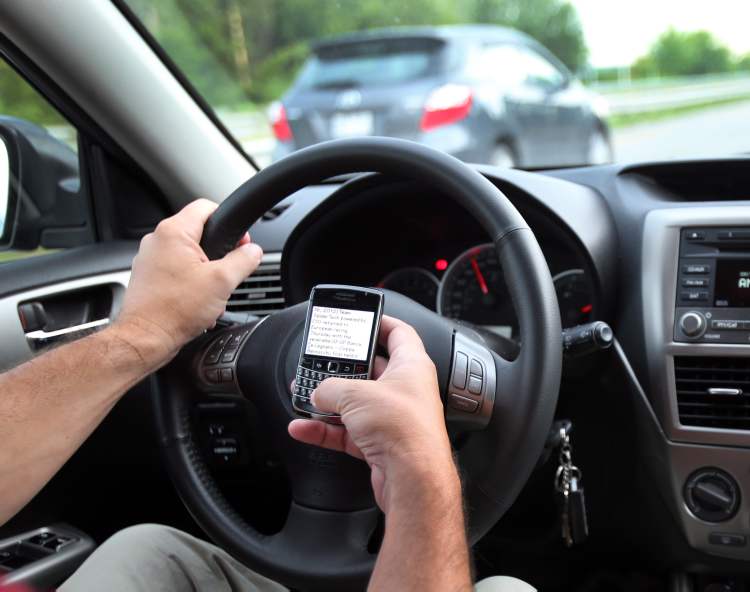
Essentially, this is what the MIT study concluded: You can take cells away from people who frequently use them while driving, but you can’t stop their inherent tendency to drive in other risky ways.
“The people who are more willing to frequently engage in cellphone use are higher-risk drivers, independent of the phone,” Bryan Reimer, associate director of MIT’s New England University Transportation Center, told the Globe. “It’s not just a subtle difference with those willing to pick up the phone,” he added. “This is a big difference.”
The subtext, which wasn’t explicitly stated, is if these drivers don’t kill people because they’re on their cellphones, they’ll do it driving in some other dangerous or distracted way.
The findings were based on the habits of 108 drivers from Greater Boston, half of whom confessed to frequently using cellphones while driving and half of whom said they did that rarely.
Researchers found frequent cell users drove faster, changed lanes more often, spent more time in the left lane and tended to do more hard-braking and rapid accelerating. More specifically, frequent users — sounds like a term for a drug addict doesn’t it? — on average travelled 4.4 kilometres per hour faster and changed lanes twice as often as rare users.
No one, least of all me, is disputing how dangerous it is to use a cellphone while driving. According to the Boston Globe story, America’s National Safety Council estimates about one in five of the 5.4 million car crashes in the U.S. during 2010 involved drivers who were talking on their cellphones. Another 160,000 are estimated to have involved drivers texting.
Here’s what’s perplexing about those findings.
Private insurance companies have not seen an overall increase in traffic collisions despite the growing numbers of drivers and soaring popularity of cellphones. In the U.S., there hasn’t been a noticeable drop in accidents even though 39 U.S. states have banned texting while driving, and 10 have made it illegal to talk on the phone while operating a vehicle.
“We have not seen that those bans have reduced crashes,” Adrian Lund, president of the Insurance Institute for Highway Safety in Arlington, Va., bluntly told the Globe.
That’s why Lund and others don’t see how cellphone laws help.
Manitoba Public Insurance takes its direction from the province, so you won’t hear that from them. What they do agree on is this:
“MPI has no evidence locally that traffic accidents are up since the use of cellphones,” said corporation spokesman Brian Smiley.
In fact, despite there being more drivers on Manitoba roads every year and the near addictive nature of cellphone use, the number of traffic collisions in the province has decreased over the last decade. Particularly between 2007 and 2010. Manitoba banned cell use while driving halfway through 2010.
Nevertheless, people are dying because of distracted drivers.
“Be it texting while driving,” Smiley said, “talking on the cellphone, animated conversation with passengers, trying to pick up CDs off the floor, eating while driving. These are all considered forms of distracted driving.”
But it’s cellphone use that’s illegal here. And, as the Boston-area study suggests, it’s not cell phones in cars that kill people — it’s people and their selfish, dangerous attitudes.
That doesn’t mean we don’t need a law banning cellphone use in cars.
What’s missing is more common sense and, of course, more enforcement and even stiffer penalties. That still might not make a difference in the overall numbers of accidents each year, but it will make me feel better. And, down the road, it may do what no study can determine.
Save the life of someone you love.
gordon.sinclair@freepress.mb.ca
Crashes were already down
DESPITE the increase in the number of drivers and the use of cellphones, the number of traffic collisions in the province has decreased in Manitoba over the last decade. Here are the numbers:
Year / Collisions / Active drivers
2010* 27,172 767,222
2009 26,578 754,485
2008 29,092 744,049
2007 29,494 728,047
2006 31,738 703,051
2005 33,164 695,091
2004 35,002 690,568

2003 34,771 683,060
2002 31,983 679,219
2001 30,999 674,921
* The banning of hand-held devices in Manitoba came into law in May 2010
— source: Manitoba Public Insurance