

Short-line railroads under threat
Shippers poised to face new costs at port

Advertisement
Read this article for free:
or
Already have an account? Log in here »
To continue reading, please subscribe:
Monthly Digital Subscription
$0 for the first 4 weeks*
- Enjoy unlimited reading on winnipegfreepress.com
- Read the E-Edition, our digital replica newspaper
- Access News Break, our award-winning app
- Play interactive puzzles
*No charge for 4 weeks then price increases to the regular rate of $19.95 plus GST every four weeks. Offer available to new and qualified returning subscribers only. Cancel any time.
Monthly Digital Subscription
$4.99/week*
- Enjoy unlimited reading on winnipegfreepress.com
- Read the E-Edition, our digital replica newspaper
- Access News Break, our award-winning app
- Play interactive puzzles
*Billed as $19.95 plus GST every four weeks. Cancel any time.
To continue reading, please subscribe:
Add Free Press access to your Brandon Sun subscription for only an additional
$1 for the first 4 weeks*
*Your next subscription payment will increase by $1.00 and you will be charged $16.99 plus GST for four weeks. After four weeks, your payment will increase to $23.99 plus GST every four weeks.
Read unlimited articles for free today:
or
Already have an account? Log in here »
Hey there, time traveller!
This article was published 10/09/2011 (5233 days ago), so information in it may no longer be current.
As early pioneers settled into their new life as wheat producers on the Canadian Prairies, it soon became clear there was more than frost, frequent drought and bitterly cold winters standing between them and success.
They also had to outwit grain companies and the railways, who many farmers suspected were colluding to hold their captive farm customers to ransom on grain marketing and transportation.
Efforts by farmers to bypass local elevators by booking rail cars and shipping their own grain to market were thwarted because the railways would only serve grain companies.
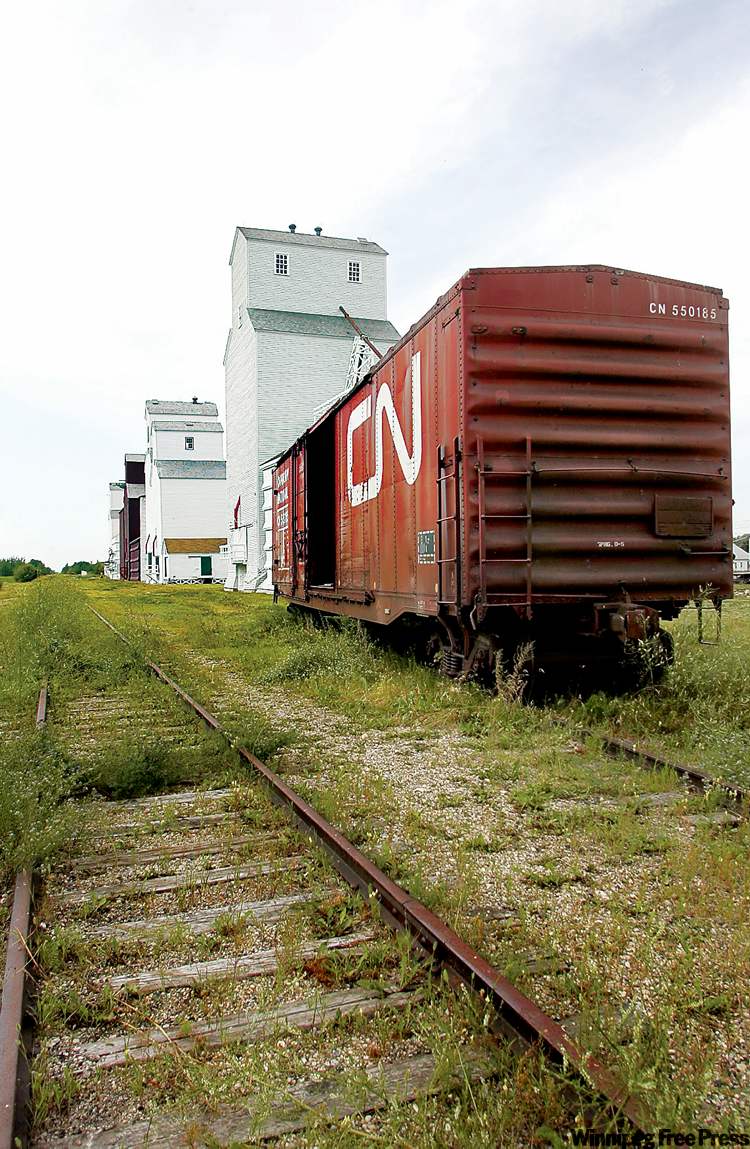
That changed, sort of, with passage of the Manitoba Grain Act in 1900, which enshrined a farmer’s right to access a railcar. But the fight still wasn’t over. While grain companies were getting all the cars they asked for, farmers were told there weren’t enough cars.
That led to the famous Sintaluta court challenge, in which a group of farmers took CP Rail all the way to the Supreme Court of Canada because the agent at Sintaluta, Sask., was giving preferential treatment to grain companies on railcar orders.
The farmers won their case in 1902 and their access to producer cars has been guaranteed ever since. Producer-car use surged in those early years, peaking at 51,000 cars in 1912.
There were even portable elevators invented — contraptions that allowed the farmer to drive a horse-drawn grain cart onto a sloping platform so the grain could be unloaded, “elevated” and dropped into a pipe running into the boxcar. The horses powered the elevation via a treadmill built into the platform.
Producer-car popularity tapered off, however, as the rise of farmer-owned grain co-operatives meant producers were assured of getting fair treatment.
Fast-forward a hundred years or so and those local elevators and the co-ops that owned them are gone. Most of the railway branch lines have been ripped up. Farmers are once again feeling captive.
Once a farmer has loaded a semi and hauled grain 100 kilometres or so to the nearest grain terminal, how likely is it that he or she will turn around and go elsewhere if the offered price is unsatisfactory?
Not surprisingly, producer-car use has surged again over the past 15 years or so as farmers invest in their own grain-loading facilities to bypass the country elevator system. There are 120 producer-car loading sites scattered across the Prairies.
Not only that, but producer-car shippers have been the main investors in the 14 short-line railways that now exist across the West. Using these cars not only saves farmers between $600 to $1,200 per 100-tonne car in handling costs, it considerably shortens the distance they have to haul their grain by road.
That added bit of competition in the system has one other advantage, one that even benefits farmers who don’t use producer cars. In a bid to get the grain, handling companies have been much more aggressive in offering trucking subsidies to their farm clients.
In the last crop year (which ended July 31), farmers loaded 12,784 producer cars, just below the record of recent history of 12,934 set two years ago. Ninety-seven per cent of those producer cars contained wheat and durum, which are currently marketed through the Canadian Wheat Board.
The board looks after securing the car supply and arranging their transportation with the major railways. But more importantly, because it manages the export of all wheat and durum exported out of Western Canada, it ensures those cars will be accepted by the companies owning port terminals.
Producer-car shippers don’t have to negotiate with the railways for car allocation, arrange authorization for unloading at port, or co-ordinate inclusion of their grain in an overseas sales programs — at least not right now.
All the talk flying around about the CWB being legislated out of existence is making producer-car shippers pretty nervous.
While their right to access a producer car is enshrined in legislation, there is nothing requiring port terminals, which are owned by the same companies the farmers are bypassing in the country, to accept those cars for delivery.

Without the CWB, which simply rolls those cars into its regular sales, producer-car shippers are likely to face higher port charges — which would negate their inland savings.
“Without the producer-car savings, there is no advantage to having a short-line railroad,” says Harold Purkess, who is part of group trying to raise $7 million this year to buy the CP line between Rathwell and Nesbitt in western Manitoba.
And not much has been said to date that puts their minds at ease.
Laura Rance is editor of the Manitoba Co-operator. She can be reached at 792-4382 or by email: laura@fbcpublishing.com
Laura Rance is editorial director at Farm Business Communications.
Our newsroom depends on a growing audience of readers to power our journalism. If you are not a paid reader, please consider becoming a subscriber.
Our newsroom depends on its audience of readers to power our journalism. Thank you for your support.
Laura Rance is editorial director at Farm Business Communications.
Our newsroom depends on a growing audience of readers to power our journalism. If you are not a paid reader, please consider becoming a subscriber.
Our newsroom depends on its audience of readers to power our journalism. Thank you for your support.
Advertisement Advertise With Us
Advertisement Advertise With Us