

Could global warming be behind the havoc?
Advertisement
Read this article for free:
or
Already have an account? Log in here »
To continue reading, please subscribe:

Digital Subscription
One year of digital access for only $205*
- Enjoy unlimited reading on winnipegfreepress.com
- Read the E-Edition, our digital replica newspaper
- Access News Break, our award-winning app
- Play interactive puzzles
*First annual payment billed as $205.00 + GST for one year. This annual subscription will automatically renew at $233.00 + GST every 52 weeks (10% off the regular annual price of $259.35). Offer available to new and qualified returning subscribers only. Cancel any time.
To continue reading, please subscribe:
Add Free Press access to your Brandon Sun subscription for only an additional
$1 for the first 4 weeks*
- Enjoy unlimited reading on winnipegfreepress.com
- Read the E-Edition, our digital replica newspaper
- Access News Break, our award-winning app
- Play interactive puzzles
*Your next Brandon Sun subscription payment will increase by $1.00 and you will be charged $17.95 plus GST for four weeks. After four weeks, your payment will increase to $24.95 plus GST every four weeks.
Read unlimited articles for free today:
or
Already have an account? Log in here »
Hey there, time traveller!
This article was published 28/05/2011 (5547 days ago), so information in it may no longer be current.
The extraordinary Joplin twister –the single deadliest tornado since U.S. officials began keeping records in 1950 — was a rare destructive phenomenon known as a “multi-vortex,” hiding two or more cyclones within the wider wind funnel.
The storm smashed the southwest Missouri city’s hospital, left nothing but splintered trees where neighborhoods once stood, and killed at least 125, with the death toll expected to rise. The storm injured another 500 and damaged or destroyed at least 2,000 buildings.
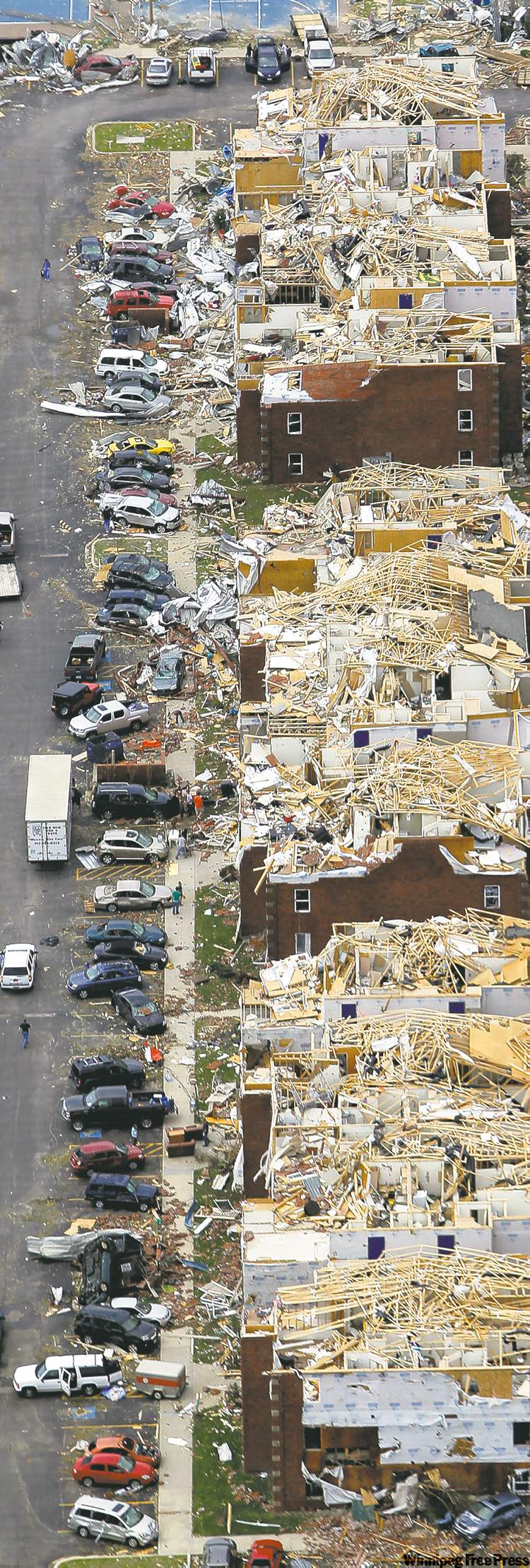
Added to the record 875 tornadoes that tore across the U.S. in April, this latest disaster has experts asking why 2011 has spawned so many deadly storms. While researchers suss out the causes for this year’s record-breaking season, one thing is certain: Unusually big twisters are blasting through heavily populated areas.
“We have had more F4s and F5s than in past years,” said Jack Hayes, director of the National Weather Service, referring to the two most destructive categories of tornadoes. And instead of touching down in farms and fields, storms have hit cities like Joplin and Tuscaloosa, Ala.
An emerging body of research points to a cyclical drop in temperatures in the Pacific Ocean as part of the answer. Called La Nina, the cycle lasts at least five months and repeats every three to five years. This year La Nina is pushing a strong North American jetstream east and south, altering prevailing winds. The jetstream’s river of cool air high in the atmosphere pulls warmer, more humid air from the ground upwards, forming thunderstorm “super cells.”
Such a pattern drove the outbreak of more than 300 tornadoes that swept from Mississippi to Tennessee in late April, killing at least 365, experts say. But it’s too early for them to know whether La Nina alone accounts for what is shaping up to be a disastrously record-breaking tornado season, said tornado expert Grady Dixon of Mississippi State University. “La Nina is probably part of it,” he said. “But it’s not the only reason.”
Tornado experts predicted a devastating season this year, and many have begun studying whether global climate change is driving more frequent — and more intense — tornado-spawning thunderstorms. Such work is at an early stage, making it difficult to draw conclusions.
“This will be a rich topic of research in the coming years,”said Russell Schneider, director of the Storm Prediction Center, part of the National Oceanic and Atmospheric Administration in Norman, Okla.
Warm air, moisture, and specific wind patterns are the deadly ingredients that mix together to form tornadoes, and climate change impacts at least one of them by increasing the amount of moisture the air can hold.
“Climate change could be boosting one of those ingredients (for tornadoes), but it depends on how these ingredients come together” said Robert Henson, a meteorologist at the University Corporation for Atmospheric Research.
The intense twister that whipped through Joplin spun with windspeeds approaching 300 kilometres per hour, ranking it as an F4, just below the top of the tornado scale.
“We are now on pace for a record year for tornado fatalities” since national record-keeping began in 1950, said Schneider.
The April total of 875 U.S. tornadoes shattered the previous record of 267 set in April 1974. The first two weeks of May were relatively quiet.
The Joplin twister touched down just west of town at 5:41 p.m. last Sunday and blasted a path of destruction about a kilometre wide and 10 kilometres long, ripping into a hospital, crushing cars, and leaving nothing but splintered tree trunks where neighborhoods once stood.
Tornado experts said the huge funnel cloud hid within it two or more swirling cyclones, a phenomenon known as a “multi-vortex” or “wedge vortex” tornado. The centres of such intense wind funnels become unstable, wobble, and spin out two to six smaller twisters from within. The short-lived but intense sub-twisters dance around the edge of the cloud, spinning up to 130 km/h faster than the wider mother funnel, said Ernest Agee, a tornado researcher at Purdue University.
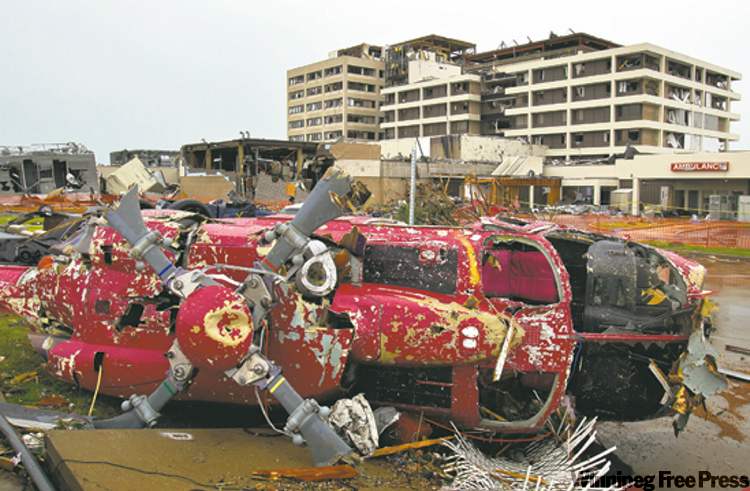
Such tornadoes often blaze a peculiar destructive path that flattens buildings on one edge of the funnel while nearby structures survive relatively unscathed.
In an online video filmed by a survivor of the Joplin tornado, the blasting roar of the storm quiets for a few seconds before a second roar arrives– a tell-tale sign of a multi-vortex tornado, Agee said.
Mississippi State’s Dixon was following the violent thunderstorm with eight students in a van just outside Joplin when they broke off the chase.
“We let it go,” said Dixon, an atmospheric scientist. “It was just getting too unsafe.”

The windows of their van open, Dixon and the students felt blasts of warm air as they followed the backside of the supercell — a sign of an unusually violent storm, Dixon said. “Normally it’s cold air on the backside. So we knew it was going to be a big storm. But when we left it… we didn’t think it was going to be catastrophic.”
Over the past decade, deeper understanding of how tornadoes form and move — coupled with advanced radar that can detect telltale swirls at the centre of a storm — have lengthened tornado warning lead times from the U.S. National Weather Service. The service announced a tornado warning for Joplin at 5:17 p.m., with the twister touching down 24 minutes later — a “phenomenal” lead time, Dixon said. The nationwide average is 14 minutes.
Despite this warning, the huge tornado set a record for the deadliest single tornado in U.S. history. The previous most deadly tornado on record killed 116 people in Flint, Mich., in 1953, an extraordinary year that also saw 114 die in a tornado in Waco, Texas, while 90 perished in a Worcester, Mass., twister that June.
— The Washington Post