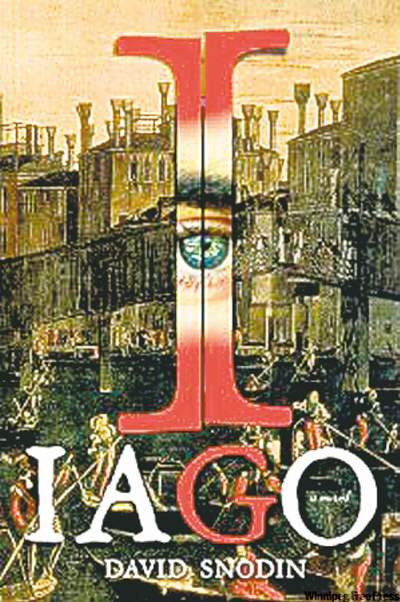
Iago novel imagines aftermath of Bard’s play

Advertisement

Advertise with us

IAGO, the villain of William Shakespeare's Othello, has both fascinated and puzzled critics in the centuries since the play's first performance.

Read this article for free:


or

Already have an account? Log in here »

To continue reading, please subscribe:

Subscribe and receive a limited-edition Free Press branded hat or tote.

Digital Subscription

One year of digital access for only $205*

  • Enjoy unlimited reading on winnipegfreepress.com
  • Read the E-Edition, our digital replica newspaper
  • Access News Break, our award-winning app
  • Play interactive puzzles

*First annual payment billed as $205.00 + GST for one year. This annual subscription will automatically renew at $233.00 + GST every 52 weeks (10% off the regular annual price of $259.35). Offer available to new and qualified returning subscribers only. Cancel any time.

To continue reading, please subscribe:

Add Free Press access to your Brandon Sun subscription for only an additional

$1 for the first 4 weeks*

  • Enjoy unlimited reading on winnipegfreepress.com
  • Read the E-Edition, our digital replica newspaper
  • Access News Break, our award-winning app
  • Play interactive puzzles
Start now

*Your next Brandon Sun subscription payment will increase by $1.00 and you will be charged $17.95 plus GST for four weeks. After four weeks, your payment will increase to $24.95 plus GST every four weeks.

Opinion

Hey there, time traveller!
This article was published 07/01/2012 (5343 days ago), so information in it may no longer be current.

IAGO, the villain of William Shakespeare’s Othello, has both fascinated and puzzled critics in the centuries since the play’s first performance.

Commentators and adapters have struggled to make sense of the seeming senselessness of Iago’s villainy, with one critic famously concluding that Iago is “a motiveless malignity.”

In this uneven historical novel, Englishman David Snodin, producer and writer of a number of TV movies, imagines the aftermath of Shakespeare’s play. The story shifts through a range of narrative perspectives, which serve both to remind the reader of the essential elements of the play and to introduce us to Snodin’s vision of 16th-century Venice, ripe with vendetta, sewage-choked canals and garrulous prostitutes.
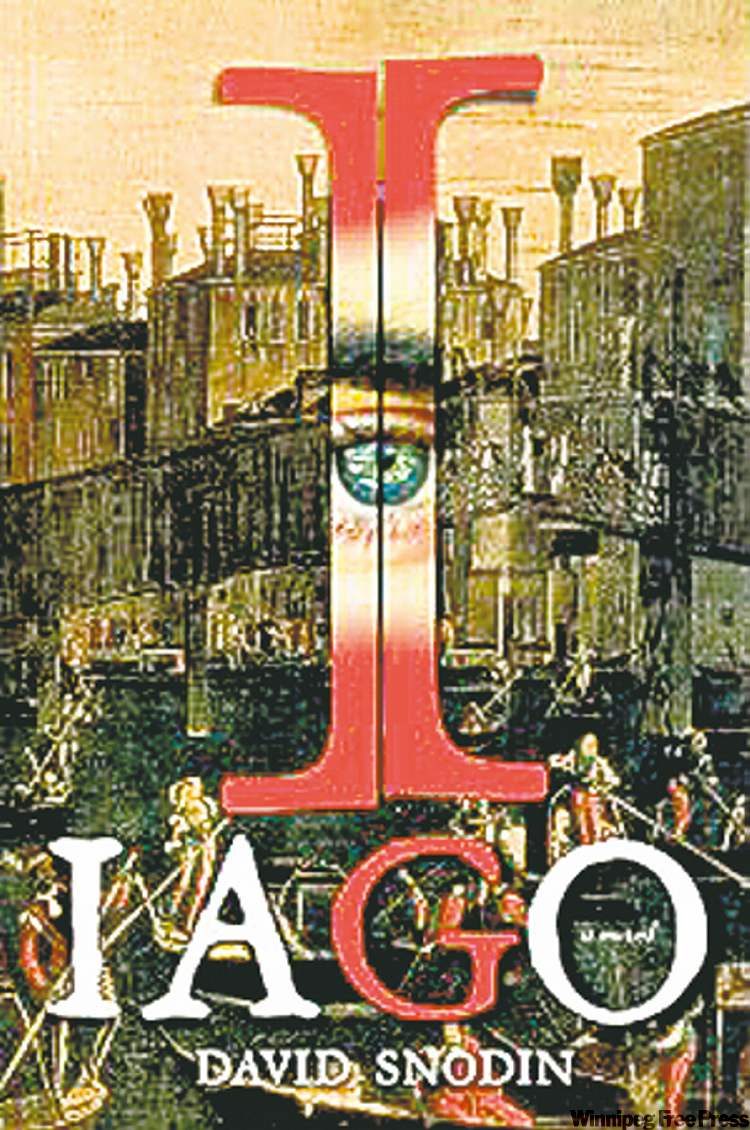
The novel follows three characters: Iago, who has escaped the custody of the Venetian authorities; the inquisitor Annibale Malipiero, who is charged not only with capturing Iago, but also with making sense of the violence Iago has loosed on Venice; and the bookish, virginal Gentile Stornello, who accompanies Iago in his flight from Venice.

Gentile, whose narration supplies most of our exposure to Iago, is an overeducated weakling, despised by his father, overshadowed by his breezily muscular soldier brother, and tormented by his nemesis Jacopo, the handsome, violent scion of the Malipiero family.

It is by way of one of his conflicts with Jacopo that Gentile comes to the attention of his uncle Annibale, who sees Gentile as a tool to ferret out Iago’s motives for causing the deaths of Othello and his wife, Desdemona.

Annibale places Gentile in a cell with the taciturn Iago, who hasn’t spoken since the final scene of Othello, and then engineers their escape from the Venetian Prigioni Ducale so that he can follow them and discover Iago’s motives.

The events leading up to the escape comprise the first half of Snodin’s book, which moves more slowly than it needs to, bogged down by repeated confrontations with Jacopo and his clan, and a Romeo and Juliet-inspired subplot in which Gentile pines for Jacopo’s servant-cum-mistress Franceschina.

This section underscores the novel’s biggest problem: Snodin is a much better plotter than he is a writer. As long as the story stagnates in Venice, the reader must endure Gentile’s adolescent, poetry-inspired romantic fantasies, made less tolerable by Snodin’s uneven prose.

Once the characters leave Venice, Iago, who is far more interesting than his young companion, becomes central, and the story becomes more engaging as it moves inexorably towards the answer to the question that Annibale, like four centuries of readers, can’t help asking: why?

Snodin worked as script editor for the BBC/Time-Life adaptations of Shakespeare’s plays in the 1980s and his familiarity with his source text is fully on display in the novel. Characters repeatedly echo lines not only from Othello but from a number of Shakespeare’s plays.

One of these lines, “I am not what I am,” serves as an epigraph to the novel. It is a quintessential expression of Iago’s nihilistic world view, a refusal to be analysed and understood. Snodin’s Iago, though, emphatically is what he is, as the story’s slow trek through the Italian countryside moves ever closer, in terms of both geography and narrative, to the source of Iago’s malevolence.

It is a journey that ends, as it seems all post-Freudian accounts of evil must, with sexual trauma suffered in childhood.

This is perhaps the most disappointing aspect of the novel, betraying as it does the most unsettling aspect of Shakespeare’s play. Whereas Shakespeare’s Othello reveals to us monstrosity disguised as mundanity, Snodin’s Iago only manages to make the monstrous mundane.


Brandon Christopher teaches Shakespeare at the University of Winnipeg.

Report Error Submit a Tip

More Stories

Stick with familial roles that work for you

Maureen Scurfield 5 minute read 2:00 AM CDT

DEAR MISS LONELYHEARTS: My teenage mother abandoned me as a baby boy. She left town after dropping me off to live with my teenage father, who still lived with his parents and their large Franco-Manitoban family. I had a good life and was spoiled by him, mémère and all the other kids.

My birth mother moved in with some of her family in another province, and didn’t figure in my life at all. I never saw her or heard from her, but I wasn’t really bitter about that. She just didn’t exist for me, except for a photo or two.

My grandmother, who told me to call her Mom if I wanted, was a great mother figure to me. She and my grandfather really loved all the kids, including me — the surprise new baby.

But now my birth mother is coming back to Manitoba for a holiday and has told people in the family she wants to see me. Why now? To see how I turned out without her? My stomach churns when I think about it. I’ve had a good life and I don’t want her coming back to claim me as her son now.

Low-income residents of 114-year-old downtown block staggered by proposed rent hikes

Malak Abas 9 minute read Preview

Low-income residents of 114-year-old downtown block staggered by proposed rent hikes

Malak Abas 9 minute read Thursday, Aug. 20, 2026

Marcel Blanchette’s life has not travelled down a smooth road.

In 2014, he was violently assaulted in his home, an unprovoked attack that left him with severe injuries, including permanent brain damage. He underwent months of hospitalization and rehabilitation. During that time, he learned his possessions had been sold off when the Office of The Public Guardian and Trustee took over his affairs.

Twelve years later, he finds himself in another fight. This time, it comes in the form of a proposal from the new owners of the Conway Court apartment block that would nearly double his monthly rent. While he’s been able to live in the Kennedy Street unit with the support of disability income assistance for nearly five years, the sudden spike, he said, could leave him homeless.

“To go through that, and now I’m going through this, it’s another obstacle,” Blanchette told the Free Press. “I fought the Public Guardian and Trustee, and I’ll fight this too, with whatever I have.”

Read
Thursday, Aug. 20, 2026

Iago novel imagines aftermath of Bard’s play

Reviewed by Brandon Christopher 4 minute read Preview

Iago novel imagines aftermath of Bard’s play

Reviewed by Brandon Christopher 4 minute read Saturday, Jan. 7, 2012

IAGO, the villain of William Shakespeare's Othello, has both fascinated and puzzled critics in the centuries since the play's first performance.

Commentators and adapters have struggled to make sense of the seeming senselessness of Iago's villainy, with one critic famously concluding that Iago is "a motiveless malignity."

In this uneven historical novel, Englishman David Snodin, producer and writer of a number of TV movies, imagines the aftermath of Shakespeare's play. The story shifts through a range of narrative perspectives, which serve both to remind the reader of the essential elements of the play and to introduce us to Snodin's vision of 16th-century Venice, ripe with vendetta, sewage-choked canals and garrulous prostitutes.

The novel follows three characters: Iago, who has escaped the custody of the Venetian authorities; the inquisitor Annibale Malipiero, who is charged not only with capturing Iago, but also with making sense of the violence Iago has loosed on Venice; and the bookish, virginal Gentile Stornello, who accompanies Iago in his flight from Venice.

Read
Saturday, Jan. 7, 2012

Puzzles Palace

1 minute read Monday, Jul. 27, 2026

To solve our puzzles, please subscribe with this special offer: |

‘Pie Lady’ was a straight-shooter and the life of the party

Nicole Buffie 6 minute read Preview

‘Pie Lady’ was a straight-shooter and the life of the party

Nicole Buffie 6 minute read Saturday, Aug. 22, 2026

Betty Gyles went by many names over the years: Mom, Grandma, hostess — and later in life, “Pie Lady.”

Elizabeth, known as Betty to most, was born in Winnipeg’s River Heights neighbourhood to Bill and Elizabeth Armstrong. She was the youngest child in her family, with three siblings: Bill, Bob and Barb.

Gyles grew up soaking up the sun in northwest Ontario, where her parents owned a cottage; it was there she learned to love to swim and sunbathe and sit on the “reading rock” with her sister.

Gyles would write stories and after each page was finished Betty would read them and it counted toward her summer reading goal.

Read
Saturday, Aug. 22, 2026

Executive exodus continues at Shared Health with three recent departures

Chris Kitching 5 minute read Preview

Executive exodus continues at Shared Health with three recent departures

Chris Kitching 5 minute read Updated: Yesterday at 10:15 AM CDT

Manitoba’s provincial health authority is looking for its fourth chief financial officer since 2023 and additional replacements after the recent departures of three executives.

Read
Updated: Yesterday at 10:15 AM CDT