

String of deficit budgets continues as Selinger government banks on spending
Maxing out
Advertisement
Read this article for free:
or
Already have an account? Log in here »
To continue reading, please subscribe:

Digital Subscription
One year of digital access for only $205*
- Enjoy unlimited reading on winnipegfreepress.com
- Read the E-Edition, our digital replica newspaper
- Access News Break, our award-winning app
- Play interactive puzzles
*First annual payment billed as $205.00 + GST for one year. This annual subscription will automatically renew at $233.00 + GST every 52 weeks (10% off the regular annual price of $259.35). Offer available to new and qualified returning subscribers only. Cancel any time.
To continue reading, please subscribe:
Add Free Press access to your Brandon Sun subscription for only an additional
$1 for the first 4 weeks*
- Enjoy unlimited reading on winnipegfreepress.com
- Read the E-Edition, our digital replica newspaper
- Access News Break, our award-winning app
- Play interactive puzzles
*Your next Brandon Sun subscription payment will increase by $1.00 and you will be charged $17.95 plus GST for four weeks. After four weeks, your payment will increase to $24.95 plus GST every four weeks.
Read unlimited articles for free today:
or
Already have an account? Log in here »
Hey there, time traveller!
This article was published 01/05/2015 (4134 days ago), so information in it may no longer be current.
The Selinger government is betting that if it keeps spending more money than it’s taking in, the payoff will be more jobs, higher wages and smoother roads.
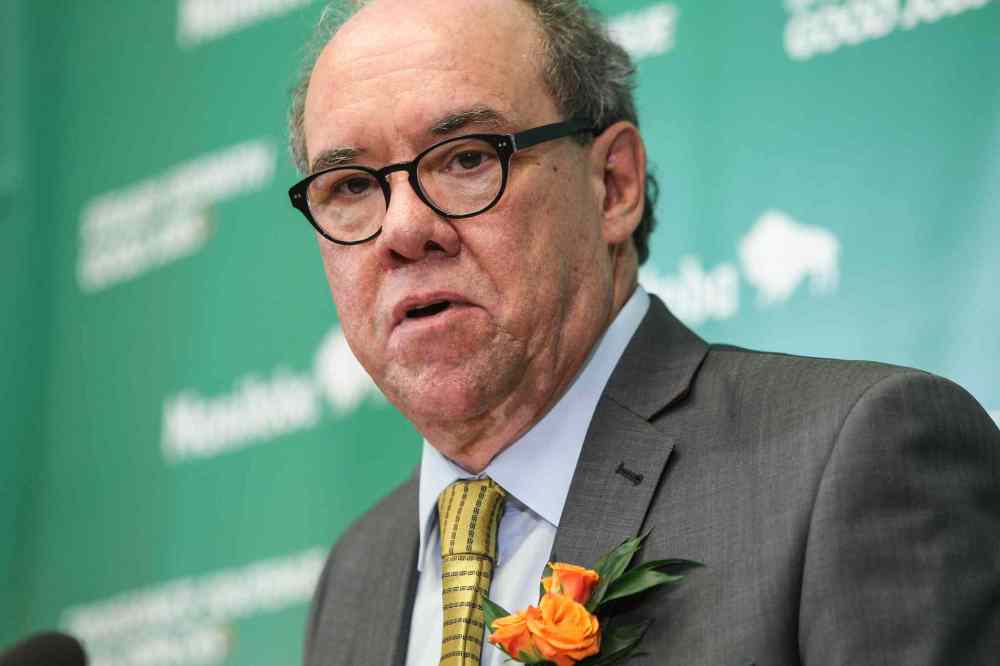
Finance Minister Greg Dewar’s first budget focuses on infrastructure spending and skills training and continues a string of government deficits dating back to 2009.
The province expects to post a shortfall of $422 million this year and doesn’t expect to balance the books on core government revenue and expenditures until 2018.
To help raise cash, the government is going after smokers — raising the tax on each cigarette by half a cent — and big banks. There are few other tax or fee increases.
What the government can’t raise through new taxes and higher fees to finance its spending, it will borrow. It will also drain its rainy day fund, drawing it down by $105 million, leaving it with $115 million by the end of the year.
The big deficit and the decision to take money out of the emergency fund come at a time when the province is not facing a major flood or some other catastrophe, leaving it open to criticism the budget is an attempt to buy votes in next year’s election.
At a news conference before he delivered his budget speech, Dewar bragged about a Conference Board of Canada report that said Manitoba would lead the nation in economic growth during the next two years. He said wage and job growth are the highest in the country.
“We are fixing roads, creating jobs and keeping health care strong for the future,” he said.
“In short, we have a plan, and that plan is working.”
Asked why he could not balance the budget sooner under these circumstances, Dewar warned that the global economy continues to be uncertain, and it’s still necessary to invest in jobs.
He noted that before the government started running deficits in 2009, the province’s economy was growing “well over” three per cent per year. Since then, it’s averaged 2.5 per cent.
“That is significant,” Dewar said.
But critics weren’t buying the finance minister’s logic.
They attacked the government for failing to tackle the deficit or institute tax cuts at a time when the economy seems to be humming.
“It’s just brutal, brutal fiscal incompetence on display,” Conservative Leader Brian Pallister said.
“If they just held the line on spending they’d be in surplus this year. But they didn’t. They chose to inflate their spending to a ridiculous degree” for short-term political gain, he said.
Chuck Davidson, president of the Manitoba Chambers of Commerce, said he’s disappointed the province didn’t do more to slay the deficit.
“The debt is continuing to increase. Eventually that is going to have to get paid for,” he said.
The $422-million deficit forecast for the coming year follows a comparable shortfall last year.
On Thursday, the province revised its forecast of last year’s deficit, revealing it has now grown to $424 million (compared with a $357-million deficit projected last spring). A final figure will be released later this year.
Davidson said he’s disappointed the finance minister offered no plan for getting the budget out of the red.
He said the NDP budget is reflective of a government that has been more preoccupied with infighting in recent months than it has been in planning for the province’s future.
Meanwhile, Dewar surprised observers by saying the government would now measure only core government spending and revenue in its efforts to balance the books instead of including the financial results for Crown corporations and other government entities.
It has employed the so-called summary method of accounting for years. The system is also used by most other provinces.
“We don’t think that bad weather — extreme weather, a snowstorm or drought — should impact health care or education funding,” he said in explaining the move.
Not everyone opposed the government’s economic approach.
Organized labour generally praised the NDP for maintaining health care, social services and jobs.
Manitoba Federation of Labour president Kevin Rebeck praised the budget for showing the way to continue to build the economy.
“We need to continue to have government be a driver of the economy, to keep that growth going,” he said.
But he said the increase in the hourly minimum wage to $11, from $10.70, set for October, doesn’t go far enough to help low-income workers.
“We still have poverty-level wages for minimum-wage earners, and that’s not right,” he said.
He said a $15-an-hour minimum wage should be the target.
At one point in his news conference Thursday, the finance minister claimed members of the Canadian Federation of Independent Business had shown confidence in the Manitoba economy.
But in a statement, the CFIB said small business optimism “remains at underwhelming levels.”

Elliot Sims, director of provincial affairs for the CFIB in Manitoba, said the budget could have helped reverse this trend.
“The province could have opted to keep spending under control, balance the budget and provide targeted tax relief to encourage more private investment and job creation in our province.
“Instead, Manitoba’s entrepreneurs received a budget that does none of these things and is bound to further stifle small business confidence.”
larry.kusch@freepress.mb.ca bruce.owen@freepress.mb.ca