

What’s behind ‘zombie apocalypse?’
Doomsday chatter has become so animated, even the Centers for Disease Control has weighed in
Advertisement
Read this article for free:
or
Already have an account? Log in here »
To continue reading, please subscribe:
Monthly Digital Subscription
$1 per week for 24 weeks*
- Enjoy unlimited reading on winnipegfreepress.com
- Read the E-Edition, our digital replica newspaper
- Access News Break, our award-winning app
- Play interactive puzzles
*Billed as $4.00 plus GST every four weeks. After 24 weeks, price increases to the regular rate of $19.00 plus GST every four weeks. Offer available to new and qualified returning subscribers only. Cancel any time.
Monthly Digital Subscription
$4.75/week*
- Enjoy unlimited reading on winnipegfreepress.com
- Read the E-Edition, our digital replica newspaper
- Access News Break, our award-winning app
- Play interactive puzzles
*Billed as $19 plus GST every four weeks. Cancel any time.
To continue reading, please subscribe:
Add Winnipeg Free Press access to your Brandon Sun subscription for only
$1 for the first 4 weeks*
*$1 will be added to your next bill. After your 4 weeks access is complete your rate will increase by $0.00 a X percent off the regular rate.
Read unlimited articles for free today:
or
Already have an account? Log in here »
Hey there, time traveller!
This article was published 09/06/2012 (4849 days ago), so information in it may no longer be current.
TAMPA, Fla. — First came Miami, and the case of a naked man eating most of another man’s face. Then Maryland, and a college student telling police he killed a man, then ate his heart and part of his brain.
It was different in New Jersey, where a man stabbed himself 50 times and threw bits of his own intestines at police. They pepper-sprayed him, but he was not easily subdued.
He was, people started saying, acting like a zombie. And the whole discussion just kept growing, becoming a topic that the Internet couldn’t seem to stop talking about.
Luka Rocco Magnotta was arrested in Germany for the Montreal slaying of Jun Lin. Magnotta videotaped the killing and dismemberment in his apartment and posted it online. The video also shows the suspect eating parts of the body, police said.
The actual incidents are horrifying — and, if how people are talking about them is any indication, fascinating. In an America where zombie imagery is used to peddle everything from tools and weapons to garden gnomes, they all but beg the comparison.
People are used to violence. Cannibalism and people who should fall down but don’t? That feels like something else entirely.
So many strange things have made headlines in recent days that The Daily Beast assembled a Google Map tracking “instances that may be the precursor to a zombie apocalypse.” The federal agency that tracks diseases weighed in as well, insisting it had no evidence that any zombie-linked health crisis was unfolding.
The cases themselves are anything but funny. Each involved real people either suspected of committing unspeakable acts or having those acts visited upon them for reasons that have yet to be figured out. Maybe it’s nothing new, either; people do horrible things to each other on a daily basis.
But what, then, made search terms like “zombie apocalypse” trend day after day last week in multiple corners of the Internet, fueled by discussions and postings that were often framed as humour?
“They’ve heard of these zombie movies, and they make a joke about it,” says Lou Manza, a psychology professor at Lebanon Valley College in Pennsylvania, who learned about the whole thing at the breakfast table Friday morning when his 18-year-old son quipped that a “zombie apocalypse” was imminent.
Symbolic of both infection and evil, zombies are terrifying in a way that other horror-movie iconography isn’t, says Elizabeth Bird, an anthropologist at the University of South Florida.
Zombies, after all, look like us, but are some baser form of us — slowly rotting and shambling along, intent on “surviving” and creating more of their kind, but with no emotional core, no conscience, no limits.
“Vampires have kind of a romantic appeal, but zombies are doomed,” Bird says. “Zombies can never really become human again. There’s no going back.
“That resonates in today’s world, with people feeling like we’re moving toward an ending,” she says. “Ultimately, they are much more of a depressing figure.”
The “moving toward an ending” part is especially potent. For some, the news stories fuel a lurking fear that, ultimately, humanity is doomed.
Speculation varies. It could be a virus that escapes from some secret government lab, or one that mutates on its own. Or maybe it’ll be the result of a deliberate combination and weaponization of pathogens, parasites and disease.
It will, many believe, be something we’ve created — and therefore brought upon ourselves.
Zombies represent America’s fears of bioterrorism, a fear that strengthened after the September 11, 2001, attacks, says Patrick Hamilton, an English professor at Misericordia University in Dallas, Pennsylvania, who studies how we process comic book narratives.
Economic anxiety around the planet doesn’t help matters, either, with Greece, Italy and Spain edging closer to crisis every day.
Consider some of the terms that those fears produce: zombie banks, zombie economies, zombie governments.
When people are unsettled about things beyond their control — be it the loss of a job, the high cost of housing or the depletion of a retirement account — they look to metaphors like the zombie.
“They’re mindless drones following basic needs to eat,” Hamilton says. “Those economic issues speak to our own lack of control.”
Chatter had become so rampant that Centers for Disease Control spokesman David Daigle sent an email to the Huffington Post, answering questions about the possibility of the undead walking among us.

“CDC does not know of a virus or condition that would reanimate the dead,” he wrote, adding: “or one that would present zombie-like symptoms.”
But the most compelling zombie stories are not about the undead. They’re about the living.
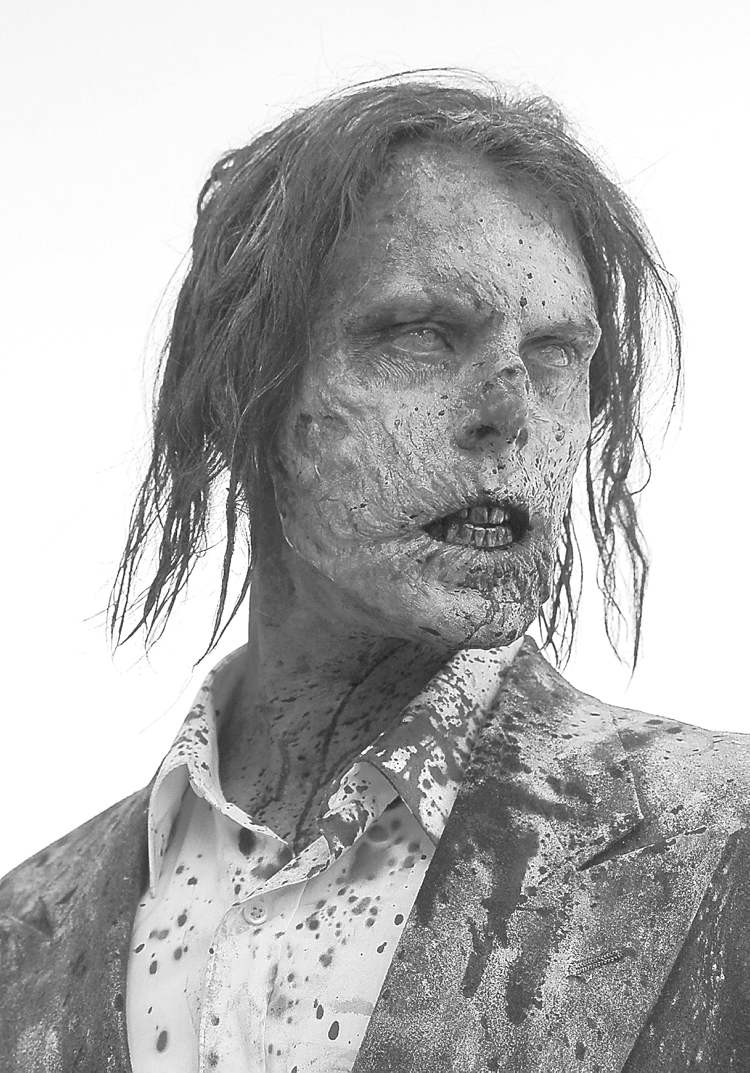
The popular AMC cable TV series “The Walking Dead” features zombies in all manner of settings. But the show is less about them and more about how far the small, battered band of humans will go to survive — whether they’ll retain the better part of themselves or become hardened and heartless.
— The Associated Press