Wright at absolute storytelling best
Advertisement
Read this article for free:
or
Already have an account? Log in here »
To continue reading, please subscribe:

Digital Subscription
One year of digital access for only $205*
- Enjoy unlimited reading on winnipegfreepress.com
- Read the E-Edition, our digital replica newspaper
- Access News Break, our award-winning app
- Play interactive puzzles
*First annual payment billed as $205.00 + GST for one year. This annual subscription will automatically renew at $233.00 + GST every 52 weeks (10% off the regular annual price of $259.35). Offer available to new and qualified returning subscribers only. Cancel any time.
To continue reading, please subscribe:
Add Free Press access to your Brandon Sun subscription for only an additional
$1 for the first 4 weeks*
- Enjoy unlimited reading on winnipegfreepress.com
- Read the E-Edition, our digital replica newspaper
- Access News Break, our award-winning app
- Play interactive puzzles
*Your next Brandon Sun subscription payment will increase by $1.00 and you will be charged $17.95 plus GST for four weeks. After four weeks, your payment will increase to $24.95 plus GST every four weeks.
Read unlimited articles for free today:
or
Already have an account? Log in here »
Hey there, time traveller!
This article was published 18/09/2010 (5785 days ago), so information in it may no longer be current.
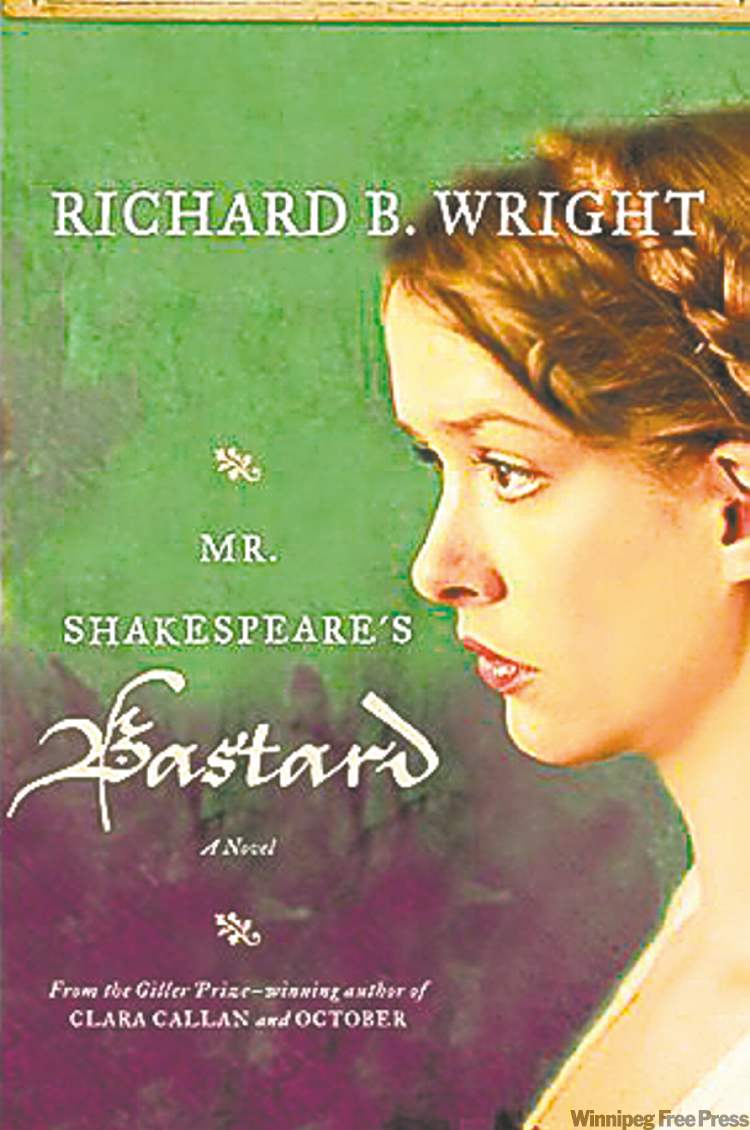
Mr. Shakespeare’s Bastard
By Richard B. Wright
HarperCollins, 342 pages, $33

Details of William Shakespeare’s life are so blurred that scholars still debate whether he or someone else wrote all those plays.
At least two of our best novelists have produced delightful takes on his life — Leon Rooke with his 1983 Governor General’s Award-winning Shakespeare’s Dog, and now Richard B. Wright with this immensely entertaining romp.
Mr. Shakespeare’s Bastard is based on the premise that the young Will, a few years after his marriage to Anne Hathaway, was in London (in 1587) without his wife, working as an apprentice to a theatrical group called the Queen’s Players, when he met and seduced a young widow named Lizzy Ward. Unknown to him, his liaisons with Lizzy resulted in a daughter.
That daughter, Aerlene, narrates this bountiful and bawdy tale in a voice that, for authenticity, rivals that of the main protagonist in Wright’s bestselling novel Clara Callan, which won both the Giller Prize and the G-G in 2001.
Wright is completely convincing in a woman’s voice, whether the era is the 1930s in Canada (Callan) or the 1600s in England (Aerlene Ward).
It’s 1658 — the time of Cromwell — when the novel begins. Aerlene, approaching 70, is living in Easton House, Worsley, Oxfordshire, where she’s been nursemaid and housekeeper for the Easton family for many years.
No longer too spry, her eyesight failing, she wants her memories of her mother and Shakespeare to be written down by 23-year-old Charlotte Easton, and Charlotte agrees.
In sessions over many weeks, Charlotte records Aerlene’s story, the first lengthy part of which is Aerlene quoting her mother — Lizzy or Mam — telling her story: Mam’s life after her scoundrel husband died, her being sent away to live in London. At one point, Mam quotes a prostitute called Mary, who arranges Mam’s first meeting with Will; here we have a story within a story within a story, all effortlessly orchestrated by the St. Catharines, Ont.-based author.
Charlotte wonders, “[H]ow your mother could recall that conversation in such detail and so convey it to you, and you to me after more than 70 years. How can we account it as true?”
And Aerlene, who has gained a reputation in the family for being a great storyteller, replies, “In relating anything we only approach the truth; we are never exactly there. Moreover, does not another truth besides the factual lurk in any account of events? A truth far more important? … Is the reader not entitled to a little more, even if it is not exactly what happened?”
These words could be the credo of any novelist, memoirist or biographer. Through Aerlene, Wright cleverly suggests that his account of Shakespeare could be just as true as any, and, if it isn’t, what does it matter, especially if the story is a good one?

Indeed, Lizzy’s story and Aerlene’s story are wonderfully funny and suspenseful and absorbing.
They capture the class distinctions of the time, the hardships of the working class, the clash of Puritan with secular, the difficulties of travelling from Oxford to London, the fear of plague, the madness of lust, the tribulations of a young woman alone on the streets of London.
The versatile Wright, in his 12th outing, draws us swiftly through the pages, building our anticipation of meeting Shakespeare, both when Lizzy is going to and later when her daughter hopes to.
As he showed way back in 1976 with his exceptional picaresque novel Farthing’s Fortunes, Wright is a gifted storyteller. In Mr. Shakespeare’s Bastard, he’s at his absolute storytelling best.
Dave Williamson is a Winnipeg novelist.