Tiger tale as much about post-Soviet Russia
Advertisement
Read this article for free:
or
Already have an account? Log in here »
To continue reading, please subscribe:

Digital Subscription
One year of digital access for only $205*
- Enjoy unlimited reading on winnipegfreepress.com
- Read the E-Edition, our digital replica newspaper
- Access News Break, our award-winning app
- Play interactive puzzles
*First annual payment billed as $205.00 + GST for one year. This annual subscription will automatically renew at $233.00 + GST every 52 weeks (10% off the regular annual price of $259.35). Offer available to new and qualified returning subscribers only. Cancel any time.
To continue reading, please subscribe:
Add Free Press access to your Brandon Sun subscription for only an additional
$1 for the first 4 weeks*
- Enjoy unlimited reading on winnipegfreepress.com
- Read the E-Edition, our digital replica newspaper
- Access News Break, our award-winning app
- Play interactive puzzles
*Your next Brandon Sun subscription payment will increase by $1.00 and you will be charged $17.95 plus GST for four weeks. After four weeks, your payment will increase to $24.95 plus GST every four weeks.
Read unlimited articles for free today:
or
Already have an account? Log in here »
Hey there, time traveller!
This article was published 18/09/2010 (5805 days ago), so information in it may no longer be current.
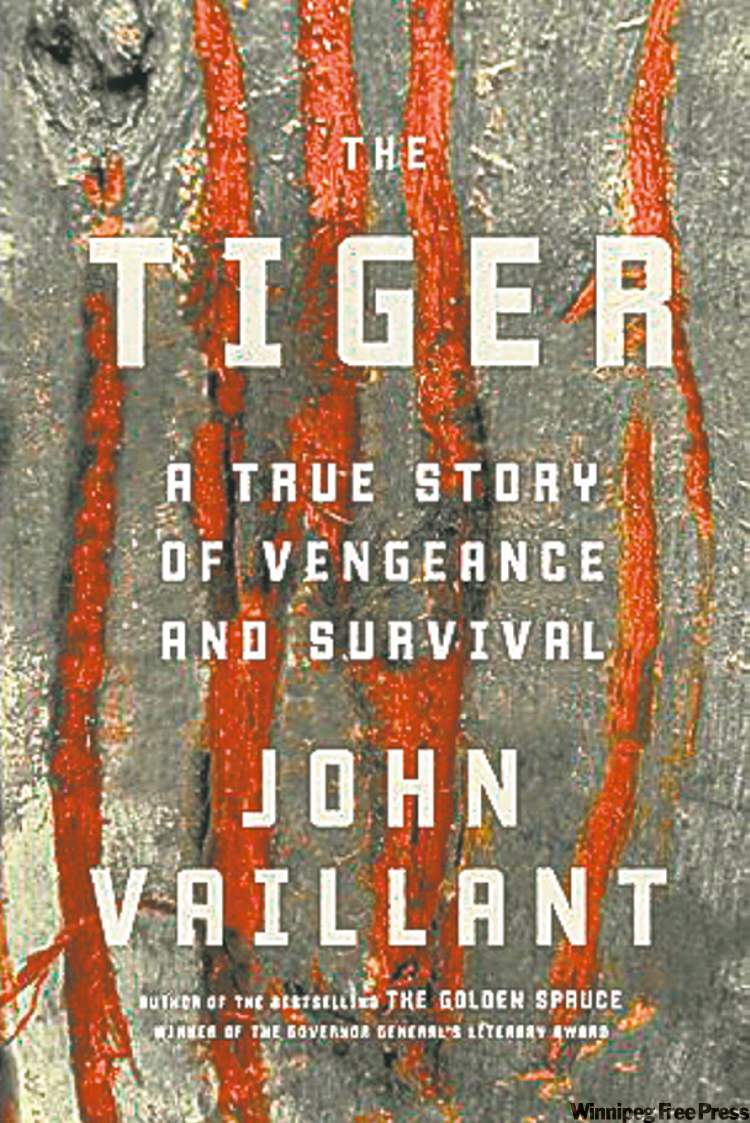
The Tiger
A True Story of Vengeance and Survival
By John Vaillant

Knopf Canada, 329 pages, $35
Be prepared. John Vaillant, the Governor General’s Award-winning author of The Golden Spruce (2005), packs so many side trips into his account of a tiger’s vengeance in remote Eastern Russia that you will ask yourself more than once, “are we there yet?”
In fact, The Tiger is as much about the rubble of post-Communist Russia as about the human remains left by a tiger avenged.
On the journey to his central storyline, the Vancouver-based Vaillant studs his narrative with political and cultural historiana. Before going off on another tangent, he also drops intriguing nuggets of information, as if he is marking his trail. “The tiger is, literally, tattooed: if you were to shave one bald, its stripes would still be visible.”
The characters living in Vaillant’s story have a gritty cachet unique to the citizens of a country’s crumbling edges. On the “far side” of Russia, fingernails are “nicotine-varnished” and memories are about “death by smallpox” or encounters with “wild animals, Chinese bandits, typhoons, blizzards, hunger and swarms of biting insects.”
To capture the ecology of the setting, Vaillant coins the term “boreal jungle” as the tag for the vast and virtually empty Primorye region butting up against an equally remote area of China and the Pacific ocean. Maps are included to help keep unfamiliar bearings straight.
The locus of the story is the village of Sobolonye, “a place with the feel of a North American mining town circa 1925, only with fewer straight lines.” For Vaillant, Sobolonye is symbolic of the many hinterland towns and villages of modern-day Russia, “a kind of feral community, left largely to its own devices.”
To begin his story, Vaillant immediately drops news that on the outskirts of Sobolonye, a hunter and poacher, Vladimir Markov, has been killed by a Siberian tiger. This is the second incident in two years.
Markov was discovered near his house, a converted Gypsy caravan. His remains were “so thoroughly and gruesomely annihilated” that locals were too afraid to investigate further. Inspection Tiger, the conservation enforcement unit, was called in to take charge.
Inspection Tiger is the mediator between the estimated 450 Siberian tigers living in the Primorye and neighbouring regions and the local population of primarily hunters and poachers.
Vaillant shows the inherent futility of trying to prevent poaching in an economically deprived region like Russia, “where many people will tell you that it’s impossible to live without breaking the law.”
In response to “international funding (and pressure),” Inspection Tiger was created “in the hope of restoring some semblance of law and order. Armed with guns, cameras and broad police powers, these teams were charged with intercepting poachers and resolving a steadily increasing number of conflicts between tigers and human beings.”
Yuri Trush, the lead Inspection Tiger tracker, normally dispatched to hunt down and apprehend poachers, is tasked with finding the predating tiger.

Vaillant notes the difference in risk between man-hunting and tiger-hunting missions. “Tigers can weigh 600 pounds, they have been hunting prey, including humans, for two million years, and they have a memory.”
The concept of a tiger actually being able to remember past slights and intentionally mete out vicious revenge is the heart and soul of Vaillant’s story.
As Vaillant says, “waiting for a tiger to attack is like waiting for a bomb to go off. Nobody slept much.” Ditto for the experience of reading this riveting book.
Winnipegger Joanne Thibault works in the public sector and fosters Winnipeg Humane Society cats.