

Plenty of room in civic ballot boxes
Municipal elections see lowest turnout of voters
Advertisement
Read this article for free:
or
Already have an account? Log in here »
To continue reading, please subscribe:

Digital Subscription
One year of digital access for only $205*
- Enjoy unlimited reading on winnipegfreepress.com
- Read the E-Edition, our digital replica newspaper
- Access News Break, our award-winning app
- Play interactive puzzles
*First annual payment billed as $205.00 + GST for one year. This annual subscription will automatically renew at $233.00 + GST every 52 weeks (10% off the regular annual price of $259.35). Offer available to new and qualified returning subscribers only. Cancel any time.
To continue reading, please subscribe:
Add Free Press access to your Brandon Sun subscription for only an additional
$1 for the first 4 weeks*
- Enjoy unlimited reading on winnipegfreepress.com
- Read the E-Edition, our digital replica newspaper
- Access News Break, our award-winning app
- Play interactive puzzles
*Your next Brandon Sun subscription payment will increase by $1.00 and you will be charged $17.95 plus GST for four weeks. After four weeks, your payment will increase to $24.95 plus GST every four weeks.
Read unlimited articles for free today:
or
Already have an account? Log in here »
Hey there, time traveller!
This article was published 15/10/2010 (5758 days ago), so information in it may no longer be current.
On Oct. 27, Manitobans in every municipality will get the chance to pick their next municipal leaders.
Odds are most won’t bother.
Although mayors, reeves and councillors handle issues that affect people the most directly, municipal elections historically have the lowest turnout — not only in Manitoba but across the country.
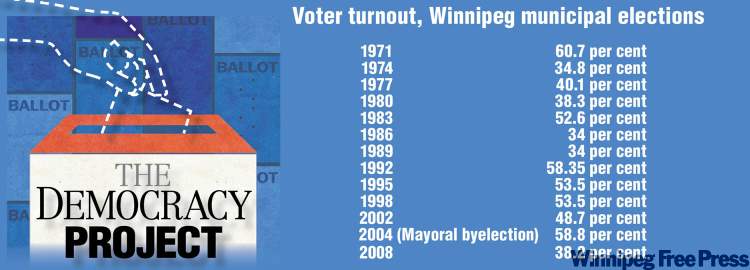
In the last civic election in Winnipeg, barely more than one in three voters bothered to cast a ballot.
In Toronto, turnout in 2006 was 39.3 per cent. In 2008, Vancouver reported just 31 per cent turnout.
It almost makes the 58.8 per cent turnout in the 2008 federal election look huge by comparison. And that, by the way, was the lowest federal electoral turnout in Canadian history.
Dave Siegel, a politics professor at Brock University in St. Catharines, Ont., said it’s difficult to understand why municipal elections don’t draw in the voters, in part because there is not a lot of research or information available on the subject.
“There might be a perception the (municipal) issues are less important, less global,” said Siegel. “Somehow they don’t seem quite as glitzy as wars or whether Canada gets a seat the UN Security Council.”
In Manitoba, there is no record of voter turnout in most jurisdictions. Results reported to the Association of Manitoba Municipalities in 2006 did not include turnout and few municipal websites contain the information. There is also no agency, like Elections Canada or Elections Manitoba, that oversees and collects data on municipal elections.
Tyler MacAfee, director of policy and communication for the AMM, said this year each municipality has been asked to supply information on voter turnout to the AMM when they report election results.
“I don’t think we’ll get it for all 197 municipalities but even if we get 50 we’ll get some idea of what turnout was,” said MacAfee. “We really don’t have anything on turnout at the moment.”
MacAfee said the AMM is looking to become a “one-stop shopping” site for municipal-election information to help guide policy decisions and lobbying efforts around electoral reform.
In 2003, Siegel and fellow Brock professor Joseph Kushner surveyed voters following the municipal election in St. Catharines to try to understand why turnout was so low.
In their report, published in the Journal of Urban Studies in 2006, they found despite ideal weather conditions, a competitive race for mayor and a polarizing issue around a new arena, only 30 per cent of voters went to the polls, the lowest turnout the city had ever seen.
Among the reasons residents gave for not voting, being too busy or experiencing problems at the polls were among the most common responses.
Siegel said the lack of an organized on-the-ground political party system at the municipal level might be in part why the get-out-the-vote work is less successful. Some U.S. cities where national parties compete see the highest turnout in the country, Siegel and Kushner reported.

Winnipeg could be a testing ground for that theory this fall. The NDP is running a slate of candidates and the well-oiled provincial NDP campaign machine is lending its weight to the efforts of a number of candidates including mayoral contender Judy Wasylycia-Leis.
In Port Moody, B.C., the council has repeatedly proposed lowering the voting age in municipal elections to 16 hoping to instil a civic duty at a younger age and stimulate conversations about elections at the high school level that could lead to a lifelong interest in voting.
The proposal came after the city saw electoral turnout drop to 27 per cent in 2008.
Other cities in Canada, the United States and Ireland have tried everything from moving voting days to weekends to having runoff ballots or term limits on municipal councillors in an effort to improve the democratic process at the civic level.
mia.rabson@freepress.mb.ca