

It’s more out of duty than passion for politics
The Democracy Project
Advertisement
Read this article for free:
or
Already have an account? Log in here »
To continue reading, please subscribe:

Digital Subscription
One year of digital access for only $205*
- Enjoy unlimited reading on winnipegfreepress.com
- Read the E-Edition, our digital replica newspaper
- Access News Break, our award-winning app
- Play interactive puzzles
*First annual payment billed as $205.00 + GST for one year. This annual subscription will automatically renew at $233.00 + GST every 52 weeks (10% off the regular annual price of $259.35). Offer available to new and qualified returning subscribers only. Cancel any time.
To continue reading, please subscribe:
Add Free Press access to your Brandon Sun subscription for only an additional
$1 for the first 4 weeks*
- Enjoy unlimited reading on winnipegfreepress.com
- Read the E-Edition, our digital replica newspaper
- Access News Break, our award-winning app
- Play interactive puzzles
*Your next Brandon Sun subscription payment will increase by $1.00 and you will be charged $17.95 plus GST for four weeks. After four weeks, your payment will increase to $24.95 plus GST every four weeks.
Read unlimited articles for free today:
or
Already have an account? Log in here »
Hey there, time traveller!
This article was published 15/01/2011 (5703 days ago), so information in it may no longer be current.
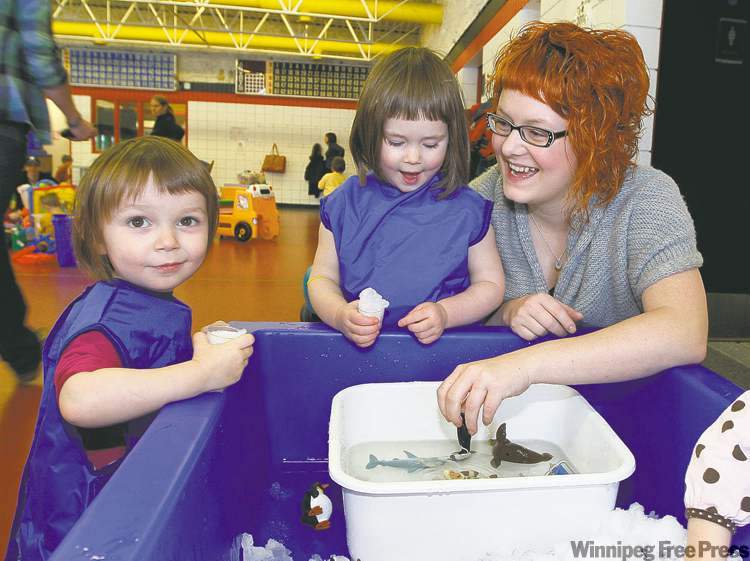
Young mother Erin McDowell is a steadfast and enthusiastic voter — “I don’t ever miss it,” she said.
During one of the flurry of federal elections several years ago, McDowell was knocked out by a brutal cold, but dragged herself down to her neighbourhood community club to vote anyway. “Then I went home, got back into my pyjamas and went back to bed,” said the former hairstylist, small business owner and now mother of two girls. “If you don’t vote, you do not get to complain.”
McDowell’s sense of civic duty reverberated among the moms gathered Tuesday morning for the friendly, colourful chaos that is the parents’ drop-in program at the Earl Grey Community Centre. Asked to talk politics while keeping one eye on their kids, several women echoed McDowell’s words exactly — they vote regularly and they do it out of a strong notion of civic responsibility.
Research shows that women vote more than men — a relatively new trend that started in the 1970s. In the decades before the modern feminist movement took hold, turnout among women was about three or four percentage points lower than men. Today, the reverse is true. Turnout among women is three or four points higher and holding.
That’s the good news.
But dig a little deeper, as political scientists are starting to do, and there are some ominous trends, which one study termed “women’s flagging political engagement.”
If women vote out of a sense of duty, men vote out of an abiding interest in politics, said McGill University political scientist Melanee Thomas, who is doing her PhD on women voters.
According to her analysis of survey, polling and voting data, women tend to be less interested in politics, less knowledgeable about government and feel less effective in the political sphere. A dramatic rise in income and education levels among women, especially over the last two or three decades, was supposed to cure that. It hasn’t.
There’s also a real issues gap. Thomas pointed to new research done by the Canada West Foundation that suggests women tend to lean to the left and are most interested in the so-called soft issues like health care, the environment, homelessness.
Those are exactly the kinds of issues mentioned as top-of-mind among the Earl Grey moms like McDowell. They talked about the midwife shortage and the safety of the River Heights traffic circles and the quality of local schools.
In contrast, men tend to care about taxes, the economy, accountability, infrastructure — the same issues that dominate news cycles, campaigns, punditry and the political discourse.
Women are also less likely to volunteer for or donate to a political party, call their MP or MLA to complain about an issue or even talk politics with friends. That means they have less impact on the nature of political debate from the bottom up, and there aren’t enough women politicians to refocus the debate from the top down.
Manitoba is unusual in that the provincial legislature has a relatively healthy number of female MLAs. Eighteen out of 56 sitting MLAs are women, with one vacant seat. But Winnipeg city hall has only two female councillors and the number of women politicians in rural municipalities is abysmal. As Thomas noted, it’s a chicken-or-the-egg question: Are women less politically engaged because the issues they care about get short shrift? Or do their issues get short shrift because women aren’t engaged and elected?
There’s also a knowledge gap — women know less about politics than men do, or at least they are more likely to admit they feel a little light on the facts. That means they might not always vote in their best interests or for politicians or parties who really reflect their values.
“If women knew as much about politics as men did, the evidence suggests election results might change,” said Thomas.
Besides a fitful interest, the demands of kids, jobs and housework typically leave women less time to devote to politics.
“I’m sort of out of the loop, and feeling strange about it, actually,” said Maria Stapleton, while watching her pigtailed daughter dart around a playhouse.
Stapleton, an employment councillor by trade, cancelled her newspaper subscription after her child was born and has little time for the 6 o’clock news, meaning she finds herself playing catch-up online on issues she cares about. She always votes, but she also takes comfort in Canada’s relatively staid and stable political culture. If there was a hugely divisive issue or some radical party position that was gaining traction, her political antennae would likely perk up.
What Stapleton dislikes is the grandstanding that dominates politics, a common complaint among the women gathered at Earl Grey. At election time, McDowell joked that the grandstanding amounts to little more than “I’m awesome. You’re not. You suck, suck, suck.”
If women are reliable voters but they feel somewhat disconnected from the tone and content of modern politics, that makes them perfect targets in the upcoming provincial election. Pollsters are already watching for fluctuations in voting preferences among women voters, who tend to favour the NDP.
Most of the Earl Grey moms said they leaned to the left, no surprise in Fort Rouge, but they also said they were willing to make some compromises and were open to other parties.

“I’m the swing voter,” said McDowell. “You could win me over.”
maryagnes.welch@freepress.mb.ca
Data about voter turnout among women is surprisingly sparse. Elections Manitoba doesn’t track voting by gender, and Elections Canada just started doing it for the 2008 election.
That year, when Prime Minister Stephen Harper defeated Liberal Leader Stéphane Dion, an estimated 57.6 per cent of women voted compared to 55.3 per cent of men.
The biggest gap was among voters in the 25 to 34-year-old age range. Only 45.5 per cent of men that age voted compared to 50.5 per cent of women.
Related Articles
For some, democracy is a foreign term


Advertisement Advertise With Us
Advertisement Advertise With Us