The Green Page: We’re hooked on salt
Advertisement
Read this article for free:
or
Already have an account? Log in here »
To continue reading, please subscribe:
Digital Subscription
One year of digital access for only $1.44 a week*
- Enjoy unlimited reading on winnipegfreepress.com
- Read the E-Edition, our digital replica newspaper
- Access News Break, our award-winning app
- Play interactive puzzles
*Billed as $5.77 plus GST every four weeks. After 52 weeks, price increases to the regular rate of $19.95 plus GST every four weeks. Offer available to new and qualified returning subscribers only. Cancel any time.
To continue reading, please subscribe:
Add Free Press access to your Brandon Sun subscription for only an additional
$1 for the first 4 weeks*
- Enjoy unlimited reading on winnipegfreepress.com
- Read the E-Edition, our digital replica newspaper
- Access News Break, our award-winning app
- Play interactive puzzles
*Your next Brandon Sun subscription payment will increase by $1.00 and you will be charged $17.95 plus GST for four weeks. After four weeks, your payment will increase to $24.95 plus GST every four weeks.
Read unlimited articles for free today:
or
Already have an account? Log in here »
Hey there, time traveller!
This article was published 22/01/2011 (5755 days ago), so information in it may no longer be current.
It’s carved from the depths of mines, shipped by the tonne across Canada and slathered generously on winter roads to reduce treacherous ice to harmless puddles.
The grit of road salt underfoot is as familiar a sign of winter as the year’s first flurry, and there’s something reassuring about such a simple way of imposing traction on slippery surfaces.
But however natural the origins of all that salt of the earth, the highly unnatural quantities of the stuff applied to roads has serious ramifications.
Besides corroding vehicles and footwear, salt is potent enough to weaken or kill roadside plant life. It can harm the paws of pets and is dangerously appealing to wild animals, which are attracted to roads where it’s spread.
A University of Toronto study last year found the high concentration of road salt in runoff turned nearby water toxic, with similar results in a 2010 Wisconsin investigation.
That study of data from across the United States found road salt had substantial effects on stream water quality and could cause “acute and chronic toxicity” in aquatic life. The problem was greater in the northerly cities.
Environment Canada’s concerns about the toxic effects of high concentrations of road salt go back to 2001. The agency encouraged communities to limit the use of road salt by following a voluntary code of conduct in 2004.
Winnipeggers like to scoff at the panic that sets in when frigid weather hits less winter-ready cities. But despite our wealth of experience, the main weapon in this city’s ice-busting arsenal is the same one used in most cities: old, reliable road salt, which works by lowering the melting point of ice.
“There are some alternatives out there, but they are very, very, expensive and they’re not as readily available as salt,” said Ken Boyd, manager of streets maintenance with Winnipeg’s public works department.
The low cost and ready availability means road salt, or sodium chloride, is the most commonly used de-icer. Other chemical options such as magnesium chloride and calcium chloride are also used.
A host of de-icers made with agricultural byproducts like sugar beet juice are also on the market. They can be mixed with salt to increase effectiveness, but they are all on the pricey side.
The City of Winnipeg uses 20,000 tonnes of salt in an average winter, said Boyd. Around 40,000 tonnes is spread on provincial roadways annually.
“Salt is used across Canada by most agencies. It’s the cheapest, by far, of any de-icing chemical,” said Boyd.
In the last calendar year, Winnipeg’s salt use dropped to just under 11,000 tonnes. But that was due mainly to weather conditions, rather than mitigation efforts: Salt use varies, depending on the sort of winter Winnipeg experiences.
Salt only gets spread when the pavement is warmer than -10 C, typically in winter’s shoulder months. When weather’s as cold as it is now, the city opts for sand, though it still contains some salt.
Many communities are looking to reduce their salt use and Winnipeg is gradually coming around to one popular method: anti-icing, which involves spreading a brine on driving surfaces before they freeze up. Evenly distributed brine uses less salt and “allows us to be more proactive, rather than being reactive,” said Boyd.
Kamloops, B.C. got a head-start on the anti-icing game with a trial back in the late 1990s and found the approach helped cut down the number of snow and ice-related accidents.
The technique is already used on bridge decks in Winnipeg, to prevent ice or early-morning frost from forming. The city got its own brine-maker in 2009 and plans to test anti-icing on secondary roads next winter in advance of storms. It’s an approach already used in numerous other cities.

Winnipeg is also cutting salt volumes through more traditional means, gradually replacing vehicles in its salt-spreading fleet with better ones. The newer vehicles have on-board liquid tanks that ‘pre-wet’ the salt, helping it stick better to roads and allowing the city to use less of it.
Across North America, cities are increasingly relying on systems of sensors embedded in roads to gauge road temperatures and weather conditions, and plan treatment accordingly. Winnipeg has two such sensors.
Some smaller communities are getting attention for their de-icing efforts. Prior Lake, Minn. — population, 19,000 — won an Excellence in Snow and Ice Control Award from the American Public Works Association last year for the city’s ‘smart’ snow and ice-control program.
Prior Lake bought brine-making equipment in 2004 after noticing rising concentrations of chloride in nearby water bodies and is working to bring anti-icing to all city streets. The city brews up five different anti-icing mixtures and comes up with a specialized plan for each storm that moves in. The community used to use 275 kilograms or more of salt per lane, per 1.6 kilometres, but has cut that down to 125 to 175 kilos in recent years.
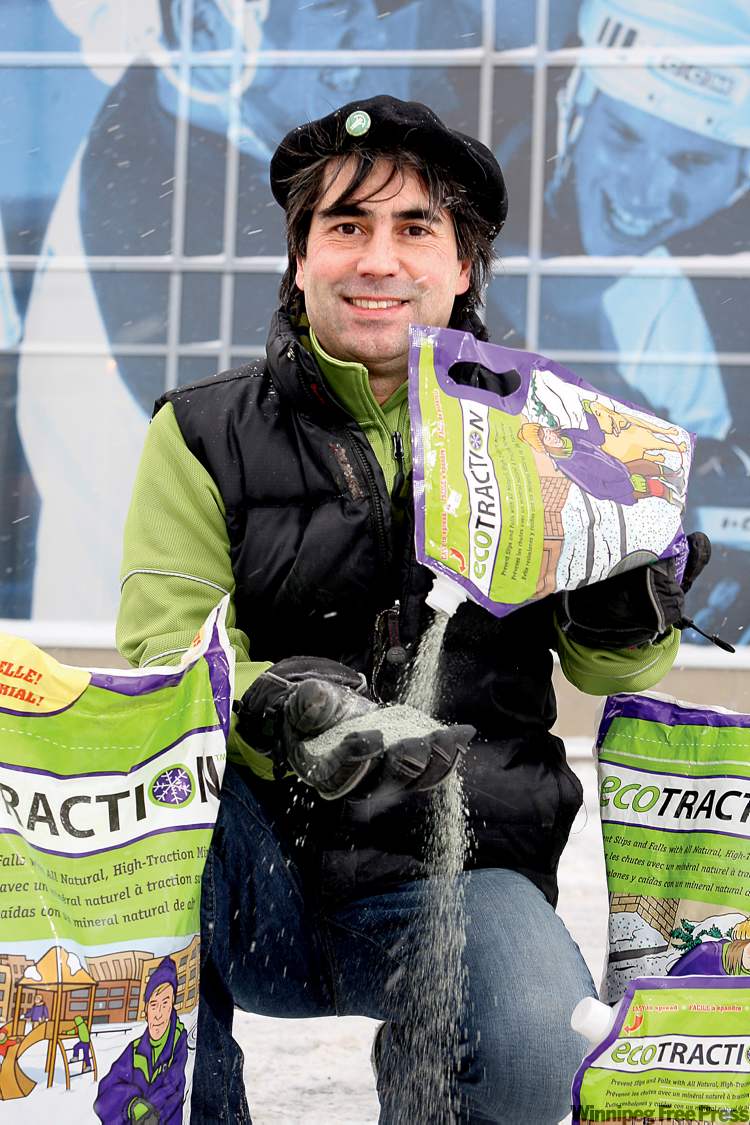
In Ottawa, a trial of a product billed as more environmentally friendly than road salt is in the works, said EcoTraction founder Mark Watson. EcoTraction is made of a volcanic mineral called zeolite, said Watson, and helps increase traction on slippery surfaces. The product entered the market around 2006.
“It’s completely safe for lakes and for rivers and for trees,” Watson said.

Products such as EcoTraction are commercially available, though more expensive than salt. But they are becoming easier to find: a 10-kg bag of EcoTraction will cost about $16 at Home Depot, while Canadian Tire sells a 4.5-kg container for $11.
A 5 kg container of Organic Melt de-icer runs about $9 at Canadian Tire. That product is made with sugar beets, though it still has some salt in the mix.
The greenest option may still be elbow grease and a good shovel — though some experts are hoping for a less labour-intensive solution.
With the help of solar panels and heat-absorbing roadways, a group of Massachusetts researchers hopes ice-slicked roads could one day spare us the headache of de-icing by thawing themselves.
lindsey.wiebe@freepress.mb.ca