

For Al-Jazeera, a CNN moment
Qatar network 'owns' the Arab upheaval story
Advertisement
Read this article for free:
or
Already have an account? Log in here »
To continue reading, please subscribe:
Monthly Digital Subscription
$1 per week for 24 weeks*
- Enjoy unlimited reading on winnipegfreepress.com
- Read the E-Edition, our digital replica newspaper
- Access News Break, our award-winning app
- Play interactive puzzles
*Billed as $4.00 plus GST every four weeks. After 24 weeks, price increases to the regular rate of $19.95 plus GST every four weeks. Offer available to new and qualified returning subscribers only. Cancel any time.
Monthly Digital Subscription
$4.99/week*
- Enjoy unlimited reading on winnipegfreepress.com
- Read the E-Edition, our digital replica newspaper
- Access News Break, our award-winning app
- Play interactive puzzles
*Billed as $19.95 plus GST every four weeks. Cancel any time.
To continue reading, please subscribe:
Add Free Press access to your Brandon Sun subscription for only an additional
$1 for the first 4 weeks*
*Your next subscription payment will increase by $1.00 and you will be charged $16.99 plus GST for four weeks. After four weeks, your payment will increase to $23.99 plus GST every four weeks.
Read unlimited articles for free today:
or
Already have an account? Log in here »
Hey there, time traveller!
This article was published 26/03/2011 (5508 days ago), so information in it may no longer be current.
WASHINGTON — What a difference the chain of Arab world uprisings has made for Al-Jazeera.
The Qatar-based pan-Arab television network was pilloried not long ago by many in Washington as the official house organ for Osama bin Laden and other terrorists because it aired their anti-American statements. Lately, however, it’s become the go-to network for the White House, Congress, Embassy Row and Washington intelligentsia seeking reliable coverage of what’s happening in foreign hot spots.
Al-Jazeera’s constant, compelling and often raw as-it-happens coverage of the uprisings earned it the scorn of Libyan leader Moammar Gadhafi, ousted Egyptian president Hosni Mubarak and other besieged rulers in the region who’ve felt the network’s hot lights, but it’s rapidly earning high praise in the U.S.
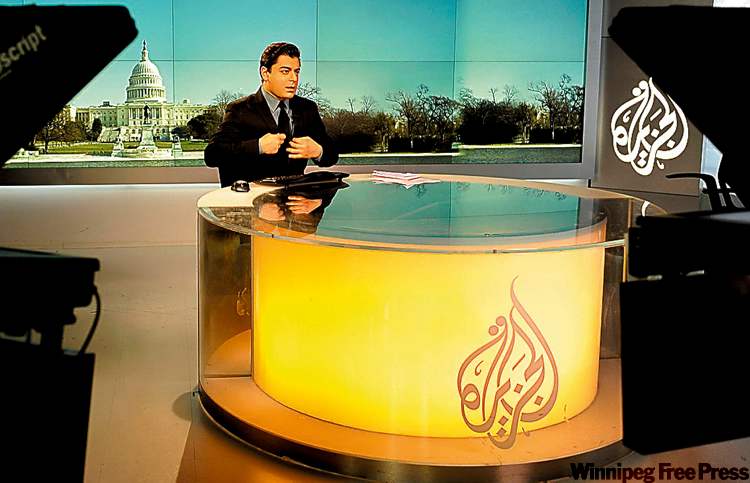
“Viewership of Al-Jazeera is going up in the United States because it’s real news,” Secretary of State Hillary Clinton told the Senate Foreign Relations Committee earlier this month. “You may not agree with it, but you feel like you’re getting real news around the clock instead of a million commercials and, you know, arguments between talking heads and the kind of stuff that we do on our news, which… is not particularly informative to us, let alone foreigners.”
Clinton isn’t alone in that assessment. Many media analysts and political experts believe Al-Jazeera is in the midst of a “CNN Moment” as its coverage of the uprisings is catapulting it into prominence much as round-the-clock coverage of the 1991 Persian Gulf War did for CNN. That’s when the Atlanta-based 24-hour news network shed its early image as an amateurish “Chicken Noodle News” outfit and became recognized as a well-respected news operation.
“The revolutions in Tunisia and Egypt could be called Al-Jazeera revolutions,” said Dave Marash, a veteran broadcast journalist who reported for years on ABC’s Nightline. He was hired by Al-Jazeera English in 2006, but quit two years later over disagreements with management. “In many ways, they have owned the story because they have complete coverage of the region. There’s no question it’s winning acceptance in America.”
“I think what we’ve seen is a sea change in recent months in the U.S.,” Al Anstey, Al-Jazeera English’s managing director, said from Doha, Qatar. “We’ve seen an exponential increase in viewership and demand. I quote with delight Hillary Clinton’s comments in the Senate Foreign Relations hearings.”
In Winnipeg, Al-Jazeera is available by subscription on Shaw Cable. In much of the U.S., it’s available only on a computer, though the network is trying for wider distribution.
When the uprisings first began, Los Angeles’s KCET, a public television station, decided to move the half-hour Al-Jazeera English newscasts it was airing on its digital channel, MHZ Worldview, to its regular channel. Station officials said the newscasts have been thriving ever since.
Between Feb. 7 and March 4, the 6:30 p.m. Al-Jazeera English broadcast alone increased by 450 per cent, drawing about 100,000 viewers, according to Bret Marcus, the station’s senior vice-president and chief content officer.
“They’re doing incredibly well,” Marcus said. “Al-Jazeera traditionally had a reputation for bias. But of all the emails we’ve gotten, only one has been negative.”
“Al-Jazeera, the pan-Arab satellite news network, showed global media how to cover a people’s uprising — by getting right into the thick of things and keeping the cameras running, both witnessing and propelling events,” the Columbia Journalism Review wrote in its March/April issue.
Sometimes it gets too close to the action. Al-Jazeera cameraman Ali Hassan al-Jaber, a Qatar native, was killed earlier this month when the car in which he was travelling came under fire in Libya near the rebel-held city of Benghazi. Al-Jazeera officials said 20 armed men broke into their Yemen bureau on Monday, ransacked it and seized broadcasting equipment.
Some media analysts say Al-Jazeera’s ascension can also be linked to the decline of international coverage by U.S. cable and network news in recent years. As ratings declined, TV outlets shuttered their foreign bureaus to save money, relying instead on video purchased from foreign media outlets or freelancers.
“American networks have abdicated their commitment to international news,” said Frank Sesno, director of George Washington University’s School of Media and Public Affairs and CNN’s former Washington bureau chief. “When you look at Al-Jazeera English, it has acquitted itself well in this process and it’s been recognized.”
Today’s recognition is a far cry from the disdainful view of Al-Jazeera during George W. Bush’s presidency. Then-defense secretary Donald Rumsfeld fumed that Al-Jazeera aired “vicious, inaccurate and inexcusable” reports about U.S. military actions in Iraq. Then-national security adviser Condoleezza Rice told reporters in 2004 “people have suggested that it would be a good thing if the reporting were accurate on Al-Jazeera, and if it were not slanted in ways that it appears to be.”

The administration distrusted the network for airing video messages from bin Laden. The feeling was mutual: Al-Jazeera executives accused the U.S. military of deliberate missile attacks on their offices in Kabul and Baghdad in 2003.
Clinton told the Senate Foreign Relations Committee American exposure on the network is critical because it has become a crucial opinion-shaper in the Middle East.
“And like it or hate it, it is really effective,” she said.
— McClatchy-Tribune Information Services