

Evacuation not part of the equation
Flood veteran surrounded by Red, plans to leave only to vote Monday
Advertisement
Read this article for free:
or
Already have an account? Log in here »
To continue reading, please subscribe:
Digital Subscription
One year of digital access for only $75*
- Enjoy unlimited reading on winnipegfreepress.com
- Read the E-Edition, our digital replica newspaper
- Access News Break, our award-winning app
- Play interactive puzzles
*Billed as $5.77 plus GST every four weeks. After 52 weeks, price increases to the regular rate of $19.95 plus GST every four weeks. Offer available to new and qualified returning subscribers only. Cancel any time.
Monthly Digital Subscription
$4.99/week*
- Enjoy unlimited reading on winnipegfreepress.com
- Read the E-Edition, our digital replica newspaper
- Access News Break, our award-winning app
- Play interactive puzzles
*Billed as $19.95 plus GST every four weeks. Cancel any time.
To continue reading, please subscribe:
Add Free Press access to your Brandon Sun subscription for only an additional
$1 for the first 4 weeks*
- Enjoy unlimited reading on winnipegfreepress.com
- Read the E-Edition, our digital replica newspaper
- Access News Break, our award-winning app
- Play interactive puzzles
*Your next Brandon Sun subscription payment will increase by $1.00 and you will be charged $17.95 plus GST for four weeks. After four weeks, your payment will increase to $24.95 plus GST every four weeks.
Read unlimited articles for free today:
or
Already have an account? Log in here »
Hey there, time traveller!
This article was published 30/04/2011 (5498 days ago), so information in it may no longer be current.
ST. JEAN BAPTISTE — It isn’t a flood without a boat ride.
And it isn’t a flood here without the Sabourin brothers, Luc and Theo.
Theo is holed up in his home atop a seven-foot hill he built after the 1997 flood, when he was surrounded by water. He turns 88 in two weeks.
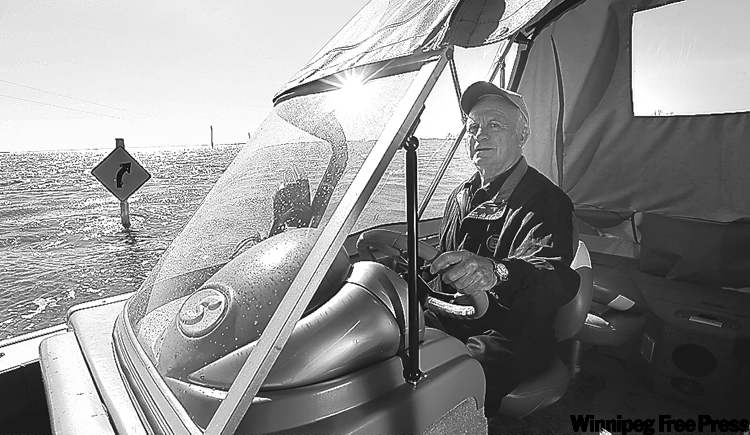
Luc, 75, has been generously giving boat rides to people wanting to see flooded farm fields. He dropped in on his older brother on Friday in his red, canopied boat to see how he’s doing.
“I’ve got no trouble,” Theo told us.
He’s stocked up. He’s got enough medicine to last him two months, and enough food to last three weeks, he said.
He figures sometime around his birthday, or a few days later, the road will open up and he’ll be able to drive out again.
The brothers are like flood ambassadors for the community of St. Jean Baptiste, about 65 kilometres south of Winnipeg. They’ve seen every flood since 1948. Since 1996, their area — where the Roseau River empties into the Red River — has flooded every year except two. From 1979 to 1996, it never flooded once.
“You get frustrated. There are too many floods,” said Luc.
Down the road, the entire reserve of Roseau River First Nation sat empty Friday, like a ghost town, after an evacuation. However, flooding hadn’t materialized — the river crested here mid-week at almost two feet below 2009 levels, and has already dropped a couple of inches, say local people — and the federal government was urging band members to return.
But the credo in farm and rural residential homes across the Red River Valley, as opposed to towns and reserves, is you never evacuate. You stay and fight to protect your home.
That lesson was learned in the 1997 flood when many rural homes were flooded due to the military’s decision to make people evacuate. That meant no one could monitor pumps and personal dikes to save the home.
Luc recalled how he was escorted off his farm by the RCMP, only to return the next day and find a piece of wood had jammed his pump. If he had stayed home, he would have heard the pump shut off and fixed the problem. Because he’d been forced to leave, he had five feet of water in his house.
Theo was also forcibly removed. But he discovered the next day that Mounties had broken their promise to look in on his pumps. So he snuck back by boat. Mounties tried to remove him again. Finally, they struck a deal that he could stay so long as he spent the night at a son’s house nearby.
How many times did he sleep at his son’s house? “Not once,” he said.
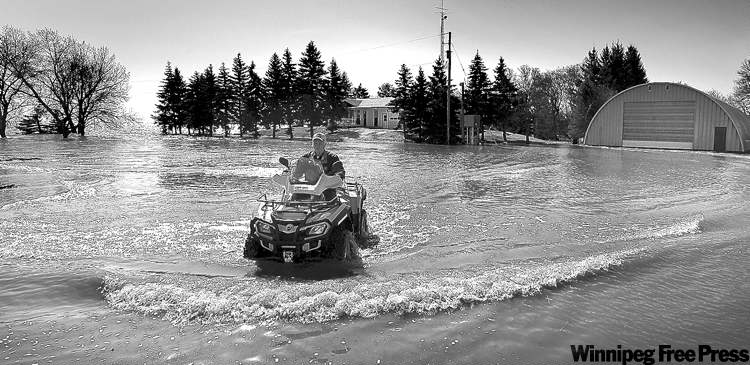
It was like living in a leaky ship. His basement was already full of water but he waged a successful battle to keep water from reaching the main floor. He parked his rubber boots at the foot of his bed and got up every two hours to check his dikes. He once discovered a stretch of sand dike ready to collapse at 2 a.m. He spent the next three hours bracing it with 2×10 planks.
This year, with water not so deep, he can access his son’s house with an ATV on a route that includes driving through one-foot deep water. His sons call him every morning and fetch his mail by boat.
As for boating, a skim across farm fields is becoming part of the Manitoban experience, like photographing crocuses or visiting Churchill’s polar bears. You boat past grain bins, Quonsets, hydro poles, the heads of highway signs. Luc had to navigate around deadfall, and then through a patch of trees to reach his own farm. (He and his wife moved off the farm into St. Jean in 1998.)

It’s surprising how fast boaters like Luc go. You might think they putt-putt around in case they hit a low spot but they really zip around. The route to Theo’s farm crosses an eight-kilometre wide stretch of flooded farm fields. The water is from three- to eight-feet deep, Luc said.
Theo said he had been boated into town only once since his road access was cut off two weeks ago but that he had to go in next Monday.
Why? What do you have to do in town Monday?
“That’s voting day,” he said.
bill.redekop@freepress.mb.ca