Insider trading a helluva tale, if uneven in spots
Advertisement
Read this article for free:
or
Already have an account? Log in here »
To continue reading, please subscribe:

Digital Subscription
One year of digital access for only $205*
- Enjoy unlimited reading on winnipegfreepress.com
- Read the E-Edition, our digital replica newspaper
- Access News Break, our award-winning app
- Play interactive puzzles
*First annual payment billed as $205.00 + GST for one year. This annual subscription will automatically renew at $233.00 + GST every 52 weeks (10% off the regular annual price of $259.35). Offer available to new and qualified returning subscribers only. Cancel any time.
To continue reading, please subscribe:
Add Free Press access to your Brandon Sun subscription for only an additional
$1 for the first 4 weeks*
- Enjoy unlimited reading on winnipegfreepress.com
- Read the E-Edition, our digital replica newspaper
- Access News Break, our award-winning app
- Play interactive puzzles
*Your next Brandon Sun subscription payment will increase by $1.00 and you will be charged $17.95 plus GST for four weeks. After four weeks, your payment will increase to $24.95 plus GST every four weeks.
Read unlimited articles for free today:
or
Already have an account? Log in here »
Hey there, time traveller!
This article was published 07/05/2011 (5582 days ago), so information in it may no longer be current.
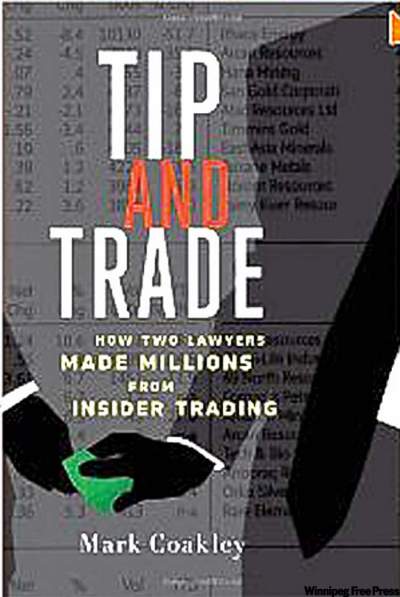
Tip and Trade
How Two Lawyers Made Millions from Insider Trading
By Mark Coakley
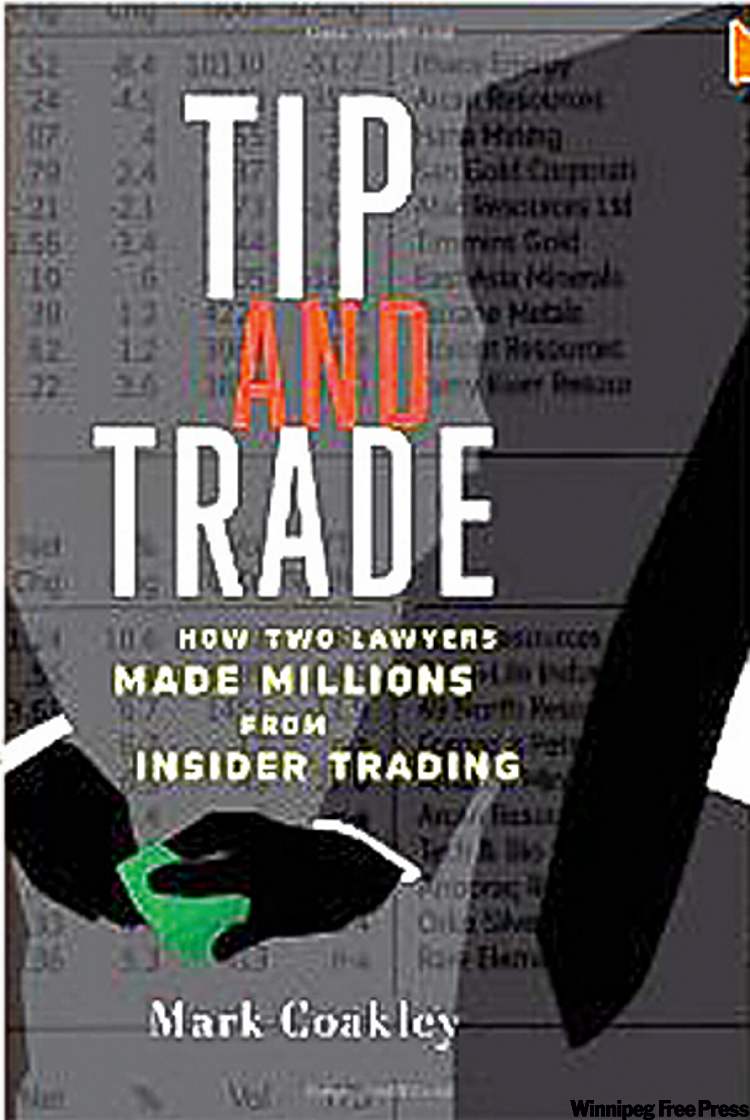
ECW Press, 381 pages, $20
TWO men meet in law school and forge a friendship based on shared politics.
Their friendship becomes a partnership in insider trading that nets several million dollars in illegal profits, until they’re caught.
One man kills himself before charges are laid; the other is sent to prison.
It’s a helluva story, and the author of this true-crime story has the advantage of having known both principals from his student days at Osgoode Hall Law School in Toronto.
But the storytelling is of uneven quality, occasionally larded with dull and unnecessary details.
Hamilton writer Mark Coakley recalls Stan Grmovsek and Gil Cornblum as practically inseparable buddies who penned provocative right-wing pieces for Osgoode Hall’s student paper in the early ’90s.
One of Grmovsek’s columns was like a parody of right-wingers, arguing that the poor should be taxed more than the rich, though Grmovsek was serious.
Coakley liked the rightist pair, and they seemed to like and respect him despite Coakley’s left-of-centre politics.
In 1994, about a year after finishing law school, Grmovsek convinced Cornblum that they should make extra money by trading stocks based on secrets Cornblum learned at work.
Cornblum would come to work early to hunt for information while no one was around to see him, then tip Grmovsek on mergers, takeovers and other transactions that his employer was facilitating.
The process continued for 14 years, minus a few years in which Cornblum did not tip Grmovsek.
By the spring of 2008, the U.S. Securities and Exchange Commission and the Ontario Securities Commission were hot on the crooked pair’s trail.
Grmovsek’s E*Trade accounts were frozen in late April, and the law firm that employed Cornblum was told of suspicious trading in client companies’ shares.
Fired, disgraced, and worried about going to prison, Cornblum committed suicide by jumping off a bridge shortly before he was to be formally charged in October 2009.
Grmovsek pleaded guilty to three charges and began a 39-month prison sentence last year at the maximum-security Millhaven Institution in Bath, Ont. The book concludes with him awaiting transfer to a minimum-security facility.
Coakley, who previously wrote a historical novel about Vikings, explains the twosome’s crimes in a way that’s easy for everyday folks to understand.
He also gives an engaging and interesting account of his own interactions with them, and the sometimes complicated friendship between Cornblum and Grmovsek (who, unbeknownst to his pal, took more than his half of the profits).
But we could do without Coakley going on about the history of York, the part of Toronto where Osgoode Hall is located, or the special place New York City’s 57th Street (where Cornblum had an apartment for a couple of years) has in popular culture.
Coakley’s decision to reprint long excerpts from court transcripts likewise provides too much information and legalese, some of it eye-glazing.
Some readers won’t like the way Coakley repeatedly links Grmovsek and Cornblum’s politics with the avarice that fuelled their crimes.
But the assertion seems fair when you consider that big-time white-collar crooks are rarely, if ever, leftists. It is reasonable to think greedy attitudes might produce greedy behaviour.
Winnipeg writer Mike Stimpson says he has never engaged in insider trading.