

Ranchers hauling cattle to drier ground
Mass exodus from Lake Manitoba area
Advertisement
Read this article for free:
or
Already have an account? Log in here »
To continue reading, please subscribe:
Digital Subscription
One year of digital access for only $1.44 a week*
- Enjoy unlimited reading on winnipegfreepress.com
- Read the E-Edition, our digital replica newspaper
- Access News Break, our award-winning app
- Play interactive puzzles
*Billed as $5.77 plus GST every four weeks. After 52 weeks, price increases to the regular rate of $19.95 plus GST every four weeks. Offer available to new and qualified returning subscribers only. Cancel any time.
To continue reading, please subscribe:
Add Free Press access to your Brandon Sun subscription for only an additional
$1 for the first 4 weeks*
- Enjoy unlimited reading on winnipegfreepress.com
- Read the E-Edition, our digital replica newspaper
- Access News Break, our award-winning app
- Play interactive puzzles
*Your next Brandon Sun subscription payment will increase by $1.00 and you will be charged $17.95 plus GST for four weeks. After four weeks, your payment will increase to $24.95 plus GST every four weeks.
Read unlimited articles for free today:
or
Already have an account? Log in here »
Hey there, time traveller!
This article was published 13/05/2011 (5519 days ago), so information in it may no longer be current.
LAKE MANITOBA NARROWS — When Blair Olafson was born and his mom brought him home from hospital, flooding here was so bad that his dad floated them 200 metres — the distance between the road and the farm house — on a manure sleigh.
That was 1956.
“Fifty-five years to the day, we’re back at it again,” said Olafson, a cattle rancher, while providing a tour of flooding in this area, and an idea of what flooding is yet to come.
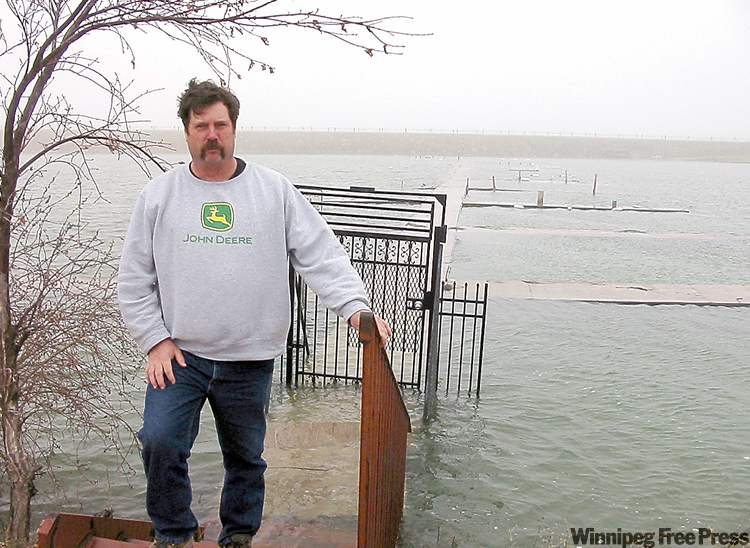
Except 55 years later this flood has had a lot of help from the Portage Diversion, built in 1974 to divert Assiniboine River water into Lake Manitoba to protect Winnipeg.
Water from the diversion has been roaring into Lake Manitoba at a rate of 25,000 cubic feet per second, and the province plans to push that to 34,000 cfs. That means at least another foot of water is coming, the province says.
Homes and cottages will be threatened by flooding all along Lake Manitoba, especially if there’s a windstorm, which is highly probable since waters are expected to stay high until August. A windstorm can add another foot-and-a-half to the water’s height. There are also four First Nations communities around the lake that must protect themselves: Ebb and Flow, Sandy Bay, Crane River and Lake Manitoba (also called Dog Creek).
But the big concern right now is cattle — and surviving financially. The largest concentration of Manitoba’s 550,000 beef cattle is around Lake Manitoba. The cattle will starve with their pastures and hay land under water, and importing feed is cost prohibitive. A mass exodus of up to 100,000 cattle has begun. The cattle will not be able to return for nine months to a year.
And that could add up to devastation for many ranchers. “We’re into a three-year wet period, and this is just going to finish a lot of people off,” said Olafson.
Farmers are burning up the phone lines trying to rent land for their cattle. Many herds are expected to move to Saskatchewan and Alberta, where government-owned pastures are open. Farmers are also scrambling to rent trucks to haul their cattle.
“You’re going to have trucks running this highway (Highway 68) day and night,” said John Johnson, who is moving 150 head, most to the Elie area west of Winnipeg. Land and transport will cost him at least $100 a head, or $15,000 in total. He thinks about just selling off his herd but a mass sell-off by farmers will only depress prices.
Joel Delaurier, 41, will start moving over 600 head on Saturday. Delaurier is wondering if he’ll continue ranching. “I don’t know if I’ll come back from this,” he said.
Delaurier has had to lay off his hired hand and cancel a machinery purchase. The hired man and his family lived in a spare home on the property. As for the purchase of an air seeder, it was a private, handshake deal and the other farmer understood.
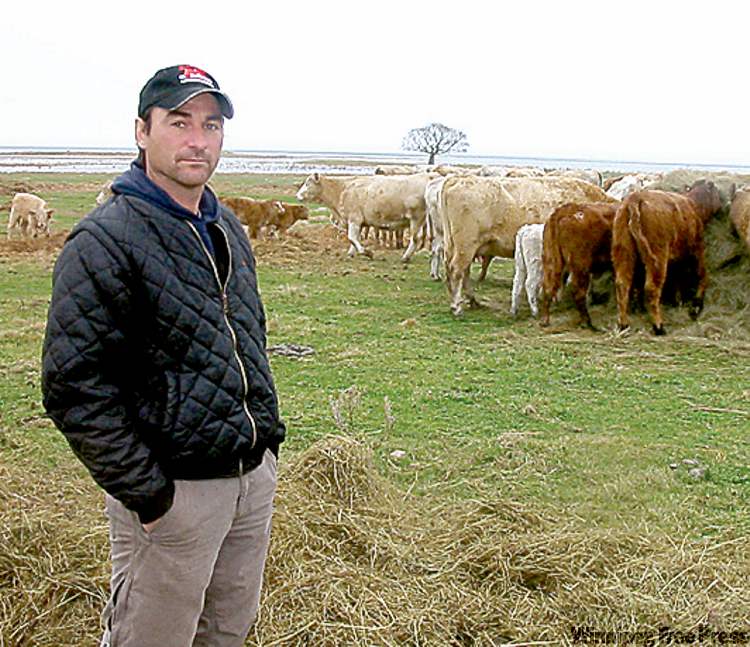
“I moved here (in an area around the hamlet of Reykjavik) 12 years ago and there were 12 families at that time. Right now, there are just four.” It will be less after this disaster, he predicted.

No one knows how well farmers will be compensated for their costs. Hay lands will take three years to return to their pre-flood yields. Will farmers be compensated for that? Emergency Measures Organization has informed producers to save all their receipts and keep track of their time and labour.
Olafson quotes a figure that flood-protection infrastructure saves Winnipeg $32 billion in potential losses. “Why not spend $2 billion helping those impacted” by the infrastructure, like those people around Lake Manitoba? he asked. Olafson is a former head of the Manitoba Cattle Producers Association and owns Lake Manitoba Narrows Lodge. On Thursday, the lodge was being sandbagged, under orders by EMO.
One place to start fixing the problem is by expanding the Fairford River Dam, the lake’s only outlet, said Olafson. The dam is releasing just 13,000 cfs, while taking over 25,000 cfs from the diversion, in addition to natural inflows from tributaries like the Waterhen River.
The lake is forecast to peak June 13-15 at 815.2 to 815.6 feet above sea level, but the province has told farmers there is a good chance it will go higher. The optimum level is 812.3 feet. The crest is expected to stay for about a month.
bill.redekop@freepress.mb.ca