

City survived loss of Jets, but fans must do better
ACT TWO: THIS ONE'S FOR KEEPS

Advertisement
Read this article for free:
or
Already have an account? Log in here »
To continue reading, please subscribe:

Digital Subscription
One year of digital access for only $205*
- Enjoy unlimited reading on winnipegfreepress.com
- Read the E-Edition, our digital replica newspaper
- Access News Break, our award-winning app
- Play interactive puzzles
*First annual payment billed as $205.00 + GST for one year. This annual subscription will automatically renew at $233.00 + GST every 52 weeks (10% off the regular annual price of $259.35). Offer available to new and qualified returning subscribers only. Cancel any time.
To continue reading, please subscribe:
Add Free Press access to your Brandon Sun subscription for only an additional
$1 for the first 4 weeks*
- Enjoy unlimited reading on winnipegfreepress.com
- Read the E-Edition, our digital replica newspaper
- Access News Break, our award-winning app
- Play interactive puzzles
*Your next Brandon Sun subscription payment will increase by $1.00 and you will be charged $17.95 plus GST for four weeks. After four weeks, your payment will increase to $24.95 plus GST every four weeks.
Read unlimited articles for free today:
or
Already have an account? Log in here »
Hey there, time traveller!
This article was published 28/05/2011 (5567 days ago), so information in it may no longer be current.
Everyone loves a comeback, and this is one hell of a comeback to be sure.
Even with all of the starts and stops, false rumours, dashed expectations and denials, it appears Winnipeg is on the verge of once again hosting a National Hockey League team. It is a rare and special event, an antidote in many respects to the cynical, greedy, bottom-line culture of major-league sports.
But none of it would have been possible if the city had not made a comeback of its own. Just think about how far the city has come.
In 1995, Winnipeg was a town down on its luck. This was a time of restraint and attrition. The federal government had slashed transfer payments for health, education and social services to get its deficit under control, and the provinces in turn cut back on those services. Filmon Fridays, the unpaid days off named after then-premier Gary Filmon, were in fashion. There was virtually no economic growth in the province or the city. And on top of all that, Winnipeg’s beloved Jets left town, victims of an increasingly affluent NHL and a decreasingly affluent Winnipeg.
When it was clear in August 1995 the team would be sold, and that the 1995-96 season was to be its last, there were predictions of economic and political doom. Hockey fans could barely look up from their tear-filled beer mugs. Opinion leaders in the business community foresaw an economic apocalypse, as if the Jets were the last peg holding up the local economy from a fall into the abyss. Stores and restaurants would close, head offices would relocate and neighbourhoods would empty as hockey fans packed up the U-Haul trailers and headed off for expansion cities. A national newspaper, describing our plight, put it this way:
“For a Canadian city, a Prairie city, to lose its National Hockey League franchise is a blow that only a Canadian could understand,” the Globe and Mail wrote recently. “It was as if the city’s raison d’être were yanked out from under it… Was there life after hockey? No.”
If the Globe editorial proves anything, it is the outside world wrote off this city when the Jets left. The prevailing wisdom was that professional sports was a catalyst for an urban economy, and a city that had professional sports and then lost it would be as doomed as doomed could be.
Predictions of our demise may have been premature. Undaunted by the loss of the Jets, Winnipeg went on to host a successful Pan American Games in 1999 that pumped hundreds of millions of dollars into infrastructure. With the start of a new decade came a new era of economic growth. Ottawa began to restore transfer payments, and government revenues were at all-time highs. Unemployment in Manitoba dropped to historic lows, public and private-sector investment soared, and the population began to grow. Construction cranes soared over the city’s core as new and renewed developments arose. Amid all this, a tenuous deal was struck between taxpayers and True North Sports and Entertainment to build the MTS Centre, the building that will house, we hope and expect, a new NHL team.
Not only was there life after the departure of the Jets, there was prosperity. Modest prosperity on a Manitoba scale, but prosperity nonetheless. The 15 years in which Winnipeg did not have an NHL team were not lost years, they were necessary years. A break that gave Winnipeg time to prove it did not need an NHL team, even if we wanted one.
“The whole debate about whether the loss of the Jets would ruin our economy is dead,” said Jino Distasio, director of the Institute of Urban Studies at the University of Winnipeg. “We did feel the pinch. But we know now that this is just one piece of the puzzle. It’s going to have a positive impact, but it’s not going to make or break us. And that’s a good thing.”
This realization comes as some comfort to those who in the 1990s stridently opposed the investment of public money to keep the Jets in Winnipeg. One of those, University of Winnipeg political scientist Jim Silver, has deliberately kept out of the current debate and generally resisted offers to comment on the possible return of the NHL. However, in a recent interview, Silver said he believes Winnipeg is ready to host a NHL team now, in large part because the city has proven it didn’t need the NHL to grow, and Winnipeggers have a more realistic idea of what an NHL team means. “We had a financial mess in the 1990s,” Silver said. “We had poured tens of millions of dollars into this and would have faced the prospect of tens of millions of dollars more. All we said is if you have that kind of money to throw around, we have some better uses for it.
“Now we have a management group that is more responsible. The provincial government seems to be more responsible and they’re not willing to give up the farm to keep the team. Last time, there was this view that there were all these economic benefits that would flow from keeping the Jets here. We know that’s not true and that puts us in a better place now.”
So, it was largely a myth to suggest the loss of the Jets would ruin Winnipeg. That is not, however, the only myth at work here.
I was a pretty big hockey fan growing up in Toronto but as a result of travel and other circumstances, I went almost a decade from the late 1970s to the late 1980s without seeing a single game.
I attended university in Ottawa, which at that time did not have an NHL team, and then worked in Calgary in the spring and summer of 1986. That was the spring the Flames made their first Stanley Cup final and tickets were very hard to come by. Weekends and holidays were spent in Toronto where tickets were even harder to come by.

My luck changed in the fall of 1986, when I came to Winnipeg to work for the Free Press. For the first time in my life, acquiring a ticket to an NHL hockey game did not require a ritual sacrifice. I went to the box office with a friend and bought two lower-bowl tickets for the Jets’ second regular-season game against the mighty Edmonton Oilers.
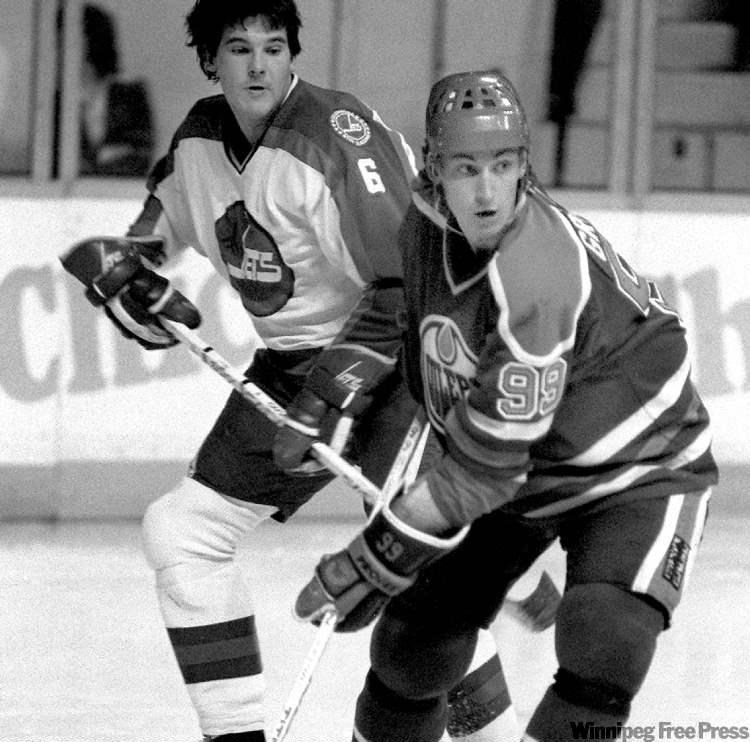
These were the heyday Oilers of Gretzky, Kurri, Anderson, Coffey and Messier. The game was brisk as Gretzky and his mates moved the puck around at will. I remember the Great One making a pass from the neutral zone to a streaking Kurri that was so unexpected and improbable that it brought an audible gasp from the crowd.
On this night, however, even the mighty Oilers could not overcome a spirited Jets team led by goaltender Eldon “Pokey” Wade Reddick, a surprise starter who won his first NHL start just two days earlier against Buffalo. His play was steady, punctuated by several spectacular saves. As the final seconds ticked down, the crowd thundered with a chant of “Pokey, Pokey.”
For all of the years I lived in Winnipeg while the Jets were in town, I never had trouble getting a ticket, even to a playoff game, which was odd given the reverence in which the Jets are discussed now. I had only known cities where fans were forced to sell their children or endure knife fights for the right to attend games. For all of the folklore about Winnipeggers and their beloved Jets, this was not one of those cities.
Winnipeg Mayor Sam Katz, who has been a point man for national and international media trying to get a fix on why the NHL is returning to Winnipeg, has made a special point of absolving Winnipeg hockey fans for the Jets’ departure. “When the Jets left it had nothing to do with fan support,” Katz told several news outlets on May 24. Katz blamed a lack of “leadership,” which in turn led to failed efforts to build a new arena. This is brilliant politics from a man who has shown a deft touch in massaging the grassroots of our city. It is pretty weak historical analysis.

While it is true that a decrepit arena with no real luxury boxes, poor ancillary revenue streams, rising player salaries and a depressed Canadian dollar all combined to drive the team from Winnipeg, fan support was never robust in Winnipeg. Not once in the Jets’ 17-year NHL history did it sell out an entire season. In the 11 years in which the team made the playoffs, only four times did the team sell out all of its home games. The harsh fact is that Winnipeg, a smaller market, never demonstrated the same enthusiasm for hockey as the top hockey markets in North America.
To be successful, this time, Winnipeg fans are going to have to up their game. This is a time when we’re going to have to exceed past performances and live up to the image we have of ourselves as a top-notch hockey town.
The timing could not be better for the return of the NHL. Winnipeg has grown stronger, both in terms of population and its economy. We have proven the world did not in fact end with the Jets’ departure and that the city could thrive without NHL hockey. We are not a community that needs a major-league sports team to succeed; we are a city that in our own modest way has succeeded, and now wants a NHL team.
We’re getting a second chance, and that’s not something that happens often. But it’s also our last chance.
dan.lett@freepress.mb.ca
Dan Lett is a columnist for the Free Press, providing opinion and commentary on politics in Winnipeg and beyond. Born and raised in Toronto, Dan joined the Free Press in 1986. Read more about Dan.
Dan’s columns are built on facts and reactions, but offer his personal views through arguments and analysis. The Free Press’ editing team reviews Dan’s columns before they are posted online or published in print — part of the our tradition, since 1872, of producing reliable independent journalism. Read more about Free Press’s history and mandate, and learn how our newsroom operates.
Our newsroom depends on a growing audience of readers to power our journalism. If you are not a paid reader, please consider becoming a subscriber.
Our newsroom depends on its audience of readers to power our journalism. Thank you for your support.
Dan Lett is a columnist for the Free Press, providing opinion and commentary on politics in Winnipeg and beyond. Born and raised in Toronto, Dan joined the Free Press in 1986. Read more about Dan.
Dan’s columns are built on facts and reactions, but offer his personal views through arguments and analysis. The Free Press’ editing team reviews Dan’s columns before they are posted online or published in print — part of the our tradition, since 1872, of producing reliable independent journalism. Read more about Free Press’s history and mandate, and learn how our newsroom operates.
Our newsroom depends on a growing audience of readers to power our journalism. If you are not a paid reader, please consider becoming a subscriber.
Our newsroom depends on its audience of readers to power our journalism. Thank you for your support.
Advertisement Advertise With Us
Advertisement Advertise With Us