

Time running out for farmers
Weather, floods hurting seeding
Advertisement
Read this article for free:
or
Already have an account? Log in here »
To continue reading, please subscribe:

Digital Subscription
One year of digital access for only $205*
- Enjoy unlimited reading on winnipegfreepress.com
- Read the E-Edition, our digital replica newspaper
- Access News Break, our award-winning app
- Play interactive puzzles
*First annual payment billed as $205.00 + GST for one year. This annual subscription will automatically renew at $233.00 + GST every 52 weeks (10% off the regular annual price of $259.35). Offer available to new and qualified returning subscribers only. Cancel any time.
To continue reading, please subscribe:
Add Free Press access to your Brandon Sun subscription for only an additional
$1 for the first 4 weeks*
- Enjoy unlimited reading on winnipegfreepress.com
- Read the E-Edition, our digital replica newspaper
- Access News Break, our award-winning app
- Play interactive puzzles
*Your next Brandon Sun subscription payment will increase by $1.00 and you will be charged $17.95 plus GST for four weeks. After four weeks, your payment will increase to $24.95 plus GST every four weeks.
Read unlimited articles for free today:
or
Already have an account? Log in here »
Hey there, time traveller!
This article was published 04/06/2011 (5561 days ago), so information in it may no longer be current.
Extension agronomists have had their hands full this spring trying to provide useful advice to farmers who are rapidly running out of options for seeding this year’s crop.
The persistently showery, unsettled weather has prevented fields from drying, while sporadic downpours are raising new flood threats in several areas in the province.
With seeding only about halfway done province-wide, and with entire areas where farmers have hardly turned a wheel, crop insurance officials are bracing for what could be a new record for unseeded acres. The last record was set in 2005, when 1.4 million acres or about 15 per cent of the province’s cultivated land couldn’t be seeded.
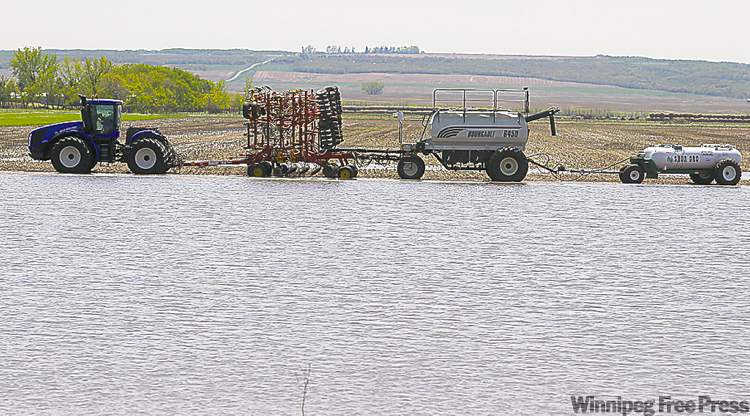
The desperation farmers feel has no limits, especially when commodity prices are so good.
Extension officials spent weeks this spring warning farmers considering broadcast seeding — sprinkling seed onto the ground either with a high clearance “floater” or from an airplane — that it was a risky venture that usually ends badly.
But when it became clear an untold number of farmers were going to do it anyway, the message changed to: here’s how you can get the best result out of a bad idea.
Now they face a new dilemma. Farmers have not only been unable to get on to their land to seed, they haven’t been able to carry out their usual spring weed control.
As it turns out, some of those “weeds” they haven’t been able to spray look remarkably like canola. And they are — sort of. Those thick patches of plants, some of which are already bursting into bloom, are volunteer canola growing from seed left on the field after last year’s harvest.
Studies have shown that about six per cent of the canola yield is left on the field after harvest. At least some of the over-wintered seed germinates and can result in a dense foliage.
So the question becomes, why seed a new crop when you already have one growing like gangbusters — especially when you can’t get into the field to seed anyway?
When it comes to the book of bad seeding ideas, this one supersedes broadcasting.
Even though the volunteer canola looks like canola and grows like canola, it is not the same high-yielding crop that was growing in the field last year.
Most of the canola varieties farmers plant nowadays are hybrids, which revert back to their parental lines in the second generation. That means the hybrid vigour known for boosting yields is gone. Some of the plants will be sterile, so they won’t produce seed at all.
Provincial extension officials say past experience with this shows farmers can expect questionable quality and yields that are about 25 per cent of normal. And crop insurance won’t cover it.
Crop protection is problematic. Some can be sprayed with a herbicide and not be killed, but as much as 15 per cent of the plants will have lost their herbicide tolerance. So how do farmers protect their self-sown canola from the other weeds popping up in the field?
The seed farmers plant every year has all been treated to withstand the diseases and insects that attack canola seedlings. Volunteer seed doesn’t have that protection.
The plant stand is uneven, so dense in some parts of the field that the plants choke each other out, and sparse in others.
Besides all of the agronomic issues, taking a volunteer canola crop to harvest is illegal. Farmers have signed contracts with their seed suppliers stipulating they will only use the seed once.
Some companies are considering whether to allow farmers to try harvesting a volunteer stand by special request, provided they register and pay the technology fees, while others have simply said no.

The few farmers who have dared to try skirting around their contractual obligations in the past have discovered these companies don’t bluff when it comes to enforcement. If they are caught, one of the penalties can be finding themselves blacklisted, unable to obtain future access to seed through the company they offended.
The only possible advantage farmers may gain from leaving these weeds in their field for part of the summer is that they act like sponges, soaking up some of the excess moisture. And when they are sprayed out or worked down, some of the nutrients they’ve consumed are recycled back into the soil.
But this story has no happy ending. Yield potential on all crops declines with each day seeding is delayed. Even if farmers do manage to sow more acres before crop insurance deadlines pass over the next couple of weeks, their chances of harvesting a good crop are slim. Manitoba farmers are truly out of time.
Laura Rance is editor of the Manitoba Co-operator. She can be reached at 792-4382 or by email: laura@fbcpublishing.com.
Related Articles
Structural experts evaluate flood damage.jpg?w=100)
Advertisement Advertise With Us
Advertisement Advertise With Us