

Getting out the money
When it comes to raking in donations, Manitoba's Tories are the new party of the little guy
Advertisement
Read this article for free:
or
Already have an account? Log in here »
To continue reading, please subscribe:

Digital Subscription
One year of digital access for only $205*
- Enjoy unlimited reading on winnipegfreepress.com
- Read the E-Edition, our digital replica newspaper
- Access News Break, our award-winning app
- Play interactive puzzles
*First annual payment billed as $205.00 + GST for one year. This annual subscription will automatically renew at $233.00 + GST every 52 weeks (10% off the regular annual price of $259.35). Offer available to new and qualified returning subscribers only. Cancel any time.
To continue reading, please subscribe:
Add Free Press access to your Brandon Sun subscription for only an additional
$1 for the first 4 weeks*
- Enjoy unlimited reading on winnipegfreepress.com
- Read the E-Edition, our digital replica newspaper
- Access News Break, our award-winning app
- Play interactive puzzles
*Your next Brandon Sun subscription payment will increase by $1.00 and you will be charged $17.95 plus GST for four weeks. After four weeks, your payment will increase to $24.95 plus GST every four weeks.
Read unlimited articles for free today:
or
Already have an account? Log in here »
Hey there, time traveller!
This article was published 16/07/2011 (5528 days ago), so information in it may no longer be current.
It’s hard to imagine the political home of Hartley Richardson and Sandy Riley as the party of the grassroots little guy, but the provincial Progressive Conservatives have slowly transformed themselves into just that in the last few years.
The province’s wealthy elites traditionally park their political capital with the Tories — and that’s still true — but it’s only half the story. According to a Winnipeg Free Press analysis of political donations over the last five years, the Tories have built a much bigger pool of donors than the NDP. Those Tory donors each gave smaller amounts, but the party still raised hundreds of thousands more than the NDP last year and enjoyed a heftier surplus.
As well, hundreds of Tory donors are brand new supporters, people who chose to write a big cheque to a political party for the first time in years.
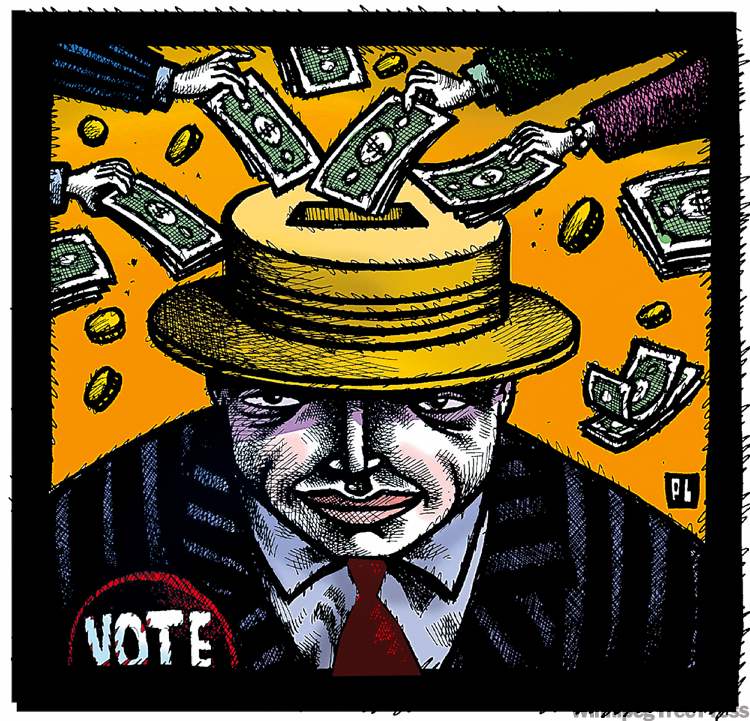
That suggests, on the eve of what’s expected to be the most competitive election in more than a decade, the Tories have a broader, more engaged base from which to draw money, volunteers and votes in the lead-up to this October’s general election.
It’s a dramatic rebound from a decade ago, when the NDP introduced new campaign finance rules outlawing union and corporate contributions and capping individual donations at $3,000. Those rules decimated the Tory’s fundraising base.
It also marks a recovery from the 2007 election that left the party $20,000 in the red and struggling to figure out how to combat the NDP’s superior riding-by-riding organization.
Over the last five years, 6,000 Manitobans have given $250 or more to a local Tory candidate, a leadership contender or directly to the party. That means their names appear on campaign finance paperwork filed annually by all parties and compiled for the first time by the Free Press.
The NDP’s major donor roster over the last five years includes only 5,200 names, and the top givers tend to be political staff and MLAs, further suggesting the party’s donor base has atrophied.
The Liberals, long the province’s struggling third party, have about 2,000 donors in their database, but their financial fortunes and their donor levels have been fairly stable.
As for unique donors, in 2010 — a critical year of coffer-padding in the lead-up to this fall’s election — the Tories had more than 1,700 names, a 70 per cent increase from the previous year.
The number of NDP contributors in 2010 remained relatively stagnant at about 1,000 despite a high-profile leadership race in 2009 that should have galvanized the party and boosted its donor lists.
That’s not to say the NDP is poor, it isn’t. But it does suggest the party hasn’t done much to broaden its appeal and reach out to new donors in the last couple of years.
Provincial NDP Secretary Nanci Morrison says the party has been able to hang on to the hundreds of new members signed up during the leadership race in 2009. And she said the central party’s finances don’t include the whopping $600,000 sitting in 57 bank accounts belonging to each riding association.
“We’re in a very healthy financial position,” said Morrison.
The NDP and the Tories have each learned lessons from U.S. President Barack Obama’s 2008 campaign, in which sophisticated databases allowed the Democrats to track voters, tailor messaging to small clusters and reach them directly for votes and money. It was built on the spin-off power of small donations.
The Tories might be doing this sophisticated American-style political fundraising better though.
The Manitoba Tories have co-opted the federal Conservative party’s software that creates detailed voter profiles based on age, location, education — even reading habits — and tailors specific, sometimes insidious mail-outs and fundraising letters designed to appeal to each group. The federal campaign focussed on getting far more people to donate small amounts of money, and the method was the envy of every other party.
May’s federal election proved just how effective micro-targeting can be, allowing Prime Minister Stephen Harper to reach voters in ethnic communities who didn’t normally vote Conservative and wage under-the-radar campaigns in ridings no one expected them to win, such as Elmwood-Transcona.
In the past, the provincial Tories had limited ways to get targeted, issue-based messages to a large number of sympathetic voters at an opportune moment — such as when a community is angry about an emergency room closure or a neighbourhood is worried about a crime wave. Though the software is still a relatively new tool for the party, it’s allowed the Tories to tease out voters who are more likely right-leaning, mould a message they’ll listen to and ask for cash using direct-mail prospecting.
One well-placed direct mailer can pull in $50,000 in donations, and it allows the party to test a message track and make voters feel their $50 or $175 is part of something bigger.
The Conservatives saw a 70 per cent increase in their donation tally between 2009 and 2010.
But Jonathan Scarth, party CEO, downplays the impact of the new software, saying it’s not that different from the party’s old Excel spreadsheets and the influx of cash has more to do with a changing political climate than the effects of micro-targeting.
“It’s all about the feeling out there that there’s change in the wind, that people are more receptive,” said Scarth.
The Tories may be pulling in more cash from more people, but they’re also spending big money to do it. The party spent more than half a million dollars last year on fundraising, including obtaining the new software.
The NDP uses the same Voter Activation Network that Obama used during the 2008 election.
It’s less of a fundraising tool and more of a voter-tracking tool that allows volunteers and staffers to keep track of supporters they meet at the door or speak to on the phone. That’s already one of the NDP’s strengths, part of a campaign machine that is traditionally stronger than the Tories’. It includes a cadre of experienced campaign volunteers, the young “poll cats” who blitz target ridings, a roster of elite campaign managers parachuted into target ridings and an election-day get-out-the-vote machine that’s the envy of most other parties.
Morrison says the party will explore how it can use the Voter Activation Network to raise funds after the election.
Until then, the NDP, which doesn’t do much direct-mail prospecting, will rely on more traditional forms of fundraising — big, fancy events such as the premier’s dinner last fall that was billed as the most successful ever, pancake breakfasts and backyard BBQs, where tickets are an affordable $24.99 — an amount that avoids the hassle of tax receipts.
Common wisdom suggests the NDP’s grassroots events would allow it to hoover up more small donations — $50 here, $25 there — to compensate for the lack of support from wealthy donors such as the Richardsons and Rileys.
In fact, the Tories now do twice as well as the NDP at obtaining small donations. In 2010, the Tories raised $646,000 in small donations, the kind that aren’t itemized name-by-name by Elections Manitoba. The NDP raised only $300,000.
About half of all Tory donors in 2010 were either brand new donors or they gave more than the $250 reporting trigger for the first time in five years.

That includes people such as retired Brandon businessman Don Porosky, who has given somewhere around $100 in years past. In 2010, he upped his donation to $300, which means he made his first appearance on the donor database.
“I was just getting kind of tired with what the NDP is doing to our province,” he said. “They promised to fix health care. They promised to do the work on the Shellmouth dam. They made a lot of promises.”
Porosky has already made his 2011 donation.
maryagnes.welch@freepress.mb.ca
Income
(Donations small and large, fundraising events, interest)
2006 (Tory leadership year)
NDP: $867,144
Conservative: $1,033,051
Liberal: $151,632
2007 (election year)
NDP: $1,383,494
Conservative: $1,126,483
Liberal: $156,109
2008
NDP: $804,586
Conservative: $961,602
Liberal: $175,213
2009 (NDP leadership year)
NDP: $1,017,053
Conservative: $996,252
Liberal: 151,074
2010
NDP: $1,117,597
Conservative: $1,676,848
Liberal: $138,802
Total donations over $250
2006 (Tory leadership year)
NDP: $551,898
Conservative: $472,422
Liberal: $78,643
2007 (election year)
NDP: $947,553
Conservative: $648,450
Liberal: $146,364
2008
NDP: $458,157
Conservative: $420,241
Liberal: $77,668
2009 (NDP leadership year)
NDP: $553,018
Conservative: $634,138
Liberal: $93,066
2010
NDP: $712,110
Conservative: $1,107,442
Liberal: $92,896
Year-end surplus
2006 (Tory leadership year)
NDP: $391,341
Conservative: $363,659
Liberal: $47,121
2007 (election year)
NDP: $199,461
Conservative: minus $18,685
Liberal: $19,885
2008
NDP: $312,389
Conservative: $810
Liberal: $36,170
2009 (NDP leadership year)
NDP: $398,881
Conservative: $163,511
Liberal: $84,569
2010
NDP: $270,870
Conservative: $428,675
Liberal: $122,429
Number of unique donors
including to party, election, campaigns
2006 (Tory leadership year)
NDP: 898
Conservative: 904
Liberal: 164
2007 (election year)
NDP: 1445
Conservative: 1642
Liberal: 407
2008
NDP: 780
Conservative: 758
Liberal: 155
2009 (NDP leadership year)
NDP: 1044
Conservative: 1023
Liberal: 181
2010
NDP: 1048
Conservative: 1737
Liberal: 187
Average donation over $250 in 2010
NDP: $679
Conservative: $637
Liberal: $496