Canada’s wartime reporters lost fight for truth
Advertisement
Read this article for free:
or
Already have an account? Log in here »
To continue reading, please subscribe:
Digital Subscription
One year of digital access for only $1.44 a week*
- Enjoy unlimited reading on winnipegfreepress.com
- Read the E-Edition, our digital replica newspaper
- Access News Break, our award-winning app
- Play interactive puzzles
*Billed as $5.77 plus GST every four weeks. After 52 weeks, price increases to the regular rate of $19.95 plus GST every four weeks. Offer available to new and qualified returning subscribers only. Cancel any time.
To continue reading, please subscribe:
Add Free Press access to your Brandon Sun subscription for only an additional
$1 for the first 4 weeks*
- Enjoy unlimited reading on winnipegfreepress.com
- Read the E-Edition, our digital replica newspaper
- Access News Break, our award-winning app
- Play interactive puzzles
*Your next Brandon Sun subscription payment will increase by $1.00 and you will be charged $17.95 plus GST for four weeks. After four weeks, your payment will increase to $24.95 plus GST every four weeks.
Read unlimited articles for free today:
or
Already have an account? Log in here »
Hey there, time traveller!
This article was published 06/08/2011 (5551 days ago), so information in it may no longer be current.
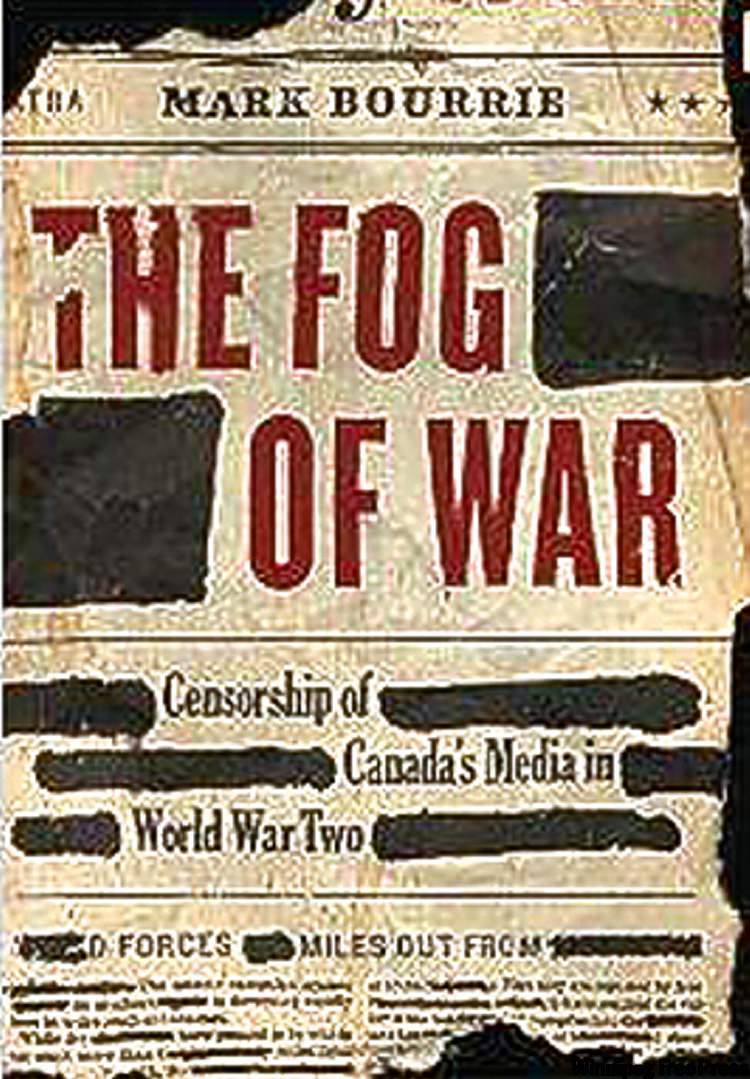
The Fog of War
Censorship of Canada’s Media in World War Two
By Mark Bourrie
Douglas & McIntyre, 340 pages, $33
In time of war, Winston Churchill insisted, truth is so precious it has to be attended by a bodyguard of lies.
That dictum presents a problem for journalists, whose central mission is to find and report the truth of any given situation.
In normal times, good journalists take pride in cutting through the spin and artifice of government press releases. But when the country is at war, that same zeal can be seen as obstructionist, unpatriotic — and occasionally treasonous.
In this informative though sometimes cumbersome work, historian and former journalist Mark Bourrie chronicles the Canadian government’s attempt to keep a lid on journalism during the Second World War.
In the process, the reader discovers many fascinating stories that were obscured, under-reported or downright suppressed as a result of wartime censorship.
There is the case of a Nazi spy who landed on the south shore of Gaspé in a dinghy launched from a U-boat in November 1942. Though he was quickly discovered and jailed, censors worked diligently to keep the story out of the public eye, while they tried to turn him into a double agent.
A month earlier, a riot at the German POW camp in Bowmanville, Ont. and the way it was violently suppressed threatened the security of Canadian prisoners in Nazi-held territories. While Canadian newspapers generally complied with requests to ignore the tale, a freelancer sold the story to Time magazine, enraging both Canadian censors and local media outlets who were angry they were scooped on the sensational news.
Bourrie, an instructor at Carleton University in Ottawa, puts his major focus on the complex relationship between official censors and media outlets. Though it would be tempting to view the censors as the overbearing bad guys in every case, Bourrie is usually sympathetic, concluding that they were thoughtful and well-intentioned in their effort to help Canada win the war.
The people chosen to enforce censorship during the war were themselves journalists, though most went on to find other work after 1945. Wilfred Eggleston, for instance, went from being the chief English-language censor to the founder and first director of Carleton’s school of journalism.
When the war ended, most Canadian publishers and editors had kind things to say about the role the censors played. That wasn’t a universal view, though.
In Toronto, the Globe and Mail was a consistent critic of the censors, arguing that they often used their powers to protect ministers and the government from embarrassment. Many Quebec newspapers, prone to supporting the Nazi Vichy regime and other fascist causes, posed the greatest problems to the official censors.
Individual battles and arguments between editors and censors are well-documented in the book, as are the issues they debated. While Bourrie credits the fighting spirit of some journalists to get their work published, he doesn’t show much regard for their analytical abilities. “If they had wanted to write thoughtful analyses of the war effort, few members of the press were skilled enough in history, geography, and military strategy to have done a credible job,” he says.

In fact, Bourrie says most Canadian journalists reacted to censorship by playing dead. Investigative reporting all but stopped. It was not mainstream journalism’s finest hour.
At some points, reading The Fog of War seems like hard work. It has the feel of an academic thesis, with not enough attention to dramatic storytelling. Eggleston and chief French-language censor Fulgence Charpentier seem like complex characters, and it may have been helpful to focus more on their personal struggles.
Even so, this is a well-researched chapter in Canadian history that has not been widely studied up to now. It raises important questions about how journalists should react when faced with difficult obstacles to their primary mission of reporting the truth.
Cecil Rosner is the managing editor of CBC Manitoba.