

A stadium full of memories
It's where Sean Brennan bonded with his father, Bill; It's where Don Keplin first saw the player who would later save his wife's life; It's where Reta Taylor never missed a season in 58 years

Advertisement
Read this article for free:
or
Already have an account? Log in here »
To continue reading, please subscribe:

Digital Subscription
One year of digital access for only $205*
- Enjoy unlimited reading on winnipegfreepress.com
- Read the E-Edition, our digital replica newspaper
- Access News Break, our award-winning app
- Play interactive puzzles
*First annual payment billed as $205.00 + GST for one year. This annual subscription will automatically renew at $233.00 + GST every 52 weeks (10% off the regular annual price of $259.35). Offer available to new and qualified returning subscribers only. Cancel any time.
To continue reading, please subscribe:
Add Free Press access to your Brandon Sun subscription for only an additional
$1 for the first 4 weeks*
- Enjoy unlimited reading on winnipegfreepress.com
- Read the E-Edition, our digital replica newspaper
- Access News Break, our award-winning app
- Play interactive puzzles
*Your next Brandon Sun subscription payment will increase by $1.00 and you will be charged $17.95 plus GST for four weeks. After four weeks, your payment will increase to $24.95 plus GST every four weeks.
Read unlimited articles for free today:
or
Already have an account? Log in here »
Hey there, time traveller!
This article was published 19/11/2011 (5372 days ago), so information in it may no longer be current.
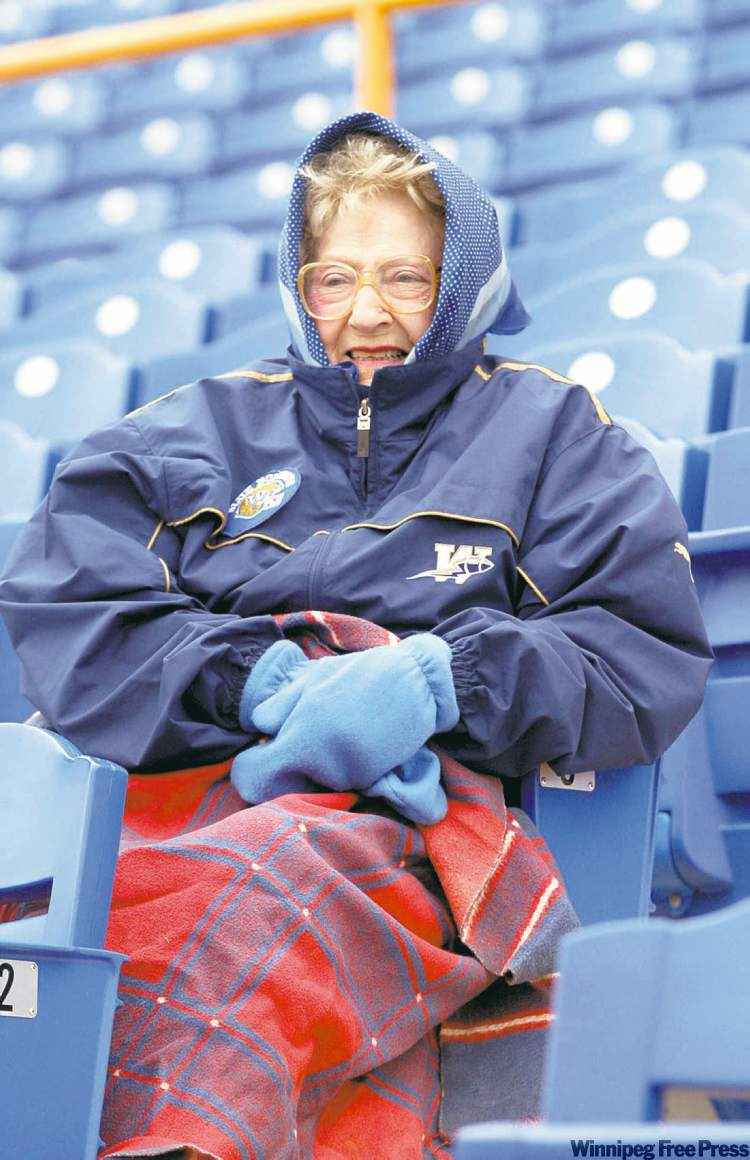
RETA Taylor didn’t know if she’d live long enough to see her beloved Winnipeg Blue Bombers at the new stadium now rising east of Pembina Highway.
She was pushing 100, after all, and had cherished the Bombers season tickets she’d held since 1949 — back when the home team played at rickety Osborne Stadium, where the Great-West Life building now stands, and women wore dresses to games.
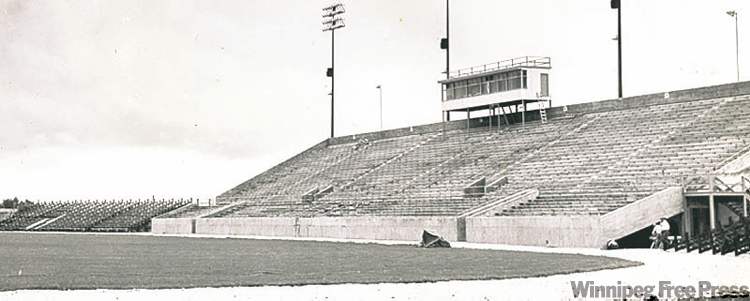
In the late summer of 1953, Reta and her husband, George, attended the official opening of Winnipeg Stadium, a 15,000-seat structure constructed on what was then mostly open prairie, surrounded by dirt roads and potholes.
The stadium evolved over the years; a section was added to the north end (1966), then upper decks were erected on both the west (1972) and east (1978) grandstands to double the original capacity.
The players came and went over the next 58 seasons. But Reta Taylor stayed — even through the loss of her husband, George, in 1966. She stayed through two knee surgeries, even if her daughter, Donna Evrick, had to cart her mother to her seats in a wheelchair at the turn of the century.
“(The Blue Bombers) were her boys,” said Donna, who, at age two, used to sit on the shoulders of legendary head coach Bud Grant when the family would picnic while watching practices at the Canada Packers plant in the 1950s.
Alas, Reta never made it to see the new stadium, set to open next season. She died in April, at age 98. So when the Bombers opened their unlikely 2011 campaign, something was missing from Section C, just behind the home team’s bench on the west side stands.
“We all had good cries,” Evrick said of the small community of fans who were rooting for Taylor to see her Bombers play in their third stadium. “We were family.”
For many Bombers faithful, the last game will carry a tinge of loss, too. Because when they leave the Stadium on Sunday after the Bombers’ East division final with the Hamilton Tiger-Cats, there is no coming back.
Win or lose, the tiny patch of prairie real estate that was the gridiron theatre shared over the decades by the likes of Jack Jacobs and Ken Ploen and Tom Clements and Bob Cameron and Milt Stegall will take a final curtain call.
“It’s going to be sad because there are a lot of memories there,” Evrick noted. “I watched a lot of players get rewarded out there. Just a lot of heartfelt memories, the good and the bad and the records we broke.
“But the joy of taking my mother was the biggest thrill of my life.”
You see, that’s the thing about Canad Inns Stadium. It was constructed of cement and steel that soon will be reduced to rubble. But the shared experiences of generations of fans will survive the wrecking ball.
Taylor died just a few weeks before the Bombers opened training camp, her season tickets renewed. But she didn’t leave this mortal coil empty-handed. On her 90th birthday, former quarterback Khari Jones presented her with a football signed by the entire team, which Reta treasured.
When they buried Reta Taylor, she took the football with her.
— — —
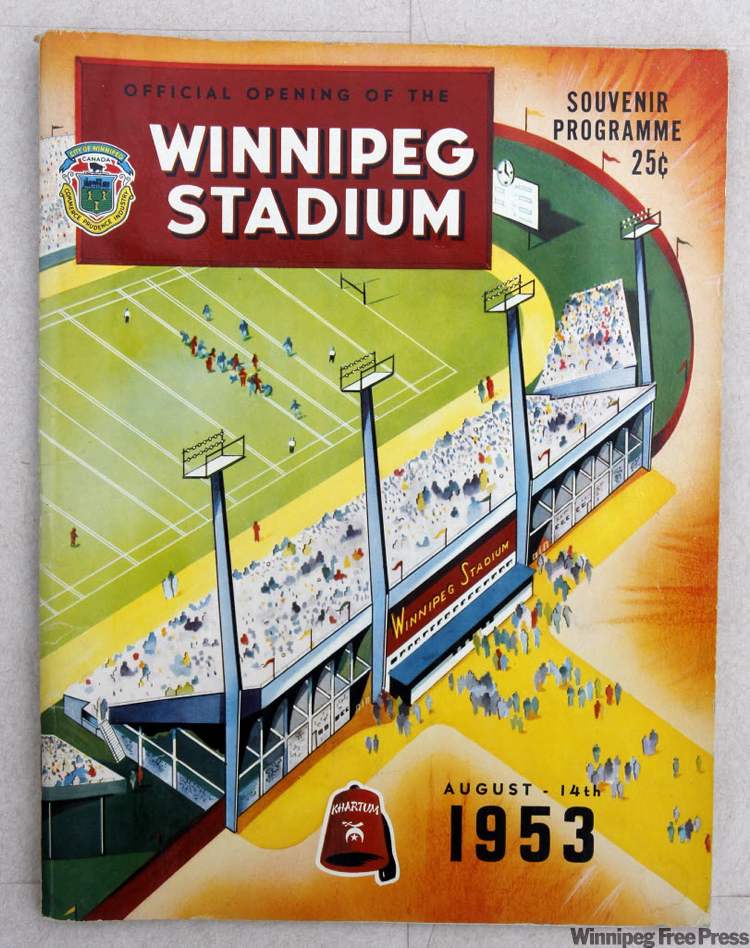
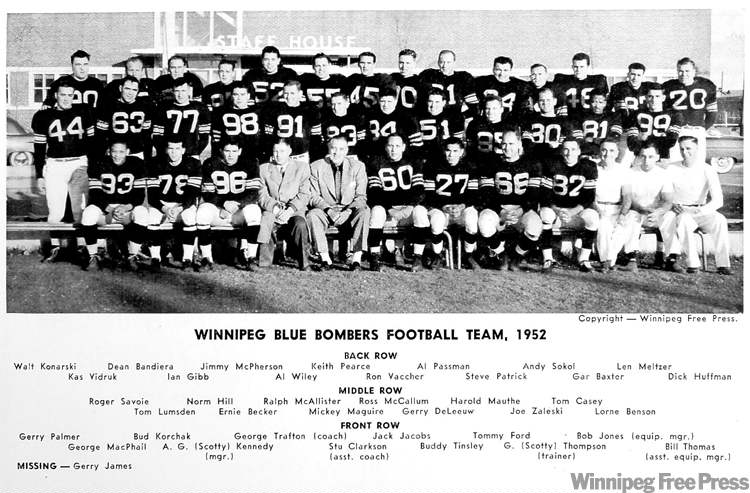
There was no shortage of pomp and circumstance on the Saturday afternoon of Aug. 14, 1953, when Winnipeg Stadium was officially opened.
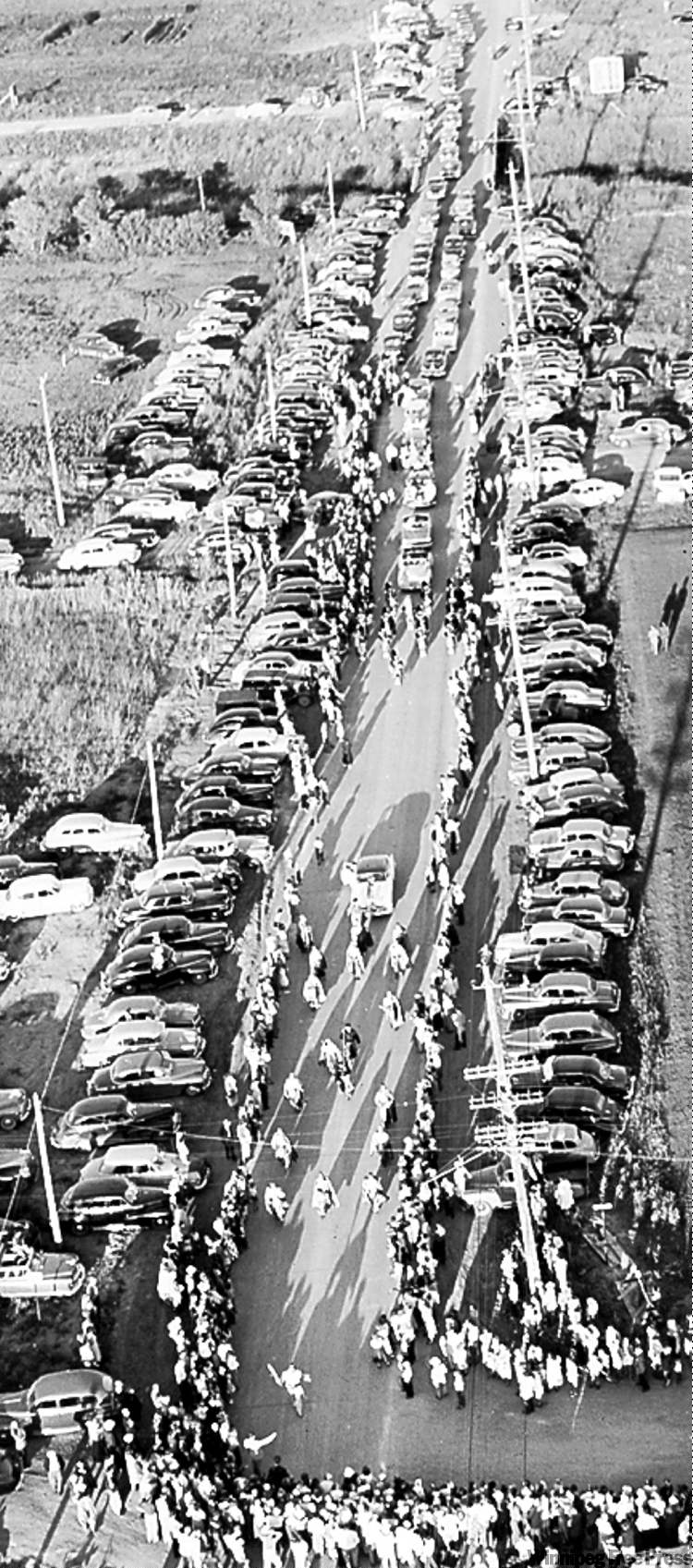
A crowd of 15,600 flocked to the Bombers’ new digs for an exhibition game with the Ottawa Rough Riders — the largest gathering for a sporting event in Winnipeg at the time outside of horse racing (which led to what the Free Press later described as the “worst traffic jam the city had ever seen.” Progress has its price).
Hockey broadcasting icon Foster Hewitt, the master of ceremonies, declared, “Winnipeg Scores!” There were bands, banners, fireworks. Shriners led a parade down St. James Street into the stadium that included convertibles carrying players from both teams.
There was a tittering appearance by French-born Hollywood actress Corinne Calvet, who wore a flaming red, low-cut dress. Calvet’s function at the ceremony was dutifully described as “brief and vivacious.”
The 300,000-watt lights were turned on, too.
“Great day,” recalled Don Ramage, then a 27-year-old Bombers fan who would in his lifetime witness in person 42 Grey Cups. “It looked a lot bigger (than the old Osborne Stadium, which sat about 7,000) and glorious. It wasn’t finished the way it is now… but it looked like a really terrific place. It looked big time. You were moving into another world, really. It wasn’t the biggest, but it looked like the modern era of the 1950s.”
Now 58 years later, Ramage, 85, still has his season tickets. And he can’t wait until next season, walking into the Bombers’ new, $190-million facility next summer.
“I think it will more glorious still,” said Ramage. “It’s going to be a step up. It’s going to be a great stadium, I’m sure.”
Ramage pauses and chuckles. “I’ve got to last a few more months to get there. But if I’m not there, my kid’s son will be there. They’ll follow through, I’m sure.”
There are three tickets in the family, after all. Ramage, his son and his grandson. It’s a common, generational thread found throughout the longtime faithful; how both territory and family history are as much apart of the old stadium as the athletes they adopted as their heroes.
For every Jack Jacobs or Ploen, there is a Don Ramage. For every Joe Poplawski or Chris Walby, there’s a Sean Brennan, who reluctantly took up an invitation to attend his first game with his father, Bill, in 1979. “But,” says Brennan, now 40, “I never had to be asked twice again.”
Brennan was eight years old. They drove to the game in his father’s old Buick and parked across St. James Street.
Section D, row 21, the west side lower deck.
“Those seats were really special because Kenny Ploen sat a row down and a few seats over,” Brennan said. “A little later we had alumni like Poplawski and Walby and Willard Reaves who sat in the area.”
“In addition to identifying with the Bombers, I identify very strongly with my seats, my perspective of the game,” he added. “There’s some family pride in that as well.”
Brennan grew to know the fans who sat in their little orbit. To this day, he remembers a man named Henry who sat right in front of them with his two nieces. “When I was a kid,” he said, “the first game of the season was getting reacquainted with all our friends that we saw at the Bombers games.”
For many, those seats, that place, became home for a sentimental journey that stretches far beyond the white lines. Brennan’s father was his best friend. On most weekend games, the routine was for father and son to watch their grandson, Rickey, play hockey. Then they’d head off to the stadium, and after that it was off to the family hunting lodge.
In the winter of 2008, however, Bill lost his battle with cancer.
“It was very difficult to go to the games without him,” said Brennan, a crown prosecutor. “I think if I didn’t have my son with me… boy, it would have been really tough. I couldn’t have gone back.”
Asked about the significance of taking his son to the stadium, like his father before him, Brennan replied: “Let me answer your question this way. At the eulogy at my dad’s funeral, I said he taught me to love what he loved, and one of those things was the Winnipeg Blue Bombers.”
Indeed, the personal tales are as deep and layered as the team’s storied 82-year history. In Section 4 of the upper deck you’ll find Yukio Morita, 81, who used to listen to Bombers games in the 1940s on a battery-operated radio in southern Manitoba, where his Japanese-born parents worked on a sugar beet farm rather than risk the family being split up in internment camps during the Second World War.
Young Yukio had never seen a football game, but he listened to the play-by-play intently and scribbled down yardage and completions on a piece of scrap paper. “I’m a stats man,” explained Morita, who grew up to become an accountant.
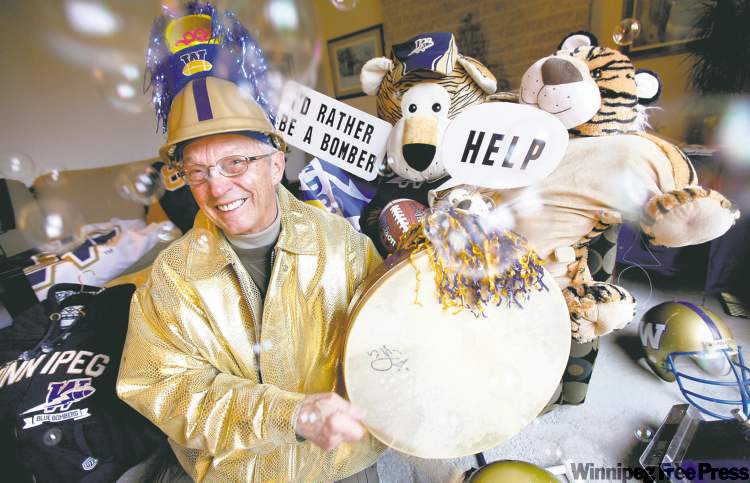
In the first row on the east side stands, directly behind the opposing team’s bench, Irv Koch will be wearing a hat that blows bubbles. Or maybe a gold Elvis jacket. He’ll be blaring a siren to rattle the opposition or clanging a locomotive bell. This Sunday, he’s planning to take a couple of stuffed tigers with him, too.
Now in his early 70s, Irv Koch used to try to sneak into the old Osborne Stadium as a boy. “I always loved the Bombers,” he said. “I can’t really say why. It just happened, I guess.”
Koch is part of a group of 30-something fans who bus to each game from Stonewall. It began with a group of 12. Now there are over 30, and more on a waiting list. In fact, a handful of the crew this year chipped in to buy an old Greyhound for $30,000.
Why? Because they’re going to need a washroom for the extra time it will take to get to the new stadium in the south end of the city.
“What the heck,” Koch reasoned. “You have to enjoy life.”
Still, old memories die hard on a football field. And the impact of the Bombers on their fans over almost six decades has manifested itself in countless, indelible ways.
Don Kelpin was also in attendance on Aug. 14, 1953, when that buxom French actress cooed to the crowd: “I think the Bombers are going to win. I felt their muscles!”
Kelpin distinctly remembers Jacobs — not surprising because it was the quarterback from Holdenville, Okla., whose dynamic play was widely considered the major reason the Bombers outgrew the confines of Osborne Stadium.
However, Kelpin looks back fondly on another Bomber on the field that day — a tight end/defensive lineman named Norm Hill.
Hill was born and raised in Winnipeg’s North End, but he played just three seasons for the Bombers in the early ’50s after winning a Grey Cup with the Calgary Stampeders in 1948.
Even Kelpin probably didn’t pay much attention to Hill that day. But that all changed in 1992 — almost 40 years later — when Kelpin’s wife suffered a brain aneurysm.
The man who saved his wife’s life on the operating table was Bomber-turned-neurosurgeon Dr. Norm Hill.
“I couldn’t thank him enough,” said Kelpin, who turns 82 this year. “It’s always something that’s stayed with me.”
So has Kelpin’s wife. They’ve been happily married 53 years and counting.
— — —
Oh, speaking of marriage…
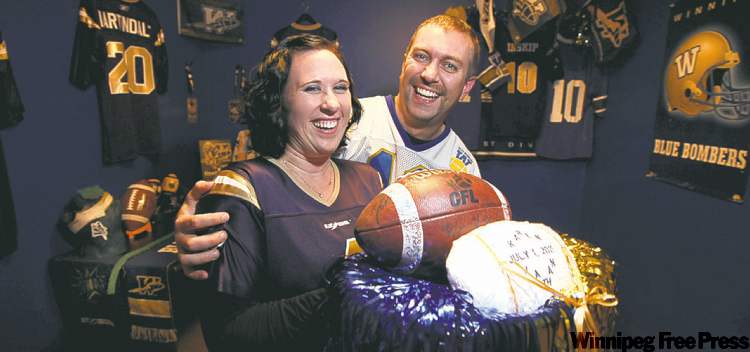
Nathan Martindale got his first season tickets in 1995 — a high school graduation present from his mother Carol, a monster CFL fan. Martindale became a fixture in Section S, along with up to 10 of his buddies, who would attend every game.
Unbeknownst to Martindale, his future bride had tickets a few rows behind them. A few years ago, they met at the wedding dance of a mutual friend.
“She looked at me and said, ‘Hey, you’re the guy who used to go to the Bombers games,’ ” Martindale remembers. “I said, ‘Used to? I’m still there!'”
Long story short, Nathan and Karen’s first date was a Banjo Bowl. This past summer, on July 1, they were married. On the same afternoon, the Bombers beat the Hamilton Tiger-Cats 24-16.
The couple had their wedding photos taken at the stadium, of course. As a surprise, their wedding party presented the newlyweds with two Bombers jerseys with their names on the back.
“I had No. 20, Karen had No. 11,” Nathan said. “20-11. It worked out perfectly.”
Martindale has his own “Blue and Gold room” in the couple’s house. His mother found the gold carpet and drapes.
It’s his shrine to the team, adorned with jerseys (about 10) and memorabilia that includes everything from Bombers oven mitts to patches of old turf that his mother cut out (after it was removed) with a pair of scissors she produced from her purse at a team practice.
“Some of my best memories are going to Bomber games with my friends and my family, and the big wins over the years,” Martindale said. “Those Friday night games in July when it’s still plus-30 at 6 p.m. — I love it. That’s one side of football in Winnipeg. The other side is the snow and the cold and the wind. It’s a Winnipeg thing. It’s a Prairie thing.
“I have a million stories about the stadium and I’ll shed a tear when it’s demolished one day. It will be emotional for me.”
Sure, Martindale, a teacher, is a pup by some season-ticket holder standards. “It’s not the same as people who are in their 80s, but still it’s been half my life sitting in those seats at that stadium.”
Sean Murray, 28, agrees.
“I don’t have a lifetime invested,” said Murray, who attended his first game in 1991. “But it’s my lifetime.”
Murray was just seven when ushered into the stadium by his aunt and uncle.
“Completely overwhelming,” he recalled. “It was my first professional sports game. Just walking in and there’s all these people, right? And just watching everybody else around me go crazy. Unbelievable.”
And like many fans, both old and young, memories of games at the stadium are often distilled to moments or images — on and off the field. Maybe sharing a beer in the parking lot with friends before opening kick-off. Maybe the time you had to scrape the ice off the bleachers after a November snowstorm.
Said Murray: “I can name you some players from pretty much every team we’ve had from ’88 or ’89. But I can tell you pretty much everybody I’ve gone to a game with. I can tell you about the big games, what we did before and afterwards.”
Case in point: July 27, 2007, Milt Stegall’s 138th touchdown reception, breaking the CFL record. “We had friends in town,” Murray recalled. “We went to the Charlie (the old Charleswood Hotel) and sat on the patio. It was a beautiful night.”
“It’s what I look forward to,” he added. “Rushing home from work, throwing on the shorts, getting the dress shirt off and throwing on the jersey. Then sitting out in the sun for three hours. It’s awesome.”
Yet it’s curious that the 28-year-old Murray is far more reluctant than most in the crowd to leave the notoriously bawdy Section S.
Why? Because it’s familiar. He knows the fans around him. He knows which parking lot to find his buddies in.
Sean Giesbrecht, 30, can relate. He has grown attached to an aging facility where the lights on the rafters seem to be cross-eyed and you can take a whiz in the legendary washroom trough during a minus-20 degree game and watch a lost mitten float downstream.
“Absolute perfection doesn’t have to come in a strict order or pattern,” Geisbrecht said. “It’s a neat way to look at the stadium, because there’s all these disorganized parts that bring together 30,000 people in a common purpose.
“The new stadium’s going to be great… but everything’s being replaced with this cookie-cutter sort of world. The (old) stadium isn’t the Walmart or Home Depot version. It’s got its own little quirks and nuances.
“I like how the upper concession is probably day-old nachos and probably week-old popcorn. Not everything has to be perfect.”
But will everything be perfect when the final gun sounds at the stadium on Sunday?
For the long-suffering faithful of a team that hasn’t won a Grey Cup since 1990 — the longest drought in the CFL — the outcome might overshadow their last literal hurrah.
“The main focus is the game,” Murray reasoned. “Winning the Grey Cup means more to me than the building. That’s what I’m focusing on. They say the average male thinks about sex once about every eight seconds. For me, when the Bombers are in the playoffs, I’m thinking about that game every eight seconds.
“But I’ll probably take some time out in the fourth quarter — hopefully, we’ve got a big lead and the crowd is going crazy — and kind of take a look around and soak it in.”
Brennan, too, will not leave the stadium one final time without reminiscing about the ghosts of football’s past. But not with a heavy heart.
“It feels very much like the end of an era for me. So, yes, I’m feeling sentimental about the old place,” he said. “Last game (of the regular season) I was starting to feel the emotions even though I knew there was a playoff game coming up. I don’t know. It’s a very different situation from losing the Jets when you’re progressing to a new facility. The Bombers seem as strong or stronger than they have, coming off a record-setting attendance year, and I’m hoping a record-setting year for profits and stability.
“I’m thinking everything’s rosy and I have full expectations that I’m going to be in comparable seats in the new place,” Bill Brennan’s son concluded. “I think it’s going to be the start of a new tradition and a curtain on my attending with my dad. It’s going to be a new start with my son and the lion’s share of what he remembers (years from now). I’m looking forward to the new chapter.”
When dusk and the final curtain fall on the old stadium, Sean Brennan will be thinking about his father.
Donna Evrick will be thinking of her mother.
And Don Kelpin, as always, will drive back home to Stony Mountain with his son. Along the way, they will stop at the Salisbury House for a coffee and cheeseburger and talk about the game.
“At my age,” he said, “it’s one of the nice outings I can have. It keeps me going.”
If they’re lucky, they’ll be talking about next week.
If not, they’ll be talking about next year, and a new beginning.
Generations of memories await.
randy.turner@freepress.mb.ca
Randy Turner
Reporter
Randy Turner spent much of his journalistic career on the road. A lot of roads. Dirt roads, snow-packed roads, U.S. interstates and foreign highways. In other words, he got a lot of kilometres on the odometer, if you know what we mean.
Our newsroom depends on a growing audience of readers to power our journalism. If you are not a paid reader, please consider becoming a subscriber.
Our newsroom depends on its audience of readers to power our journalism. Thank you for your support.
Randy Turner
Reporter
Randy Turner spent much of his journalistic career on the road. A lot of roads. Dirt roads, snow-packed roads, U.S. interstates and foreign highways. In other words, he got a lot of kilometres on the odometer, if you know what we mean.
Our newsroom depends on a growing audience of readers to power our journalism. If you are not a paid reader, please consider becoming a subscriber.
Our newsroom depends on its audience of readers to power our journalism. Thank you for your support.
Related Articles
Are Bombers amusing pretenders or true legends? Bombers coverage to remain on CJOB Bombers to face Lions in Grey Cup





Advertisement Advertise With Us
Advertisement Advertise With Us
History
Updated on Saturday, November 19, 2011 11:16 AM CST: Corrects "Nancy Martindale" to "Karen Martindale" in cutline
Updated on Saturday, November 19, 2011 12:15 PM CST: Corrects spelling of "Keplin" to "Kelpin"