Manitoba Opera’s Salome suitably relentless
Advertisement
Read this article for free:
or
Already have an account? Log in here »
To continue reading, please subscribe:

Digital Subscription
One year of digital access for only $205*
- Enjoy unlimited reading on winnipegfreepress.com
- Read the E-Edition, our digital replica newspaper
- Access News Break, our award-winning app
- Play interactive puzzles
*First annual payment billed as $205.00 + GST for one year. This annual subscription will automatically renew at $233.00 + GST every 52 weeks (10% off the regular annual price of $259.35). Offer available to new and qualified returning subscribers only. Cancel any time.
To continue reading, please subscribe:
Add Free Press access to your Brandon Sun subscription for only an additional
$1 for the first 4 weeks*
- Enjoy unlimited reading on winnipegfreepress.com
- Read the E-Edition, our digital replica newspaper
- Access News Break, our award-winning app
- Play interactive puzzles
*Your next Brandon Sun subscription payment will increase by $1.00 and you will be charged $17.95 plus GST for four weeks. After four weeks, your payment will increase to $24.95 plus GST every four weeks.
Read unlimited articles for free today:
or
Already have an account? Log in here »
Hey there, time traveller!
This article was published 21/11/2011 (5382 days ago), so information in it may no longer be current.
Opera has never been an art form to hold anything back. But even within the genre itself, Salome is — literally — one tough, depraved act to follow.
Manitoba Opera’s daring choice of Richard Strauss’ staged tone poem sung in German (with English surtitles) took its viewers into the blackest heart of darkness Saturday night. Based on Hedwig Lachmann’s translation of Oscar Wilde’s play Salomé, the 110-minute production (no intermission) directed by MO’s Larry Desrochers featured an expanded Winnipeg Symphony Orchestra led by maestro Tyrone Paterson. The three-show run that closes next Friday notably marks only the company’s second staging of the 20th century classic in 23 years.
The gritty one-act opera based on the New Testament story of the beheading of John the Baptist deals with incest, prophecy and madness — and yes, ultimately, love. Young Princess Salome has become obsessed with prophet Jokanaan, who is imprisoned by her stepfather/uncle, King Herod. He, in turn, lusts for her and cajoles her to dance for him. She agrees only after he promises he will give her whatever she desires — in this case, the Baptist’s head on a silver platter.
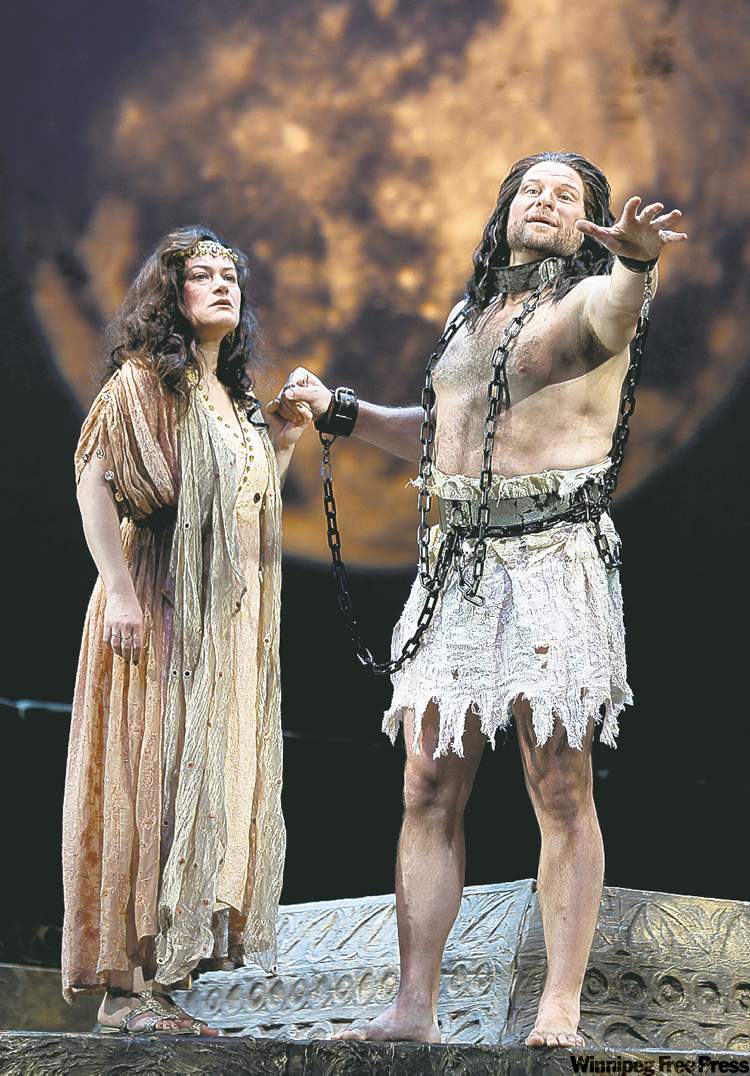
U.S.-based soprano Mlada Khudoley’s riveting portrayal of the title role ranged from tempestuous, fist-pounding mannerisms to lovesick, vengeful insanity. The Russian-born powerhouse’s well-paced delivery allowed her to save her last breath — if it were possible — for her final declamatory “If you had seen me, you would have loved me” that is the impetus for this opera. Strauss’ dissonant, through-composed score proved no match for this dynamo, with her soaring voice effortlessly projecting over the knotty, Wagnerian-scale orchestration.
Tenor Dennis Petersen crafted his lecherous Herod, at times, as a sickeningly juvenile ruler who plays peekaboo with Salome during her erotic Dance of the Seven Veils, choreographed by Brenda Gorlick. His penetrating voice grew more desperate as he attempted to seduce his stepdaughter in Dance for me, Salome, stamping his feet in a sudden, volatile outburst after the princess insists on her prize. His wife/sister-in-law Herodias, sung by the incomparable Canadian mezzo-soprano Judith Forst, sputtered as a long-suffering partner, attempting to pierce her husband’s growing obsession for Salome like a knife.
Special mention must be made of Winnipeg baritone Gregory Dahl’s chain-shackled Jokanaan, who immediately asserted his booming presence even from the depths of the cistern with his first vocal entry, “After me, will come one.”
The charismatic singer brought both requisite strength and nobility to the role, with his robust voice trembling with fury as he foretold the coming of the Son of Man.
Lyric tenor Michael Colvin performed Captain of the Guard, Narraboth with focused clarity, growing increasingly agitated as Salome ignores his advances for Jokanaan. Mezzo-soprano Marcia Whitehead’s Page sets the stage for the entire tragedy to unfold with her ominous “Something terrible will happen.”
The chorus of five Jews (Mark Thomsen, Michel Corbeil, P.J. Buchan, Keither Klassen and David Watson) brought contrapuntal might to the stage with the two Nazarenes (Mark Bodden and Peter Klymkiw) telling of miracles.
Intriguing directorial choices underscored the love triangle — if you will — between Herod, Salome and Jokanaan, with Salome quietly slipping a veil into the cistern while also gravitating toward it during her famous striptease, creating multiple layers of subtext. The closing image of Salome bathed in white light after being killed by Herod’s guards also hinted at her own redemption (by love?) — a purifying baptism of sorts that made her a sympathetic character to be pitied, not abhorred.
The production also features Boyd Ostroff’s set design created for the Opera Company of Philadelphia with a large, luminous moon radiating throughout the show, as well as blood-red lighting effects by Bill Williams. Costumes designed by Richard St. Clair include jewel-encrusted robes for Herod and his wife.
Salome is not an opera for the faint of heart — nor is it the safest box-office draw. Salome’s chilling aria Ah, you would not let me kiss your mouth, sung to the bloodied, severed head before she does just that, still resonates with horror even in the 21st century.
There are no jocular drinking songs or bands of dancing gypsies for levity. Instead, Salome is a relentless opera that must be seen by any serious opera lover. After nearly a quarter-century hiatus, thankfully, MO audiences have been given that chance.
holly.harris@shaw.ca
CONCERT REVIEW
Manitoba Opera
Salome
Saturday, November 19
Centennial Concert Hall
Attendance: 1,850
(Four stars out of five)
Holly Harris writes about music for the Free Press Arts & Life department.
Our newsroom depends on a growing audience of readers to power our journalism. If you are not a paid reader, please consider becoming a subscriber.
Our newsroom depends on its audience of readers to power our journalism. Thank you for your support.