True love is timeless, but so is tragedy
Advertisement
Read this article for free:
or
Already have an account? Log in here »
To continue reading, please subscribe:

Digital Subscription
One year of digital access for only $205*
- Enjoy unlimited reading on winnipegfreepress.com
- Read the E-Edition, our digital replica newspaper
- Access News Break, our award-winning app
- Play interactive puzzles
*First annual payment billed as $205.00 + GST for one year. This annual subscription will automatically renew at $233.00 + GST every 52 weeks (10% off the regular annual price of $259.35). Offer available to new and qualified returning subscribers only. Cancel any time.
To continue reading, please subscribe:
Add Free Press access to your Brandon Sun subscription for only an additional
$1 for the first 4 weeks*
- Enjoy unlimited reading on winnipegfreepress.com
- Read the E-Edition, our digital replica newspaper
- Access News Break, our award-winning app
- Play interactive puzzles
*Your next Brandon Sun subscription payment will increase by $1.00 and you will be charged $17.95 plus GST for four weeks. After four weeks, your payment will increase to $24.95 plus GST every four weeks.
Read unlimited articles for free today:
or
Already have an account? Log in here »
Hey there, time traveller!
This article was published 26/11/2011 (5395 days ago), so information in it may no longer be current.
The poignant message left by a modern setting of Romeo + Juliet is that violence and tragedy are all too common among young people.
It was so in 15th-century Verona, where Shakespeare’s iconic tragedy plays out, and is also in present-day Jerusalem, where the Royal Manitoba Theatre Centre has set its first Romeo and Juliet in 44 years. And no one in the opening night audience Thursday could fool themselves into thinking that the same thing is not happening nightly among knife-wielding youth on Winnipeg’s mean streets.
The love story always gets top billing in Romeo and Juliet, but hate is the undisputed winner. Youth is sacrificed in the service of ancient grudges between warring houses. You only have to look at the death toll of impressive teens: Tybalt, Mercutio, Paris, Romeo and Juliet.
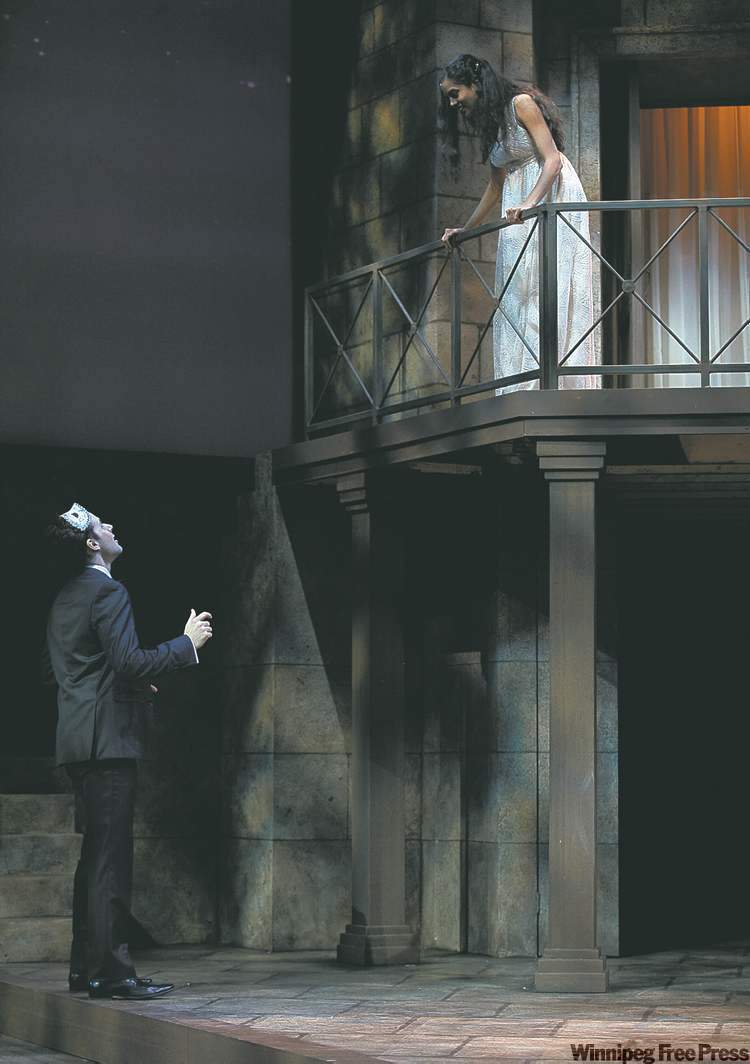
Director Steven Schipper has attempted to draw new meaning from the old story by making the Capulets Muslim and the Montagues Jewish, and locating them in a city where there are constant tensions between those cultures. Both sides regularly admonish the other for slights or provocations and Schipper doesn’t take sides, implying that both sides are to blame. As Romeo’s friend Mercutio lies dying, he curses both families with the words, “a plague on both your houses.”
The effective RMTC revival ends with the family patriarchs clasping arms over the bodies of their dead children and vowing to end their bitter enmity. That shard of hope fades in an eternally disputed city like Jerusalem, where Jews and Arabs have been in conflict for thousands for years. It is hard to believe that any ceasefire, no matter how genuine its declaration, will hold very long.
Like any modern interpreter of Romeo and Juliet, Schipper has to grapple with the general familiarity of the story of the doomed lovers. He adds a visual exoticism by having all the Capulets played by actors of colour in Michael Gianfrancesco’s radiant, stone-walled settings, expertly lit by designer Michael J. Whitfield.
Schipper’s attempts at contemporizing mostly succeed in enhancing the drama. It’s quite a jolt to have the Shakespearean version interrupted by a couple of bursts from Uzi submachine gun toted by bodyguards or the Prince trying to quell a street brawl. The timelessness of the piece is underlined by how the ancient Persian 72-string santur shares the stage with a BlackBerry Romeo whips out to show a photograph of his beloved.
A brilliant addition to Romeo + Juliet is the never-before-seen combat game in which the blindfolded Tybalt and Mercutio attack each other with lengths of pipe that serve as sword-like weapons. It succinctly and simply captures the folly of pointless battle, in which the participants lash out at unseen foes.
What is surprising is that in a story about bad blood between families — and plenty is spilled in the 165-minute tragedy — not a drop is seen.

The cast, a mixture of locals and imports, is skilled, led by Marc Bendavid, who is a Romeo worth dying for. His sexy swain sells impulsive youth, wavy-haired insouciance and intelligent self-awareness. The long-limbed Pam Patel is a convincing moonstruck 13-year-old and captures the sugar rush of sweet infatuation. Although she is up to the challenge of making the language clear, it doesn’t always feel as if it is deeply felt.
The pair are almost upstaged by leader-of-the-pack Mercutio, played by the scene-stealing Gareth Potter. His roguish charm and ribald horseplay enliven every moment he’s on stage. RJ Parrish’s bad-ass Tybalt with his razor-sharp sideburns is a physically scary warrior (“Talk of peace, I hate the word.”), ever-ready to crush the enemy. Ari Weinberg’s Benvolio is a geeky peacekeeper.
R&J’s enablers, her Nurse (Andrea Davis) and Friar Laurence (Kevin Klassen), are appealingly played. Davis is earthy and funny as Juliet’s de facto parent. Klassen is also something of a friendly father figure to what the friar calls his “young waverer.”
If the romance in Romeo + Juliet does not evoke a tear, maybe the sight of all those wasted young lives will.
kevin.prokosh@freepress.mb.ca