Greener Beemer
New i3 and i8 will be fast & efficient
Advertisement
Read this article for free:
or
Already have an account? Log in here »
To continue reading, please subscribe:
Digital Subscription
One year of digital access for only $75*
- Enjoy unlimited reading on winnipegfreepress.com
- Read the E-Edition, our digital replica newspaper
- Access News Break, our award-winning app
- Play interactive puzzles
*Billed as $5.77 plus GST every four weeks. After 52 weeks, price increases to the regular rate of $19.95 plus GST every four weeks. Offer available to new and qualified returning subscribers only. Cancel any time.
Monthly Digital Subscription
$4.99/week*
- Enjoy unlimited reading on winnipegfreepress.com
- Read the E-Edition, our digital replica newspaper
- Access News Break, our award-winning app
- Play interactive puzzles
*Billed as $19.95 plus GST every four weeks. Cancel any time.
To continue reading, please subscribe:
Add Free Press access to your Brandon Sun subscription for only an additional
$1 for the first 4 weeks*
- Enjoy unlimited reading on winnipegfreepress.com
- Read the E-Edition, our digital replica newspaper
- Access News Break, our award-winning app
- Play interactive puzzles
*Your next Brandon Sun subscription payment will increase by $1.00 and you will be charged $17.95 plus GST for four weeks. After four weeks, your payment will increase to $24.95 plus GST every four weeks.
Read unlimited articles for free today:
or
Already have an account? Log in here »
Hey there, time traveller!
This article was published 02/12/2011 (5289 days ago), so information in it may no longer be current.
BMW is set to launch its new i division, a sub-brand that keys on sustainable mobility. The brand’s objective is not to sell hundreds of thousands of electric cars but to focus on future transportation (and the electrified world that is rapidly emerging) through groundbreaking innovations.
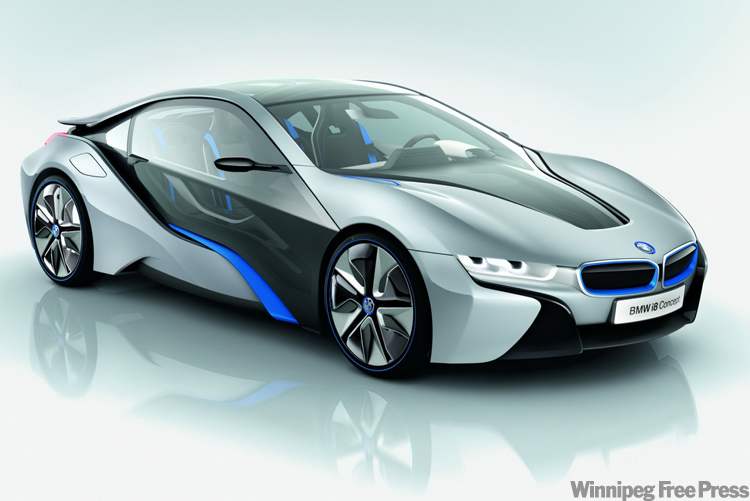
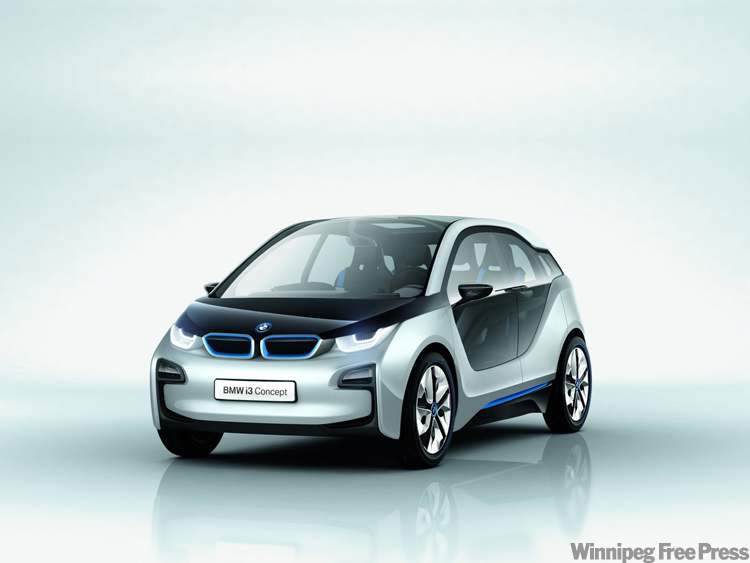
The first two cars will be the i3, an all-electric commuter car, and the i8. The latter is a radical speedster that uses a hybrid powertrain to deliver both efficiency and performance. At this point, both are concepts. However, the production versions will be launched in 2013 and 2014, respectively.
The advantage the new i cars share is that, unlike so many electric/hybrid-electric cars, these two were purposely designed to accommodate the powertrain of the future — in this instance, the platform was designed to house and protect the battery pack as well as accommodate the power electronics and running gear.
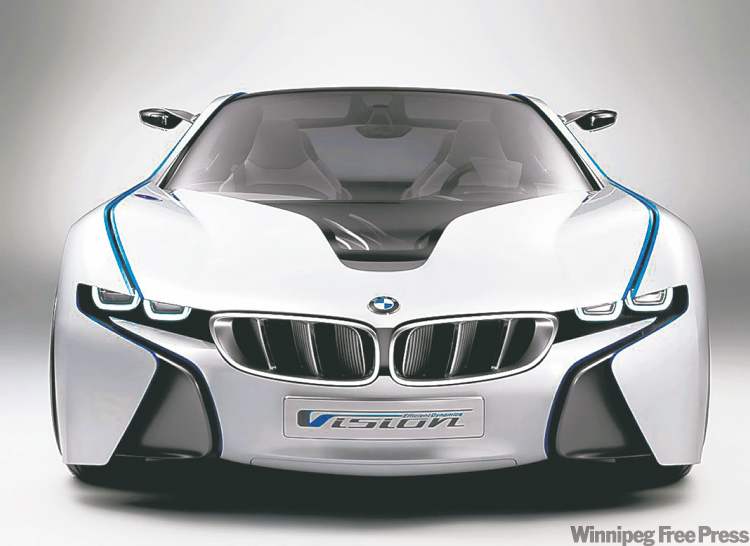
In each case, the bulk of the car is made of carbon fibre-reinforced plastic (CFRP). This ultra-lightweight material is not only 30-per-cent lighter than aluminum, it also boasts the same strength as steel, which is important from a safety standpoint.
The choice of material is important because mass not only hurts fuel efficiency (a 10-per-cent reduction in mass equates to a six-per-cent improvement in fuel economy), it also impacts the driving distance of an all-electric car. As such, CFRP is going to play an increasingly important role in the future.
Likewise, most of each i car is recyclable or made from recycled materials (interior fabrics and seat foams, for example), with the objective of reducing the life-cycle footprint the i car leaves in its wake.
The i3 concept is an electric car that employs BMW’s eDrive, currently being used in the ActiveE. It consists of an electric motor, an advanced lithium-ion phosphate battery and an intelligent management system that extracts the best from the two. The electric motor, which sits at the rear axle, generates 170 horsepower and 184 pound-feet of torque from Rev One. The combination allows the i3 to accelerate to 100 kilometres an hour in 7.9 seconds and manages the more important 80-to-120-km/h passing move in six seconds.
That, for a car designed as an urban commuter, is more than respectable. A fully recharged i3, which takes six hours using a 220-volt outlet, delivers a driving range of up to 160 kilometres. There is a fast-charge option that instills an 80-per-cent charge in one hour, although the cost and the lack of an infrastructure will delay this option at the onset.
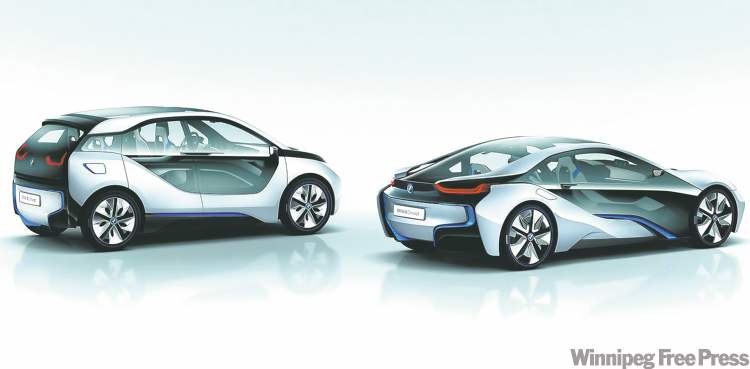
I have driven the BMW ActiveE, and it managed to impress me mightily. It boasted plenty of pickup and surprising range given that the bulk of my drive was on the highway, where there was little or no regenerative braking. The i3 should outstrip the ActiveE in terms of performance and driving range because of its CFRP body and the smaller, lighter battery allowed by the lightweight structure.
The i8 concept is a very different take on future transportation. It’s a plug-in hybrid that uses a modified version of the i3’s electric drive system. Where it differs is that the electric motor powers the front wheels, with a turbocharged 1.5-litre three-cylinder gasoline engine providing the motivation for the rear wheels through a seven-speed twin-clutch transmission. This format allows the i8 to be powered by the front, rear or all four wheels.
The drivetrain is overseen by an intelligent drive system that maximizes regenerative braking without sacrificing driving dynamics or stability. In the i8’s case, the electric side contributes 170 hp and 184 lb.-ft. of torque; the gas side brings another 220 hp and 221 lb.-ft. of torque. The net output (328 hp and 400 lb.-ft. of torque) promises a serious sports car — BMW claims it will hit 100 km/h in 4.6 seconds!
The plug-in side, which fully recharges the main battery in two hours using a 220-volt outlet, allows the i8 to be driven for the first 35 km on electric power alone. This ability and the combined effects of the two power sources delivers a European test-cycle average fuel economy of less than three litres per 100 km.
One of the more interesting aspects of the i8 is its use of laser-based headlights. In simple terms, blue laser light is shot into a box containing phosphorous. What is emitted is a brilliant white light that outstrips any current form of illumination.

For the worrywarts bothered by staring into a laser-based headlight, fear not. I looked into the headlights of the test rig at the technical presentation and suffered no ill effects.
The advantage to the laser design is it produces a light beam that provides 1,000 times more light than conventional LEDs yet consumes half the energy. In an electric world, this is an important consideration. The other advantage is size. Within reason, the whole light source can be packaged into something significantly smaller than the sleekest headlight. This, for the designer of the future, removes one of the key stylistic headaches.
When the production versions of the i3 and i8 arrive, both will stay true to the concepts in terms of power and ability — barring any significant improvement in battery technology in the intervening term.
The i3 will also be offered as a range-extended electric vehicle (REx) — think Chevrolet Volt. This option is designed to give those with an incurable case of so-called range anxiety a greater driving distance and the peace of mind this brings.
The i3 REx’s electric side is exactly the same; however, there is a small three-cylinder engine and a small gas tank. When the battery is spent, after 160 kilometres of driving, the gas engine fires to life and begins to charge the battery, which doubles the driving range to 320 km.

As with the Volt, the gasoline side does not drive the wheels; rather, it drives a generator that is used to charge the battery, which continues to power the electric motor.
— Postmedia News