

Tell drunk drivers to SCRAM
MLA pushes for alcohol-sensing bracelets to be tested in Manitoba
Advertisement
Read this article for free:
or
Already have an account? Log in here »
To continue reading, please subscribe:
Digital Subscription
One year of digital access for only $1.44 a week*
- Enjoy unlimited reading on winnipegfreepress.com
- Read the E-Edition, our digital replica newspaper
- Access News Break, our award-winning app
- Play interactive puzzles
*Billed as $5.77 plus GST every four weeks. After 52 weeks, price increases to the regular rate of $19.95 plus GST every four weeks. Offer available to new and qualified returning subscribers only. Cancel any time.
To continue reading, please subscribe:
Add Free Press access to your Brandon Sun subscription for only an additional
$1 for the first 4 weeks*
- Enjoy unlimited reading on winnipegfreepress.com
- Read the E-Edition, our digital replica newspaper
- Access News Break, our award-winning app
- Play interactive puzzles
*Your next Brandon Sun subscription payment will increase by $1.00 and you will be charged $17.95 plus GST for four weeks. After four weeks, your payment will increase to $24.95 plus GST every four weeks.
Read unlimited articles for free today:
or
Already have an account? Log in here »
Hey there, time traveller!
This article was published 05/12/2011 (5326 days ago), so information in it may no longer be current.
It goes around your ankle, but it’s not a fashion statement.
Instead, it measures how much you’re drinking.
And while it’s a common tool for the courts in the United States to monitor offenders, it’s barely used in Canada.
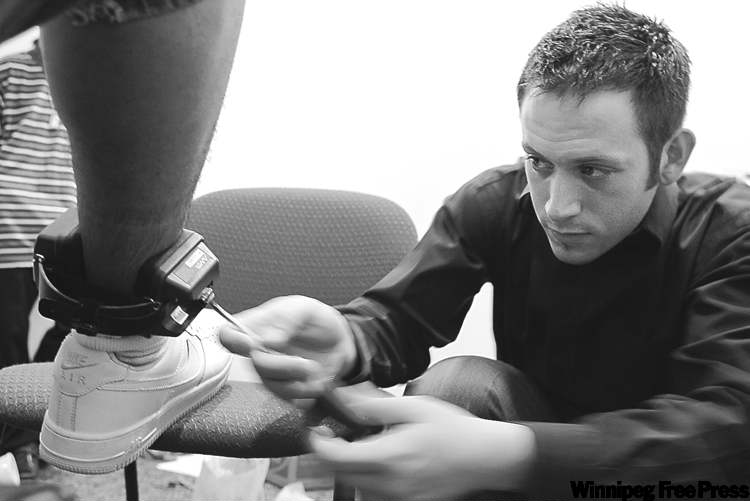
Progressive Conservative justice critic Kelvin Goertzen says that should change as the Secure Continuous Remote Alcohol Monitor (SCRAM) may also reduce recidivism among hardcore drunk drivers.
“I’d like to see it used as a test basis,” Goertzen said. “This is a bit more of a more robust way of monitoring,”
He said SCRAM could be used with the province’s ignition interlock program — offenders must blow into a device to start a car — to monitor repeat impaired drivers more closely and as a requirement for them to get their driver’s licence back.
“I think you should certainly try it to see what kind of results you get, not as a replacement for incarceration, but if they’re already getting probation or bail and they’re eligible for it, then it can be an additional measure on them,” he said.
Provincial spokeswoman Jodee Mason said the province is aware of SCRAM and consideration might be given to using it in the future.
Meanwhile, its use is spreading in the U.S., including South Dakota, North Dakota and Minnesota, as an affordable way to monitor offenders under house arrest rather than sending them to jail, which has been shown in some studies to have no general deterrent effect, according to the U.S. National Highway Traffic Safety Administration.
The U.S. highway traffic group also says while devices like SCRAM are far from perfect, systems like it provide the promise of monitoring abstinence with a minimum of limitations on the offender’s behaviour. In South Dakota, SCRAM use coupled with other measures has also led to a money-saving decrease in that state’s prison population over the past five years.
South Dakota’s 24/7 sobriety program is still being evaluated, but one study found offenders placed at least 30 consecutive days on 24/7 are more than 50 per cent less likely to commit another impaired driving offence.
“It’s not a surprise that with the SCRAM bracelet, where your chance at getting caught is virtually certain, that it would change behaviour,” Goertzen said.
In Canada, SCRAM has seen only limited use in Ontario, Canadian SCRAM spokesman and Toronto lawyer Peter Marshall said.
Marshall said Canada’s Criminal Code should be amended, giving an exception to a minimum jail sentence, to allow an offender convicted of an alcohol-related crime to instead go into an alcohol treatment program where SCRAM can be more widely used.
“SCRAM works best by satisfying the law-and-order interest in seeing people not drinking and protecting public safety without spending the money on keeping them in jail,” Marshall said.
The added bonus is that the use of SCRAM for compliance can also be used to change problem drinkers’ behaviour.
“If a program was designed to allow for someone who was dependent on alcohol to be part of the program in the community, at least the people assisting them, monitoring them, will have accurate information about whether they’re consuming or not, and if so how much,” Marshall said.
Andy Murie, CEO of MADD Canada, said his concern with the SCRAM device is it still gives someone with an anklet the opportunity to drink and drive if used alone.
Murie said the ignition interlock is a more recognized and cost-effective device to reduce impaired driving.
Goertzen acknowledged that concern, but said government must put in place practical measures to not only deter impaired driving, but make roads and highways safe.
“There aren’t magic bullets when it comes to drinking and driving,” he said. “It’s difficult to legislate people’s common sense.”
bruce.owen@freepress.mb.ca
What is it?

The Secure Continuous Remote Alcohol Monitor is made up of three components that monitor an offender’s alcohol consumption every half hour.
Ankle bracelet: Attached to the offender’s leg, it captures transdermal alcohol readings taken from sweat every half hour. The tamper-proof anklet collects the data at predetermined intervals and then sends it by radio frequency to a base station.
Base station: It’s plugged into a phone line in the offender’s home or office and stores data from the anklet. At set times during the day it transmits the data from the anklet to SCRAMNET.
SCRAMNET: It’s a web-based application where offender data is collected by product maker Colorado-based Alcohol Monitoring Systems. AMS also analyzes and stores the information. The system allows law enforcement to access it, through a standard web browser, to find out if the offender has been drinking. A breach means the offender could go to jail.
See how it works at http://www.alcoholmonitoring.com/index/scram/how-scramx-works