He can sing women’s roles, but he’s all man
Advertisement
Read this article for free:
or
Already have an account? Log in here »
To continue reading, please subscribe:

Digital Subscription
One year of digital access for only $205*
- Enjoy unlimited reading on winnipegfreepress.com
- Read the E-Edition, our digital replica newspaper
- Access News Break, our award-winning app
- Play interactive puzzles
*First annual payment billed as $205.00 + GST for one year. This annual subscription will automatically renew at $233.00 + GST every 52 weeks (10% off the regular annual price of $259.35). Offer available to new and qualified returning subscribers only. Cancel any time.
To continue reading, please subscribe:
Add Free Press access to your Brandon Sun subscription for only an additional
$1 for the first 4 weeks*
- Enjoy unlimited reading on winnipegfreepress.com
- Read the E-Edition, our digital replica newspaper
- Access News Break, our award-winning app
- Play interactive puzzles
*Your next Brandon Sun subscription payment will increase by $1.00 and you will be charged $17.95 plus GST for four weeks. After four weeks, your payment will increase to $24.95 plus GST every four weeks.
Read unlimited articles for free today:
or
Already have an account? Log in here »
Hey there, time traveller!
This article was published 04/02/2012 (5332 days ago), so information in it may no longer be current.
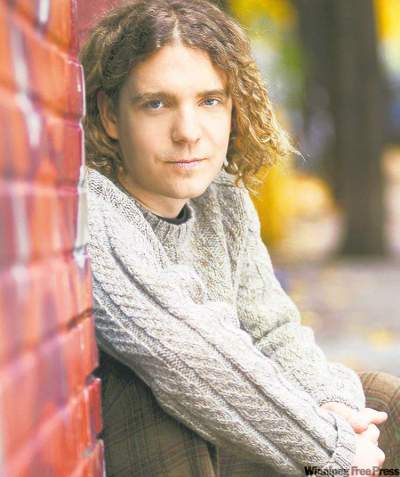
The adjectives “ravishing” and “ethereal” often arise when critics try to capture the beauty and purity of Daniel Taylor’s voice.
It’s been praised as rich, warm, sweet, agile and unforced. Britain’s The Guardian called the Ottawa-born singer with the curly mane “part angel, part man.”
Taylor, 42, is a superstar of baroque and Renaissance music. What might surprise many is that he sings in a female range, routinely sailing through notes that are typical for a high mezzo-soprano.

He is not only Canada’s foremost countertenor (the highest vocal range for a man), but one of the world’s most sought-after countertenors.
“My range is higher than most,” Taylor says. “Most of my countertenor colleagues are more like a contralto. I sing up to a B-flat just under high C (two octaves above middle C).”
Taylor, who is particularly known for sensitive interpretations of Bach and Handel, has performed with many of the world’s most prestigious orchestras and opera companies, including the Metropolitan Opera. He appeared with the Manitoba Chamber Orchestra in 2007, singing Handel works.
He is said to be Canada’s most prolific recording artist, having appeared on an extraordinary 99 CDs, including non-classical discs such as Cirque du soleil’s Totem soundtrack.
He comes to Winnipeg’s Westminster United Church on Tuesday and Wednesday for a rare event: a concert performance of Henry Purcell’s 50-minute 1689 opera Dido and Aeneas, with the program rounded out by other works by Purcell and Thomas Tallis.
Manitoba Opera and the MCO are co-presenting the touring opera, a tragic love story that includes the famous Dido’s Lament.
Taylor is bringing his Theatre of Early Music, a world-travelled Montreal vocal and period-instrument ensemble. He conducts the ensemble, which has a rotating lineup and often features guest artists such as British soprano Dame Emma Kirkby.
In Winnipeg, there will be seven instrumentalists, including harpsichord and lute, and about 13 singers including Taylor. He stars in the female role of the Sorceress in the opera, sung in English.
Hungarian soprano Noémi Kiss and British-Canadian baritone Alexander Dobson play the lovers. The performance will not be in costume.
You can’t tell from Taylor’s speaking voice that he’s a countertenor. He is matter-of-fact that he’s heterosexual — his girlfriend is studying law — and, shall we say, anatomically intact.
Many of the operatic roles and sacred works he performs were originally sung by castrati, European men of the 16th to 18th centuries who were castrated before puberty to prevent their voices from changing.
“I joke about the whole castrato business, especially when I’m doing master classes with students,” says Taylor, who divides his time between Montreal, Ottawa and Toronto.
“I’ll draw a little picture (of two figures) on the chalkboard, and I’ll label it ‘Normal Man’ and then ‘Me,’ with a little equals sign, just to get it out of the way.”
From the age of six, Taylor was a treble choirboy. Like Chris Colfer, the countertenor who plays Kurt on the TV series Glee, Taylor says that while his voice was changing at puberty, he kept singing and was able to retain some of his treble voice.
Many people are confused between reedy, Bee Gees-style falsetto singing and what a countertenor does. Some prominent countertenors, like England’s James Bowman, are “strictly falsettists,” Taylor says.
But people have always said Taylor has a fuller, richer sound. He wondered himself how he was “engaging the instrument.” So years ago, he went to a hospital to have a tiny video camera put down his throat.
“My vocal cords are the same size as any other voice type,” he says. “The vast majority of the time, I keep the cords together. They vibrate together. In falsettists, there’s a gap of air between the vocal cords. You can hear it. It’s actually the flesh around the vocal cords that’s doing the vibrating.
“I do, at times, choose esthetically to bring air into the sound, as part of the palette of colours I can access. In Dido and Aeneas, the Sorceress is a great part for me — a great villain. That’s full-throttle singing, very dramatic. There’s going to be no hint of falsetto.”
Taylor is passionate about preserving and sharing early music in a style that’s historically accurate. It’s a cause that didn’t gain broad momentum until the second half of the 20th century.
To date, he has never had the chance to perform in a costumed, full theatrical production of Dido and Aeneas.
“This music is still neglected,” he says. “In Canada, it’s rare that baroque operas are given full productions. It’s the lack of risk that opera houses are willing to take, tied in with reduced federal and provincial funding. . . . We’re doing something that’s a very important start.”
alison.mayes@freepress.mb.ca