Kodak to phase out it camera, digital picture frame business as part of cost cuts

Advertisement

Advertise with us

ROCHESTER, N.Y. - Picture it: Except for a few disposable point-and-shoots, Kodak is exiting the camera business.

Read this article for free:


or

Already have an account? Log in here »

To continue reading, please subscribe:

Subscribe and receive a limited-edition Free Press branded hat or tote.

Digital Subscription

One year of digital access for only $205*

  • Enjoy unlimited reading on winnipegfreepress.com
  • Read the E-Edition, our digital replica newspaper
  • Access News Break, our award-winning app
  • Play interactive puzzles

*First annual payment billed as $205.00 + GST for one year. This annual subscription will automatically renew at $233.00 + GST every 52 weeks (10% off the regular annual price of $259.35). Offer available to new and qualified returning subscribers only. Cancel any time.

To continue reading, please subscribe:

Add Free Press access to your Brandon Sun subscription for only an additional

$1 for the first 4 weeks*

  • Enjoy unlimited reading on winnipegfreepress.com
  • Read the E-Edition, our digital replica newspaper
  • Access News Break, our award-winning app
  • Play interactive puzzles
Start now

*Your next Brandon Sun subscription payment will increase by $1.00 and you will be charged $17.95 plus GST for four weeks. After four weeks, your payment will increase to $24.95 plus GST every four weeks.

Hey there, time traveller!
This article was published 09/02/2012 (5335 days ago), so information in it may no longer be current.

ROCHESTER, N.Y. – Picture it: Except for a few disposable point-and-shoots, Kodak is exiting the camera business.

Eastman Kodak Co. said Thursday that it will stop making digital cameras, pocket video cameras and digital picture frames in a move that marks the end of an era for the beleaguered 132-year-old company.

Founded by George Eastman in 1880, Kodak was known all over the world for iconic cameras such as the Brownie and the Instamatic. For the last few decades, however, the Rochester, New York-based company has struggled. It was battered by Japanese competition in the 1980s, and failed to keep pace with the shift from film to digital technology.
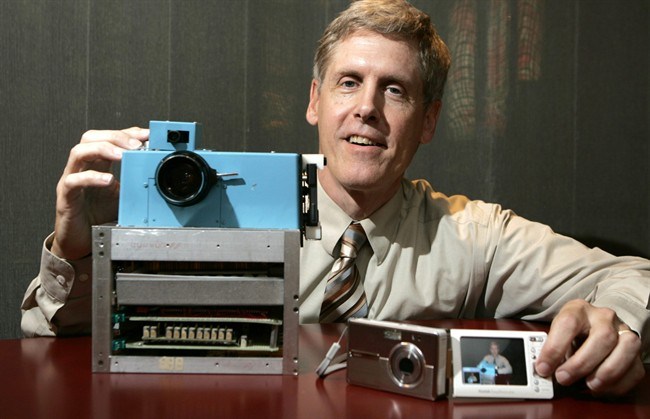
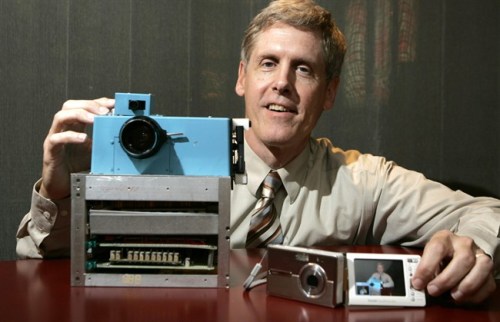
File - In this Aug. 17, 2005 file photo, Steven J. Sasson, then Eastman Kodak Co. project manager, shows his prototype digital camera he built in 1975 next to Kodak's latest digital camera the EasyShare One, at Kodak headquarters in Rochester, N.Y. Soon after joining Eastman Kodak Co. Eastman Kodak Co. said Thursday, Feb. 9, 2012, that it will stop making digital cameras, pocket video cameras and digital picture frames, marking the end of an era for the company that brought photography to the masses more than a century ago. (AP Photo/David Duprey, File)

The company sought bankruptcy protection from creditors last month in a case that covers $6.7 billion in debt. It has a year to devise a restructuring plan. Citigroup Inc. was approved to lend the company $650 million to continue operating.

Exiting the digital camera business is especially poignant for Kodak. In 1975, using an electronic sensor invented six years earlier at Bell Labs, a Kodak engineer named Steven Sasson created the world’s first digital camera. It was an eight-pound (3.6 kilogram), toaster-size device that captured low-resolution black-and-white images.

Reached at home Thursday, Sasson told The Associated Press that seeing Kodak exit the business is “a bit sad” but part of a transition facing all companies that use evolving technology.

“The average person probably owns more digital cameras than they realize,” he said. “It’s just the reality that digital imaging is a part of our lives and you can capture images in a lot of different ways. There’s a lot of choices people have, cellphones being one of them.”

Through the 1990s, Kodak spent some $4 billion developing the photo technology inside most of today’s cellphones and digital devices. But fearing that it might cannibalize its celluloid film business, Kodak waited until 2001 to bring its own digital cameras to the consumer market. By then, it faced strong competitors like Sony Corp. and Canon.

These days, digital camera sales are suffering as consumers increasingly take photos on smartphones such as the iPhone. Certain smartphone makers such as LG, Nokia, Motorola and Samsung have agreed to pay Kodak to license its digital camera technology, while companies like Apple are fighting its patent claims.

Before Thursday’s announcement, Kodak had already been trying to shrink its product line and sell in fewer retail venues, but as sales declines worsened, the company saw no way to make the business profitable.

“We made the logical conclusion that there was no clear path to profitability and we have to focus on generating profits at this point,” said Kodak spokesman Chris Veronda.

Kodak said getting out the digital camera business by June should help cut losses by about $100 million a year as it struggles to emerge from bankruptcy.

The company’s digital camera line was part of a rapidly shrinking division that accounted for about a quarter of Kodak’s revenue in the three-month period through September.

For the nine months through September, total company sales plunged 18 per cent to $4.3 billion and it lost $647 million.

Kodak sees home photo printers, high-speed commercial inkjet presses, workflow software and packaging as the core of its future business. Since 2005, the company has poured hundreds of millions of dollars into new lines of inkjet printers. Once the digital camera business is phased out, Kodak said its consumer business will focus on printing. It will seek a company to license its EasyShare digital camera brand.

Kodak said it’s working with retailers to ensure an orderly transition. The company will continue to honour product warranties and provide technical support for the discontinued products.

The company didn’t say how many jobs would be eliminated as a result of the decision, but did say that it expects to take a charge of $30 million related to separation costs.

Kodak owns patents that cover a number of basic functions in many smartphone cameras, and the bankruptcy judge has given the company until June 30 to come up with a procedure to sell them.

The company picked up $27 million in patent-licensing fees in the first half of 2011. It made about $1.9 billion from those fees in the previous three years combined. But no buyers have emerged since Kodak started shopping them around in July.

___

AP Business Writer Ryan Nakashima in Los Angeles contributed to this report.
Report Error Submit a Tip

More Stories

Winnipeg author relies on typewriter collection to punch out manuscripts

Sheldon Birnie 8 minute read Preview

Winnipeg author relies on typewriter collection to punch out manuscripts

Sheldon Birnie 8 minute read Yesterday at 6:22 PM CDT

Local author Michael Clark has not only taken the words “keep at it” to heart, but repeated them so often that last year, his daughter, 29, suggested the pair get matching tattoos bearing the mantra before her wedding.

The words are inked to appear as though they were punched onto his forearm by a typewriter.

Clark has a thing for typewriters. The award-winning crime fiction author figures he has 50 or more stashed in various nooks and crannies of his St. Vital home.

“There’s a joke in the typewriter community: if you leave four typewriters in your car unlocked, when you come back there’ll be three more,” the 57-year-old says with a laugh.

Read
Yesterday at 6:22 PM CDT

Kodak to phase out it camera, digital picture frame business as part of cost cuts

The Associated Press 5 minute read Preview

Kodak to phase out it camera, digital picture frame business as part of cost cuts

The Associated Press 5 minute read Tuesday, Feb. 14, 2012

ROCHESTER, N.Y. - Picture it: Except for a few disposable point-and-shoots, Kodak is exiting the camera business.

Eastman Kodak Co. said Thursday that it will stop making digital cameras, pocket video cameras and digital picture frames in a move that marks the end of an era for the beleaguered 132-year-old company.

Founded by George Eastman in 1880, Kodak was known all over the world for iconic cameras such as the Brownie and the Instamatic. For the last few decades, however, the Rochester, New York-based company has struggled. It was battered by Japanese competition in the 1980s, and failed to keep pace with the shift from film to digital technology.

The company sought bankruptcy protection from creditors last month in a case that covers $6.7 billion in debt. It has a year to devise a restructuring plan. Citigroup Inc. was approved to lend the company $650 million to continue operating.

Read
Tuesday, Feb. 14, 2012

Manitoba abandoning spring, fall clock changes

Carol Sanders 8 minute read Preview

Manitoba abandoning spring, fall clock changes

Carol Sanders 8 minute read Updated: Yesterday at 5:36 PM CDT

Time’s up for the time change in Manitoba.

Manitobans won’t be setting their clocks back an hour in November. The province has decided to permanently stay on daylight time after surveying residents on the twice annual clock adjustment.

“We heard from Manitobans loud and clear — no more changing the clocks in Manitoba,” Premier Wab Kinew said in a news release Thursday.

Most of the 72,000 votes submitted in an online EngageMB survey — 92 per cent — said they would like to see the practice end. The survey asked if they preferred earlier sunrises in winter with standard time or the later sunsets in summer with daylight time. More than half of survey participants (58 per cent) indicated a preference to stay on permanent daylight time; 34 per cent voted to eliminate the time change but stay on standard time.

Read
Updated: Yesterday at 5:36 PM CDT

EPC votes to award $115-M sewage plant upgrade development contract to Canadian arm of U.S.-based company

Joyanne Pursaga 5 minute read Preview

EPC votes to award $115-M sewage plant upgrade development contract to Canadian arm of U.S.-based company

Joyanne Pursaga 5 minute read Yesterday at 5:58 PM CDT

The Canadian branch of a U.S. company is one vote away from winning a $115-million North End sewage treatment plant upgrade contract Winnipeg’s mayor expects will produce many local jobs.

Council’s executive policy committee voted to award the development phase agreement for the third and final portion of the $3.1-billion upgrade project to Kiewit Construction Services, pending final city council approval.

The company is a branch of Kiewit Canada Group, whose parent company is located in Omaha, Neb., according to its website.

While there has been a renewed push for governments to buy local in and beyond Winnipeg, Mayor Scott Gillingham said this contract should prove very beneficial to the city’s economy.

Read
Yesterday at 5:58 PM CDT

‘Parental rights’ issue resurfaces

Maggie Macintosh 5 minute read Preview

‘Parental rights’ issue resurfaces

Maggie Macintosh 5 minute read Yesterday at 2:00 AM CDT

Trustee campaign material that condemns rainbow flags is being met with outrage of all kinds, written complaints and, in one case, a cease-and-desist order.

“Parental rights,” including questions about classroom diversity, equity and inclusion policies, are resurfacing heading into school board elections across Manitoba.

“People are trying to advance their politics and their issues while simultaneously calling teachers ideologues and brainwashers,” said Shannon Moore, an associate professor at the University of Manitoba who studies sexual health education. “And I find that rich.”

Moore said parents have a right to choose independent school or homeschool, but they do not have a right to dictate curriculum that is currently developed using research and mainstream morals.

Read
Yesterday at 2:00 AM CDT

Gerdau recycling workers on strike

Gabrielle Piché 3 minute read Preview

Gerdau recycling workers on strike

Gabrielle Piché 3 minute read Yesterday at 7:29 PM CDT

Workers behind recycling operations for Selkirk’s steel mill walked off the job last week, calling for higher wages.

Unionized members voted to strike July 23, with a 92 per cent mandate. Months of bargaining hasn’t produced a new deal, said United Steelworkers Local 8740. The union represents 78 members striking at Gerdau AmeriSteel Manitoba Metals recycling plant.

“We’re not being recognized for the amount of work we’ve been doing,” Andrew Sealey, acting president of the local, said Thursday. “The mill is a sensational beast … We’ve got to feed her all the time, and she’s always hungry.”

The scrap metal inspected and unloaded at the recycling facility is used in steel mill operations.

Read
Yesterday at 7:29 PM CDT