Updated Seuss delivers a modern lesson
Advertisement
Read this article for free:
or
Already have an account? Log in here »
To continue reading, please subscribe:

Digital Subscription
One year of digital access for only $205*
- Enjoy unlimited reading on winnipegfreepress.com
- Read the E-Edition, our digital replica newspaper
- Access News Break, our award-winning app
- Play interactive puzzles
*First annual payment billed as $205.00 + GST for one year. This annual subscription will automatically renew at $233.00 + GST every 52 weeks (10% off the regular annual price of $259.35). Offer available to new and qualified returning subscribers only. Cancel any time.
To continue reading, please subscribe:
Add Free Press access to your Brandon Sun subscription for only an additional
$1 for the first 4 weeks*
- Enjoy unlimited reading on winnipegfreepress.com
- Read the E-Edition, our digital replica newspaper
- Access News Break, our award-winning app
- Play interactive puzzles
*Your next Brandon Sun subscription payment will increase by $1.00 and you will be charged $17.95 plus GST for four weeks. After four weeks, your payment will increase to $24.95 plus GST every four weeks.
Read unlimited articles for free today:
or
Already have an account? Log in here »
Hey there, time traveller!
This article was published 03/03/2012 (5310 days ago), so information in it may no longer be current.
How far can you push a message before it starts to feel pushy? This is one of the central concerns that comes pre-packaged with The Lorax, easily the most urgent of all the Dr. Seuss books, as it directly addresses the issue of industry and the environment.
Centred around a young boy’s quest to discover the true history of his own town, The Lorax book is relatively straightforward: The kid visits a Boo Radley kind of character with green arms named the Once-ler, who tells him what the landscape used to look like.
Back in the day, it was all forests and meadows teeming with wildlife. Now, it’s a barren wasteland.
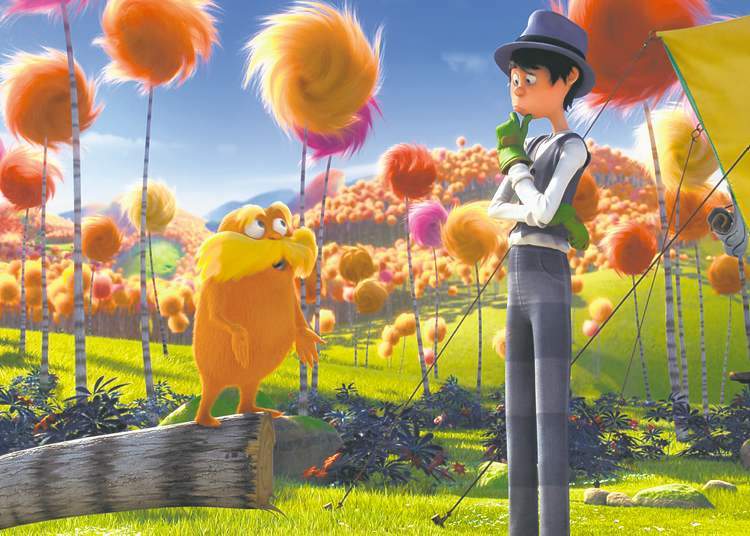
The problem was greed. The Once-ler created a thing that everyone wanted, but in order to make it, he had to cut down trees. He could have harvested sustainably, but it took too long and he was flush with the rush of raking in big cash. He got greedy. He kept going, despite the protests of the Lorax, a shaggy orange mop who calls himself the guardian of the trees.
The Once-ler took one look at the ball of flaming fur and found him ridiculous. Moreover, he was unreasonable, an enemy of profit, and sexually ambiguous.
The Once-ler clearcut the whole forest. Not a single tree was left standing. Yet, without trees, the air began to smell, the quality of life degraded, the animals had to find new habitats and the Once-ler’s business went bankrupt, since he had no resources left to exploit.
That was the book. It was published in 1971, in the same breath as the birth of the environmental movement, the foundation of Greenpeace, and the anti-pollution ad with the crying First Nations chief in full regalia.
In many ways, The Lorax is the product of its time, when we could look at the world around us and take it at face value. Industry was an unapologetic polluter. Environmentalists were flaky hippies who didn’t understand business.
But things aren’t so simple anymore. Now, we have the phenomenon of “optics” — a sophisticated new concept invented by public-relations strategists, which allows a pretty face to be plastered on an ugly reality.
Before, big industry didn’t try to hide its smokestacks or black effluent. Today, we have scientists from petroleum companies cradling a tree seedling in the palms of their hands, apparently proving they really care about the planet.
Today, the Once-ler and the Lorax are indistinguishable on the outside, which means any modern adaptation of Dr. Seuss’s cautionary tale needs to cut through a whole new layer of industrial veneer.
So if you walk into the theatre and see a variety of characters who didn’t appear in the book, don’t waste your time grandstanding about the purity of the original. The producers and writers behind this moderate revision needed to add extra edge to the mix to remain true to the original raison d’etre.
On screen, this amounts to a whole new plotline about the boy, Ted (Zac Efron), and his crush on a tree-loving girl named Audrey (Taylor Swift), as well as a whole new villain in Mr. O’Hare, a tiny little man who gets richer by the day selling clean air to the unquestioning and naive citizens of Thneed-Ville — because, “once you put something in a plastic bottle, people will buy it.”
We also get Danny DeVito voicing the Lorax and Betty White playing an eco-warrior Granny, ensuring there’s showmanship behind all these new curves. Yet, while much of the new material is stock device and see-through plot, we need it to extend the running time to full feature length.
We also need it for a sense of grey scale in this otherwise black and white universe.
People aren’t all good or all bad, and, in order to really understand the current challenge regarding the environment, we have to grasp the abstracts of human nature, as well as the nascent corporate urge to cover up the muck and make it pretty.
The Lorax accomplishes all these things, even if it often feels a little addled and hyperactive, because it shows us how one ordinary man lost his way in a bid for love and affection via money.
The most important facets of Dr. Seuss’s fable remain intact, from respecting the environment to the importance of taking responsibility — and being honest — in the face of climate calamity.
The filmmakers don’t pull any punches. By the same token, the movie never feels too pushy, because it isn’t as bleak or as gloomy as it could have been. Putting the emphasis on hope and overcoming obstacles, all to the beat of a Broadway-styled score, The Lorax delivers an engaging piece of entertainment wrapped around a hard-core message for the next generation: “Unless someone like you cares a whole awful lot, nothing is going to get better, it’s not.”
— Postmedia News
Other voices
Selected excerpts from reviews of Dr. Seuss’ The Lorax:
From the opening number introducing us to the plastic-loving population of Thneedville, to the adorably comic critters who live in the lush valley, this kid-pleasing movie packs a visual punch and a worthy message.
— Linda Barnard, Toronto Star
The Lorax has its share of eye-popping amusements, but its wobbly pacing and routine kidpic elements make for an experience that feels not just tiresome and rudderless but antithetical to the Seuss spirit.
— Justin Chang, Variety
This is purely warm, wonderful, wise and hilarious family entertainment that is fantastic movie fun for everyone.
— Pete Hammond, Boxoffice
Nice and easily enjoyable for kids and ex-kids.
— Matt Pais, RedEye
Chris Renaud crafts his action with equal doses of surreal sweetness, silliness and flair, and does so without ever feeling overly pushy and desperate to please.
— Nick Schager, Slant magazine
The movie is like a less original WALL-E, but it’s still vibrant and touching.
— Owen Gleiberman, Entertainment Weekly
Compiled by Shane Minkin
MOVIE REVIEW
Dr. Seuss’ The Lorax

Starring: Danny DeVito, Zac Efron, Taylor Swift and Ed Helms
Directed by: Chris Renaud and Kyle Balda
Parental advisory: none
Running time: 87 minutes
3 1/2 stars out of 5