

Coyotes, wolves destroy livestock, wreak havoc on farms
Advertisement
Read this article for free:
or
Already have an account? Log in here »
To continue reading, please subscribe:
Monthly Digital Subscription
$1 per week for 24 weeks*
- Enjoy unlimited reading on winnipegfreepress.com
- Read the E-Edition, our digital replica newspaper
- Access News Break, our award-winning app
- Play interactive puzzles
*Billed as $4.00 plus GST every four weeks. After 24 weeks, price increases to the regular rate of $19.95 plus GST every four weeks. Offer available to new and qualified returning subscribers only. Cancel any time.
Monthly Digital Subscription
$4.99/week*
- Enjoy unlimited reading on winnipegfreepress.com
- Read the E-Edition, our digital replica newspaper
- Access News Break, our award-winning app
- Play interactive puzzles
*Billed as $19.95 plus GST every four weeks. Cancel any time.
To continue reading, please subscribe:
Add Free Press access to your Brandon Sun subscription for only an additional
$1 for the first 4 weeks*
*Your next subscription payment will increase by $1.00 and you will be charged $16.99 plus GST for four weeks. After four weeks, your payment will increase to $23.99 plus GST every four weeks.
Read unlimited articles for free today:
or
Already have an account? Log in here »
Hey there, time traveller!
This article was published 24/03/2012 (5133 days ago), so information in it may no longer be current.
BIRD RIVER — Shooting 101 coyotes last year with a sniper rifle sounds like a lot.
Many people might think the 62 coyotes Ron Alexander has shot so far this year is excessive and cruel.
But there’s a context. We are in the midst of an explosion in the coyote and wolf populations.
The canine predators are encroaching on built-up areas — remember the coyote that ran loose in a downtown Winnipeg parkade this week — and have even threatened people. They are destroying livestock. The number of livestock killed has rocketed to 466 in 2010, from 115 in 2003. Wolves have also destroyed pets belonging to cottagers in Lake of the Woods and in Kenora.
And then look at how many coyotes were killed in Saskatchewan after it introduced a $20 bounty per head in 2010 to control population. Almost 71,000 coyotes were destroyed in a single year.
Alexander would be called a bounty hunter except there is no bounty on coyotes in Manitoba like there is in Saskatchewan.
The outdoorsman performs the tasks because he is a crack marksman — he drops coyotes from 300 to 500 metres away, and these are moving targets (he has a rangefinder on his rifle that tells him the target distance) — and he’s got time on his hands since he retired.
“I put 20-year-olds to bed. I’ve got the energy they don’t have,” said Alexander, 67.
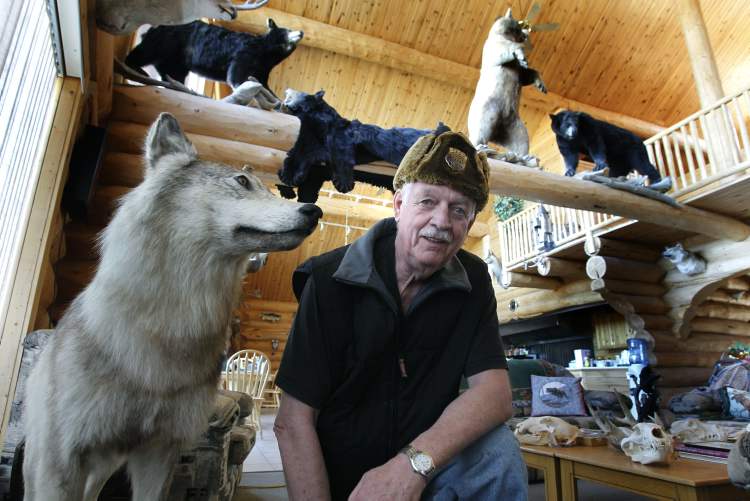
As a lifelong trapper, Alexander can legally shoot coyotes as long as property owners give him permission. He uses the call of a distressed rabbit and stays downwind.
“If coyotes see the truck, even half a mile down the road, it’s over. They’re gone. I put white on to blend in with the snow. If it’s deep snow, I put on snowshoes.” He has shot a coyote at 580 metres.
Alexander provides a valuable service, said Roy Nawrocki, a farmer north of Beausejour. “We’ve never had coyotes like this before,” he said.
The prairie chicken population has been wiped out in the area by coyotes, he said. On the east side of Lake Winnipeg, wolves are blamed for the disappearance of the moose. Similar stories are told across the province.
Alexander was a guide and then outfitter for 28 years combined. He has been a trapper for even longer.
But he doesn’t have the rural upbringing you’d expect. He grew up in Winnipeg’s West End. He was in his 20s when he had a hair-brained idea to try to live off the land on a property along Bird River, north of Lac du Bonnet. He hunted, fished and trapped, while his wife — they’ve been married 47 years now and Alexander calls himself a lucky man — worked a regular job. He became so good at it he was soon working as a hunting guide. Then, in 1994, he bought a patch of land and built his own log resort cabin out of pine logs imported from 100 Mile House in British Columbia and became an outfitter.
The resort log cabin on the Bird River is amazing. It is a two-storey, 6,900-square-foot building that has 14 bedrooms, six bathrooms, a conference room, a full basement with a pool table and sauna that is currently on sale for about $1.7 million.
Alexander skins some of his coyotes and makes hats from the leather but he sells most of them. This year, he sold 53 carcasses to a Hutterite colony that skins them, stretches and dries the hides and sells them at a fur auction. The returns for coyotes or wolf hides are not great.
Alexander said he thinks the provincial government needs to do more to control the predators, such as introduce a bounty the way Saskatchewan did. However, the province has made it legal for people with big-game hunting licences for deer or moose to also take down one coyote. It has also extended the wolf-hunting season. Alexander doesn’t think that’s enough.
“Coyotes are the most adaptable creatures on the planet,” Alexander said.
Coyotes have also killed calves on Mitcheal and Liz Ledarney’s farm near Tyndall. Six coyotes also charged their pet dogs. Mitcheal shot three coyotes in their yard late last year.
“You talk to a few neighbours and they all tell the same story,” said Liz.

She approves of Alexander’s service but said the province has to do more. “You talk to someone in the city and they’ll say nature will take care of itself. That’s possibly true in the wilderness without humans but there are too many people here,” especially farmers, for the coyotes to live off, she said.
The coyote and wolf populations have increased due to the huge deer populations of the recent past.
Predator populations usually drop a year or two after the prey population drops, Manitoba Conservation said.
bill.redekop@freepress.mb.ca