

A real cliffhanger
Hiking through the rugged beauty of the Welsh countryside
Advertisement
Read this article for free:
or
Already have an account? Log in here »
To continue reading, please subscribe:
Monthly Digital Subscription
$1 per week for 24 weeks*
- Enjoy unlimited reading on winnipegfreepress.com
- Read the E-Edition, our digital replica newspaper
- Access News Break, our award-winning app
- Play interactive puzzles
*Billed as $4.00 plus GST every four weeks. After 24 weeks, price increases to the regular rate of $19.95 plus GST every four weeks. Offer available to new and qualified returning subscribers only. Cancel any time.
Monthly Digital Subscription
$4.99/week*
- Enjoy unlimited reading on winnipegfreepress.com
- Read the E-Edition, our digital replica newspaper
- Access News Break, our award-winning app
- Play interactive puzzles
*Billed as $19.95 plus GST every four weeks. Cancel any time.
To continue reading, please subscribe:
Add Free Press access to your Brandon Sun subscription for only an additional
$1 for the first 4 weeks*
*Your next subscription payment will increase by $1.00 and you will be charged $16.99 plus GST for four weeks. After four weeks, your payment will increase to $23.99 plus GST every four weeks.
Read unlimited articles for free today:
or
Already have an account? Log in here »
Hey there, time traveller!
This article was published 14/04/2012 (5132 days ago), so information in it may no longer be current.
PEMBROKESHIRE, Wales — Some time ago, while living in England, I learned to walk.
Not the everyday walking you use when you pop over to the store to pick up milk — I mean wonderfully lonesome, spirit-rousing, long-distance walking.
There aren’t many places in Canada I’d feel comfortable undertaking such walks because our country is so vast and wild. Bears, cougars and overripe mountain men aren’t my ideal company.
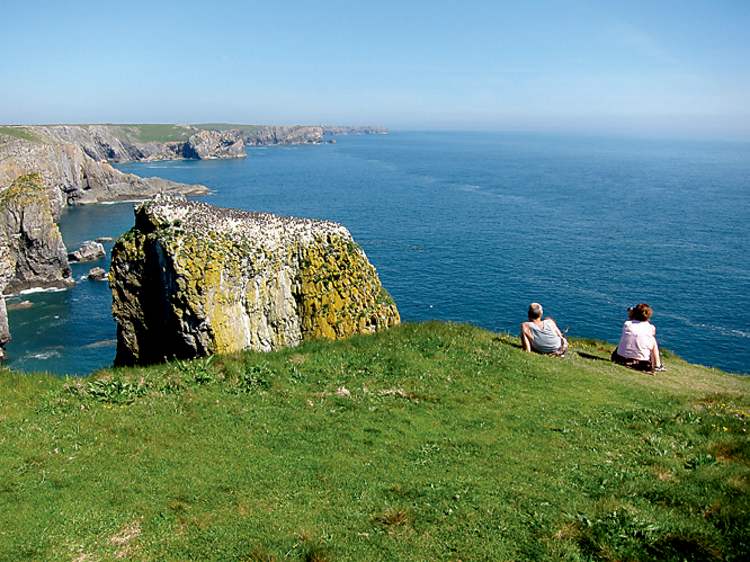
In the U.K., cows tend to be your most fearsome trail companions. Furthermore, you’re never far from civilization. Worst-case scenario: you stray off course and end up at different pub than expected.
I’d covered a fair few miles in England when I decided to test my mettle in the wild west: Wales.
The Pembrokeshire Coast Path is 300 km of rugged beauty, poised on the edge of the world. I walked 47 km of it in four days.
Perfectionists will wait for bucolic April/May weather, when the wildflowers really strut their stuff. More importantly, they’ll break in their hiking boots well in advance.
This silly girl did neither, arriving in Fishguard in the first week of March with brand-new shoes. After a fine night at the exceptional Manor House Hotel, I was sent on my way with a packed lunch complete with regional baked goodies Bara Brith and Welsh cakes.
The path delivered history without hesitation; upon exciting Fishguard, I discovered three Neolithic tombs. Today they’re collapsing stones, but once upon a time they were covered in earth, encapsulating bodies of heroic leaders and hot celebrities.
These were practically in someone’s backyard (I could just imagine the locals taking them for granted: “Gwythyr, set the hibachi on the Neolithic tombs.”)
I soon learned ancient vestiges are as prevalent on the path as lurkers on a nude beach: from Iron Age forts to Norman castles, the path’s wildness is studded with evidence of human life.
Even in early March, Wales proved downright balmy. Meanwhile, Jack Frost was back in Canada, insisting upon stretching the party well beyond its prime.
For this reason, I was feeling pretty smug as I left Fishguard — until I heard something large rustle in a nearby bush. Then I nearly released a prehistoric noise of my own.
Forgive me if I gave the impression that all British cows are tame dames called “Betsy.”
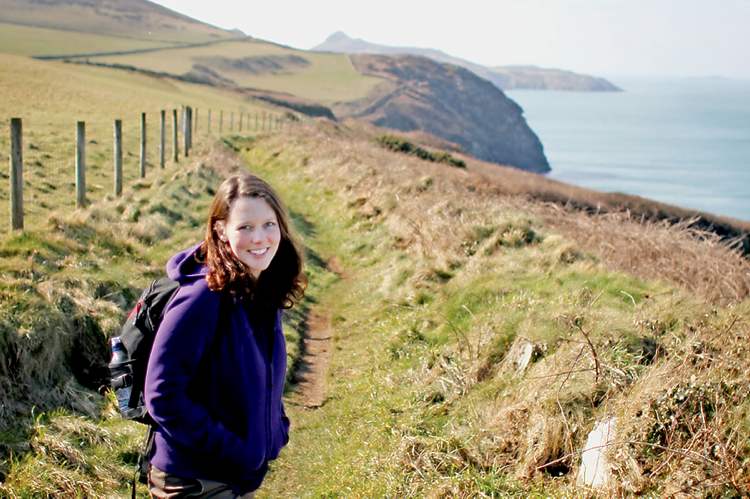
Nuh-uh.
In preparing for the trip, I perused some message boards (suggestion: never visit message boards. Of any sort. Ever.)
They planted an ugly seed in my mind: cows and bulls can be dangerous.
To assuage my fears, Dave Maclachlan, a trail officer, emailed to say most bulls aren’t permitted on land crossed by rights of way.
“Indeed, for much of its length the path is fenced off from the farm land.”
But … but …
“There are a few farms that overwinter young stock on the coastal slopes — these cattle are like teenagers — inquisitive and frisky. If you meet any of these (they still seem quite big) and feel intimidated — jump and shout ‘BOO!'”
Thankfully, human terrorization was a low priority for this particular beast; I ventured forth without being harassed for the rest of the day. Humans, too, were scarce: I may have encountered one fellow wayfarer per hour.
Gulches, however, I met in bulk.
For the first dozen or so, I huffed and puffed and focused on the cake that I would devour as a reward. But, probably around the time my biggest blister was entering its third trimester, I got an exhilarating burst of adrenalin. Getting somewhere substantial on foot, all alone, was primitive and satisfying.
Most of the time, I was perched between 30 and 70 metres above the infinite sea, taking in the same view as those Iron Age fort dwellers. And it won’t be changing because it’s protected by law.
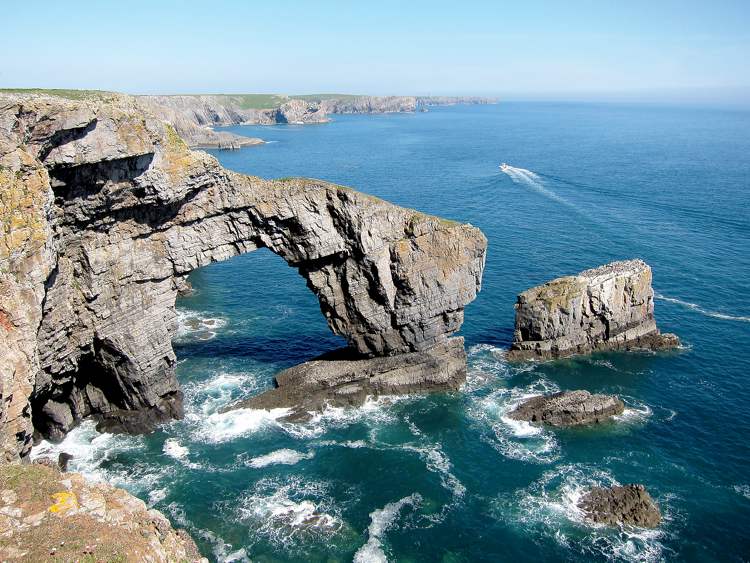
While the vistas were soothing, at times the trail hugged the edge so closely there was but a metre between me and a free fall into a reunion with my dead grandparents.
By the time I reached Pwll Deri, I’d covered 14.5 km and was overjoyed to put my feet up at a guest house close to the trail.
The next day was a quiet blur of coves, beaches, cliffs, seals, grazing sheep and wild ponies as I covered another 16 km between Porthgain and Whitesands.
I rounded St. Davids head, the most westerly point in Wales, and, like a pilgrim of yore, stumbled into St. Davids Cathedral as the day waned — muscles sore, feet screeching, eyes seeking friendly faces.
It’s said St David founded a monastery there in 550 AD. Today, it’s a grand site, complete with a 12th-century cathedral and ruined bishop’s palace.
I did a shorter day from St. David’s to Solva (a perfect day trip) before being whisked off to Stackpole to experience southern Pembrokeshire.
By this time, my poor tootsies could have landed a supporting role in a horror movie. So, seeing the figure 30 km on my itinerary wasn’t exactly propitious. I’d have to walk most of it on my hands.
So I did what any hardy walker would: I cheated. I got a lift to Lydstep and walked to Tenby, a mere 6.4 km of pure pain down the path.
I did get hopelessly lost and wander into a military firing range (of all places), but by the time I stepped onto the stunning, vast beach at Tenby, the town’s noble fort and church spire thrusting out to sea, my prevailing feeling was one of pride and accomplishment.
I’d ascended more cliffs than I could count. I’d admired one of the most beautiful landscapes in the world. I’d avoided bovine conflict. And I’d done it all by my lonesome, with no iPod or idle chatter overpowering nature’s soundtrack.
Bonus: my new shoes were officially broken in.
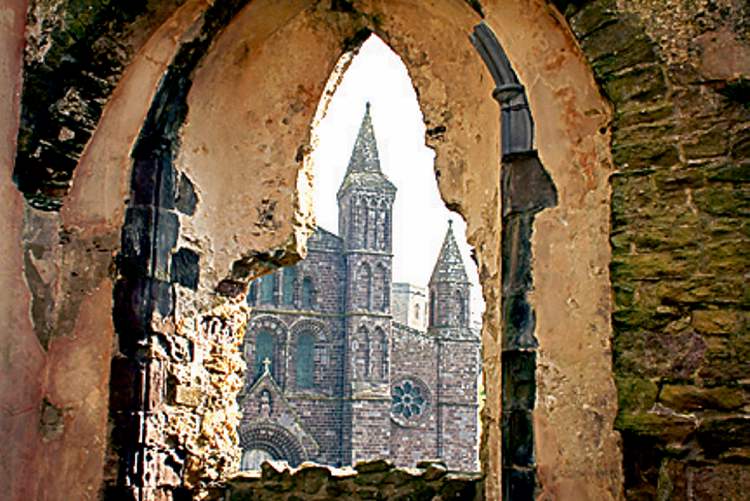
— Postmedia News
IF YOU GO
The Pembrokeshire Coast Path runs from St. Dogmaels in the north to Amroth in the south. At a challenging pace, it will take 12 days to walk the entire route.
For information on walking the trail, including where to stay along the path and information about luggage transfer, go to www.nt.pcnpa.org.uk
Ordnance Survey maps OL35 and OL36 cover the Pembrokeshire Coast Path: www.ordnancesurvey.co.uk
Tips for solo travellers: although the signal is non-existent on some stretches of the path, you should carry a cheap pay-as-you-go U.K. mobile (you can get one for £20). Always let your hotel or guest house know when to expect you.
Life Doesn’t Have to Suck blog — www.rebstevenson.com