

2012 TOYOTA HIGHLANDER: A real beauty (inside)
Highlander's bland exterior conceals a luxurious ride
Advertisement
Read this article for free:
or
Already have an account? Log in here »
To continue reading, please subscribe:
Digital Subscription
One year of digital access for only $75*
- Enjoy unlimited reading on winnipegfreepress.com
- Read the E-Edition, our digital replica newspaper
- Access News Break, our award-winning app
- Play interactive puzzles
*Billed as $5.77 plus GST every four weeks. After 52 weeks, price increases to the regular rate of $19.95 plus GST every four weeks. Offer available to new and qualified returning subscribers only. Cancel any time.
Monthly Digital Subscription
$4.99/week*
- Enjoy unlimited reading on winnipegfreepress.com
- Read the E-Edition, our digital replica newspaper
- Access News Break, our award-winning app
- Play interactive puzzles
*Billed as $19.95 plus GST every four weeks. Cancel any time.
To continue reading, please subscribe:
Add Free Press access to your Brandon Sun subscription for only an additional
$1 for the first 4 weeks*
- Enjoy unlimited reading on winnipegfreepress.com
- Read the E-Edition, our digital replica newspaper
- Access News Break, our award-winning app
- Play interactive puzzles
*Your next Brandon Sun subscription payment will increase by $1.00 and you will be charged $17.95 plus GST for four weeks. After four weeks, your payment will increase to $24.95 plus GST every four weeks.
Read unlimited articles for free today:
or
Already have an account? Log in here »
Hey there, time traveller!
This article was published 20/04/2012 (5146 days ago), so information in it may no longer be current.
For some reason that defies conventional marketing wisdom, Toyota does not build great-looking sport-utes.
Yes, they are functional, reliable and pleasant to drive; streamlined and eye-catching, not so much.
But the seven-passenger Highlander’s forthright styling convention — a squarish two-box shape alleviated by flared fenders and a few character lines in the sheet metal — masks a driving experience that rivals Toyota’s own upscale brand, Lexus, in unruffled smoothness.
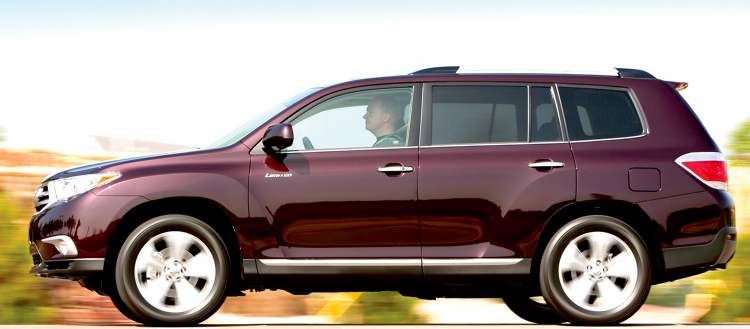
I don’t make a habit of quoting myself, but the last time I drove a Highlander, three years ago, I said: “I have long considered Toyota’s Highlander to be just like the Lexus RX 350 except for the fancy nameplate, the looks and the personality.”
I will stand by the statement today. Nothing has changed — except the mid-sized sport-utility segment itself, which has seen a greater influx of crossovers geared more for style and fuel economy.
This is not to say the Highlander has become a rolling anachronism; far from it. While I was driving the topline all-wheel-drive V6-powered Limited, there is also a hybrid version and a base front-drive four-cylinder model. Toyota has covered its bases well.
Still, the V6 4WD powertrain is what, in my mind, defines this family-focused SUV. And it goes about its business with remarkable poise. Taking my octogenarian dad to a downtown medical appointment had him — a past owner of numerous Jeeps and a fan of the brand going all the way back to the Second World War — he commented on the silky nature of Toyota’s tried-and-true 3.5-litre engine and the unruffled ride (not to mention my superb driving skills).
The well-proven 3.5L V6 continues to pump out 270 horsepower and a stout 248 pound-feet of torque, and it’s more than capable of getting the 1,960-kilogram Highlander to speed in a good time, never sounding discordant when passing or merging power is needed.
Fuel economy, considering the SUV’s size and powertrain, was predictable — 15.5 litres per 100 kilometres, with a bit more highway driving than what my usual weekly commute entails.
The V6 is mated to a five-speed automatic transmission with a manual-shifting sport mode. Hardly the last word in trannies, with many of the competition moving to six speeds and more, the unit nonetheless does a yeoman job in spreading out the power in a reasonably seamless manner.
As for the Sport mode — using the console-mounted shifter — it might prove its worth in off-road or deep snow conditions, but it’s superfluous in traffic conditions. Besides, upshifts are accomplished by pushing forward on the lever, which is counterintuitive to most longtime manual users.
Not that it got any use, thanks to the mild winter and almost total lack of snow, but the Highlander’s full-time four-wheel-drive system is there for you when road conditions get dicey, and it’s backed up by Hill-start Assist Control and Downhill Assist Control. And let’s not forget Toyota’s Star Safety System — vehicle stability control, traction control, ABS with electronic brake-force distribution and brake assist, plus Smart Stop Technology.
As much as I like the Toyota’s powertrain for its smoothness and efficiency, the real standout is its ride and handling. Having recently sampled Ford’s new Explorer and finding its electric power steering to be wooden and uncommunicative, I was delighted to discover the Highlander’s was the exact opposite. It’s quick, properly weighted and provides excellent road feedback , and the 11.8-metre turning circle isn’t bad, either.
All Highlanders feature independent suspension systems front and rear, with MacPherson gas struts, gas shock absorbers, coil springs and stabilizer bars, plus anti-vibration subframes. The result is a stable ride that isolates the worst road conditions, but it’s far from pillowy.
Inside, the Highlander’s cabin contains all the bells and whistles a top-level, sub-$50,000 sport-ute should contain — power everything, two-zone automatic climate control, heated leather seats, push-button start, high-end JBL audio system, navigation system, backup camera, Toyota’s lovely, high-visibility Optitron instrumentation and much more.
The centre console is a bit overwhelming at first, with myriad buttons and controls. But, unlike a few of the Highlander’s competitors and their complicated touchscreen systems, there are no sub-menus to scroll through — just a single push or a twist achieves the required result.
My biggest quibble with the Highlander is the same as with every mid-sized SUV or crossover that attempts three rows of seating — the limitations on comfort and cargo room caused by that last row, which is designed for the small and limber. If all three rows need to be occupied, cargo room is at a premium — only 10.3 cubic feet available.
Fortunately, dropping the back seats takes just a couple of tugs of the straps, and the 42.3 cu. ft. that open up once the seats fold flat are a lot more user-friendly.
If you’re pulling up to Whistler’s Fairmont Chateau for a weekend of skiing, the Highlander is not the rig in which to be seen — that is if you’re looking to gain even a glance from the après-ski crowd. It just isn’t the sexiest SUV on the block.
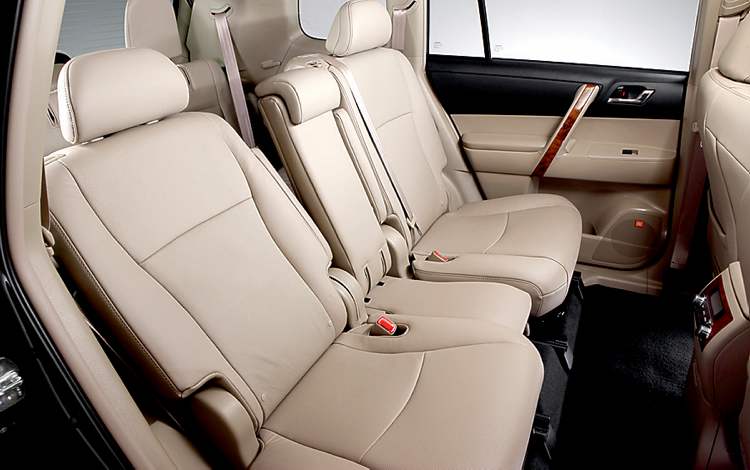
Beneath its sober skin, though, is a truly competent and comfortable vehicle that has luxury bona fides. One could certainly do a lot worse.
— Postmedia News
THE SPECS
TYPE OF VEHICLE: All-wheel-drive mid-sized crossover
ENGINE: 3.5L DOHC V6
POWER: 270 hp 6,200 rpm; 248 lb-ft of torque 4,700 rpm
TRANSMISSION: Five-speed manumatic
BRAKES: Four-wheel disc with ABS
TIRES: P245/55R19
PRICE: base/as tested: $45,075/same
DESTINATION CHARGE: $1,635
TRANSPORT CANADA FUEL ECONOMY (L/100 KM): 12.6 city, 8.7 hwy.