Left is left, right is right and ne’er the twain shall meet
Advertisement
Read this article for free:
or
Already have an account? Log in here »
To continue reading, please subscribe:

Digital Subscription
One year of digital access for only $205*
- Enjoy unlimited reading on winnipegfreepress.com
- Read the E-Edition, our digital replica newspaper
- Access News Break, our award-winning app
- Play interactive puzzles
*First annual payment billed as $205.00 + GST for one year. This annual subscription will automatically renew at $233.00 + GST every 52 weeks (10% off the regular annual price of $259.35). Offer available to new and qualified returning subscribers only. Cancel any time.
To continue reading, please subscribe:
Add Free Press access to your Brandon Sun subscription for only an additional
$1 for the first 4 weeks*
- Enjoy unlimited reading on winnipegfreepress.com
- Read the E-Edition, our digital replica newspaper
- Access News Break, our award-winning app
- Play interactive puzzles
*Your next Brandon Sun subscription payment will increase by $1.00 and you will be charged $17.95 plus GST for four weeks. After four weeks, your payment will increase to $24.95 plus GST every four weeks.
Read unlimited articles for free today:
or
Already have an account? Log in here »
Hey there, time traveller!
This article was published 21/04/2012 (5241 days ago), so information in it may no longer be current.
THE title seems pompous, but the cover hides an exhaustive and humbling search for the origins and components of morality.
Why liberal- and conservative-minded groups are vehemently and sometimes violently opposed to each other is the American social psychologist Jonathan Haidt’s main focus, revealing how emphasis upon certain foundations of moral development, like care and fairness, have led to the bitter and great divide between Republicans and Democrats.
Haidt identifies “groupishness” as the reason why good people are unable to coalesce into a single force that would obviously benefit all, but instead choose left and right political (and religious) sides of the spectrum and ignore any common foundations of morality.
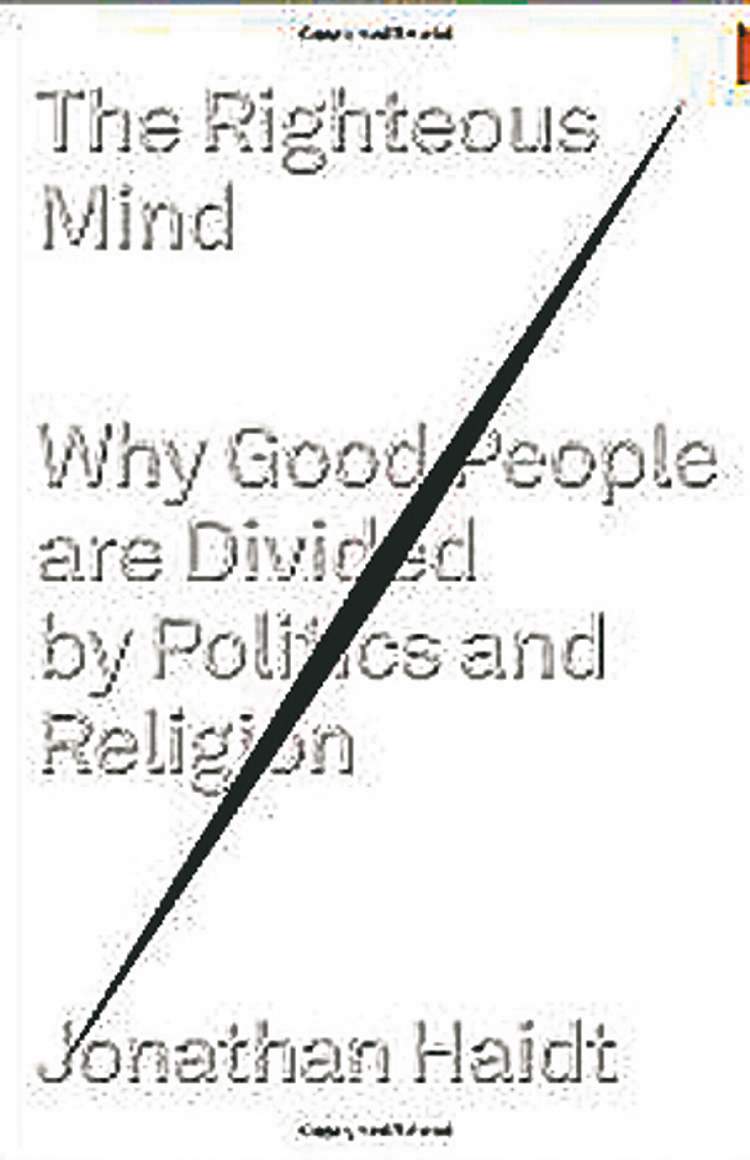
Although The Righteous Mind is a scholarly examination of a complex issue (research notes and references take up the last quarter of the book), it isn’t dauntingly cerebral.
Haidt, whose first book was 2006’s The Happiness Hypothesis, uses interesting metaphors and fluid syntax to help clarify his arguments, while symbolic photos and meaningful charts provide visual confirmation.
The book is the result of his interest in moral psychology and a quest to understand where his own Democrat (liberal) views came from.
The Righteous Mind synthesizes moral reasoning, religious thought and political analysis in three distinct parts, each with its own principle of moral psychology.
These are best read consecutively to appreciate the “ceaseless, petty, and divisive moralism” that Haidt says describes modern-day politics and religion.
Haidt suggests that relentless portrayals of religious and political adversaries as evildoers stem from moral emotions evolved in humans over the past 50,000 years.
He presents a compelling case for genetic disposition, arguing that Darwin’s theory of evolution explains an individual’s moral matrix.
Borrowing from an array of studies by social psychologists and anthropologists, he shows that individuals tend to embrace people and their viewpoints intuitively, often instantly.
So-called “rational reasons” for disliking other people and what they represent are only later confirmed within large groups (like a political party or a church), where feelings of “them” versus “us” become arguable, and worth defending.
This intuitiveness, or gut reaction, is the spark for building individual and group morality, an idea interestingly symbolized in Part I through Haidt’s metaphorical rider on an elephant.
The rider is “reason” and the elephant is “intuition.” For too long, Haidt argues, social psychologists believed that the rider was in charge, when in fact, it is the elephant that first moves right or left, leaving the rider scrambling to justify the move.
In his words, “We are deeply intuitive creatures whose gut feelings drive our strategic reasoning.”

He suggests we can gradually evolve a stronger “rider,” but only if political scientists and moral psychologists co-operate in devising forums where the moral matrices of opposing groups aren’t automatically deemed bad or unfair, but are analyzed for good commonalities.
Haidt concludes that liberals and conservatives are like the Chinese concepts of yin and yang, “necessary elements of a healthy state of political life” and wrongly demonized by each other.
There is reason for hope in this contemplative book, but readers should remember evolution is time consuming and electoral mandates have limited time offers.
Joseph Hnatiuk is a liberal-minded retired teacher in Winnipeg with some conservative-minded friends who are otherwise good people.