

Scientists create chemicals that can undergo evolution
Advertisement
Read this article for free:
or
Already have an account? Log in here »
To continue reading, please subscribe:
Digital Subscription
One year of digital access for only $1.44 a week*
- Enjoy unlimited reading on winnipegfreepress.com
- Read the E-Edition, our digital replica newspaper
- Access News Break, our award-winning app
- Play interactive puzzles
*Billed as $5.77 plus GST every four weeks. After 52 weeks, price increases to the regular rate of $19.95 plus GST every four weeks. Offer available to new and qualified returning subscribers only. Cancel any time.
To continue reading, please subscribe:
Add Free Press access to your Brandon Sun subscription for only an additional
$1 for the first 4 weeks*
- Enjoy unlimited reading on winnipegfreepress.com
- Read the E-Edition, our digital replica newspaper
- Access News Break, our award-winning app
- Play interactive puzzles
*Your next Brandon Sun subscription payment will increase by $1.00 and you will be charged $17.95 plus GST for four weeks. After four weeks, your payment will increase to $24.95 plus GST every four weeks.
Read unlimited articles for free today:
or
Already have an account? Log in here »
Hey there, time traveller!
This article was published 28/04/2012 (5178 days ago), so information in it may no longer be current.
PHILADELPHIA — Blurring the lines between life and inanimate matter, biologists announced recently they have created six different chemical alternatives to DNA and coaxed them to undergo evolution.
A description of these code-carrying molecules, called XNAs, was published in the journal Science. The work bolsters a prevailing hypothesis that life as we know it evolved from simpler life forms, no longer here, and that those evolved from something simpler. There may be no moment when the first life emerged, but instead an evolutionary process by which chemicals most of us would consider non-life gradually gave rise to living cells through natural selection.
The work on XNA molecules adds to a growing field of test-tube evolution, in which scientists are nudging code-carrying chemicals to evolve into drugs or other useful compounds.
Scientists don’t have a universal definition for life, but they do agree that to qualify as life, an organism must be subject to natural selection. All life on Earth is related and uses the same basic building blocks, but life elsewhere might be put together differently, challenging scientists to recognize it. NASA defines life as a self-replicating system capable of Darwinian evolution. They’re keeping the definition broad and their search for life as open as possible.
Biochemist John Chaput, one of the authors of the XNA paper, said evolution can happen in a molecule as long as it can carry a code and copy itself with a few errors. At that point you have something capable of heredity.
Such chemicals might be commonly thought of as primordial soup, but on a molecular scale, they are highly organized.
By most definitions, including NASA’s, these XNAs aren’t alive because they need help to replicate. Gerald Joyce, a researcher at the Scripps Research Institute in La Jolla, Calif., said that’s why he saw no particular danger at this stage. If someone spilled a flask of XNA molecules on the floor or down the drain, the molecules couldn’t multiply or infect living things. They can’t feed off our biology.

Joyce, who wrote a commentary accompanying the scientific paper, said there’s more danger in making novel organisms with traditional biochemistry, which could potentially interfere with living things. “This is more radical but less dangerous,” he said of these XNA molecules. “It’s outside our biology.”
Like DNA, these XNA molecules string together four different chemical units into long chains, thus carrying a code in four-letter alphabets. In DNA, the four chemical units are called bases and are identified by the letters A, T, C, and G. Those are attached to a backbone or scaffolding, which in DNA is made from sugars and chunks called phosphates. The XNAs use the same characters — A, T, C, and G — but the backbones that hold them together are different.
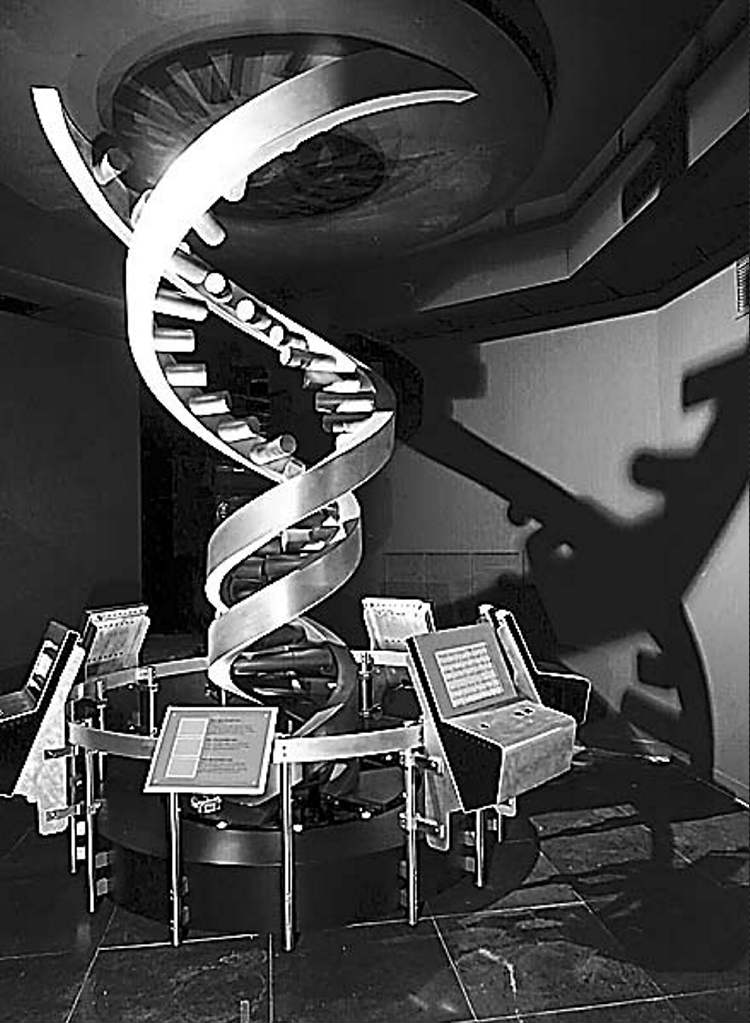
Scientists suspect DNA evolved from a simpler cousin called RNA. DNA comes as a double strand of code twisted into a spiralling ladder, while RNA is a simpler single strand. But RNA is still a complicated molecule, so scientists studying it suspect it came about from a simpler precursor that no longer exists in nature.
— The Philadelphia Inquirer