

Who is really getting railroaded?
Advertisement
Read this article for free:
or
Already have an account? Log in here »
To continue reading, please subscribe:

Digital Subscription
One year of digital access for only $205*
- Enjoy unlimited reading on winnipegfreepress.com
- Read the E-Edition, our digital replica newspaper
- Access News Break, our award-winning app
- Play interactive puzzles
*First annual payment billed as $205.00 + GST for one year. This annual subscription will automatically renew at $233.00 + GST every 52 weeks (10% off the regular annual price of $259.35). Offer available to new and qualified returning subscribers only. Cancel any time.
To continue reading, please subscribe:
Add Free Press access to your Brandon Sun subscription for only an additional
$1 for the first 4 weeks*
- Enjoy unlimited reading on winnipegfreepress.com
- Read the E-Edition, our digital replica newspaper
- Access News Break, our award-winning app
- Play interactive puzzles
*Your next Brandon Sun subscription payment will increase by $1.00 and you will be charged $17.95 plus GST for four weeks. After four weeks, your payment will increase to $24.95 plus GST every four weeks.
Read unlimited articles for free today:
or
Already have an account? Log in here »
Hey there, time traveller!
This article was published 26/05/2012 (5163 days ago), so information in it may no longer be current.
Striking CP railway engineers and conductors aren’t getting any moral support from farmers in their bid to get a better deal from the railway this week.
Letters calling for the government to intervene, basically ceding the balance of power to the railway, were on their way to the federal minister before the workers even walked off the job.
This was par for the course. Farmers have historically bashed unions for sport. But it’s odd posturing on their part, because both groups are essentially in the same position — struggling to negotiate a better deal without any of the usual tools to make it happen.
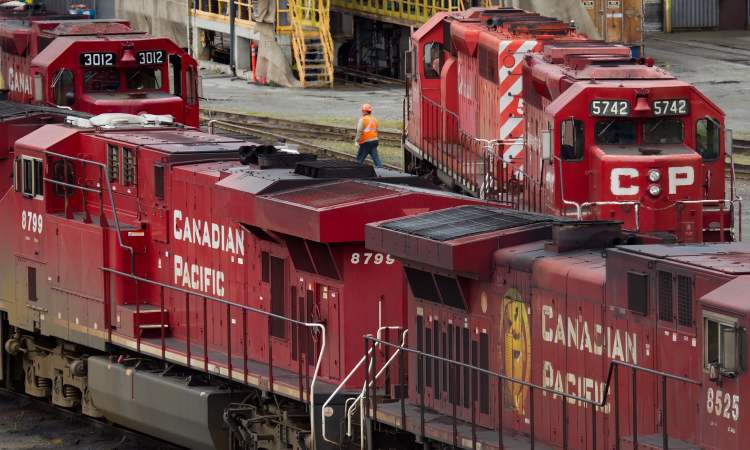
The workers, like any other unionized worker in this country, must have known when they walked off the job the Harper government would quickly intervene, as it appears will be the case next week, to legislate them back to work.
Apparently nothing, not even the long-held rights of workers to collectively withdraw their services in seeking better working conditions or a fairer distribution of corporate wealth, can be allowed to stand in the way of the free-market economy.
As for the farmers, they’ve been promised regulation that will make it easier for them to negotiate service agreements with the railways, but they aren’t seeing much action.
Right now, shippers face steep penalties if the railway rolls up to the siding and they aren’t ready to load. But there is no counter-remedy if the railway arrives late, sometimes by days, or sends fewer cars than were ordered.
Former Alberta treasury minister Jim Dinning recently added his name to the long list of notables who have tried and failed over the past half-century or so to consult the industry and come up with solutions to grain-transportation issues. This time it was railway-service accountability.
Dinning was appointed last fall to get the railways and its customers to agree to service agreements and a streamlined commercial dispute-resolution process. He wasn’t successful and it’s hoped the federal government will introduce legislation this fall to force the railways to play nice.
However, in the meantime, the federal Grain Transportation Agency approved a whopping 9.5 per cent increase in the revenue cap — a regulatory ceiling on how much the railways can charge for their services in the coming crop year.
The move infuriated farmers who already think they are being charged too much for service that may or may not be provided.
Doug Faller, the policy adviser for the Agricultural Producers Association of Saskatchewan, estimates the change will add $3 per seeded acre to Prairie farmers’ costs.
“Most of the 9.5 per cent increase has little to do with the actual costs of hauling grain,” Faller said in a published opinion piece. “In fact, the price index for the actual costs of hauling grain went up by only 1.6 per cent.”
Most of the increase relates to changes in how the CTA calculates the railways’ corporate costs such as pensions and the “cost of equity” — how much shareholders need to get in order to compensate them for their investment risks.
Faller questions how much risk there is in investing in Canada’s two national railways. After all, they have monopolistic control over rail freight. CN’s share price has risen 400 per cent since 2003 and CP’s has gone up 250 per cent.
“From 2001 to 2012, CN dividends on their shares have increased every year, a total of 388 per cent, while CP dividends have increased eight of 11 years, a total of 275 per cent. The revenue cap for grain has never prevented the railways from meeting their cost of equity.”
As for the pensions, at least the farmers don’t blame the employees for this one, but rather the skyrocketing cost of retiring senior executives.
“For example, the CEO of Canadian Pacific is entitled to a pension at age 65 of $1.122 million, according to their 2011 annual meeting information.”
“Is it really true that CN and CP need more money from farmers to fund their pension plans?” Faller asks.
He further points out the net income for the railways in 2011 was at least 25 per cent higher than the combined net income before tax for all Prairie farmers.

His conclusion is the revenue cap for grain does not limit the railway’s ability to attract shareholders.
But at the same time, there are some influential voices, including the federal agriculture minister’s, who question whether capping railway revenues is really just getting in the way of a more efficient system.
In the end, railway workers and farmers may find themselves in the same boat, with one bristling over too much regulation and the other over too little.
Laura Rance is editor of the Manitoba Co-operator. She can be reached at 792-4382 or by email: laura@fbcpublishing.com .