Earthship takes shape
Living off the grid: It's not just for hippies, hermits and survivalists anymore
Advertisement
Read this article for free:
or
Already have an account? Log in here »
To continue reading, please subscribe:

Digital Subscription
One year of digital access for only $205*
- Enjoy unlimited reading on winnipegfreepress.com
- Read the E-Edition, our digital replica newspaper
- Access News Break, our award-winning app
- Play interactive puzzles
*First annual payment billed as $205.00 + GST for one year. This annual subscription will automatically renew at $233.00 + GST every 52 weeks (10% off the regular annual price of $259.35). Offer available to new and qualified returning subscribers only. Cancel any time.
To continue reading, please subscribe:
Add Free Press access to your Brandon Sun subscription for only an additional
$1 for the first 4 weeks*
- Enjoy unlimited reading on winnipegfreepress.com
- Read the E-Edition, our digital replica newspaper
- Access News Break, our award-winning app
- Play interactive puzzles
*Your next Brandon Sun subscription payment will increase by $1.00 and you will be charged $17.95 plus GST for four weeks. After four weeks, your payment will increase to $24.95 plus GST every four weeks.
Read unlimited articles for free today:
or
Already have an account? Log in here »
Hey there, time traveller!
This article was published 10/07/2012 (5178 days ago), so information in it may no longer be current.
Most people who decide to build their dream home probably wouldn’t dream of asking their friends and co-workers to help out by collecting bottles and cans.
But in the case of Nicole Bennett and Kris Plantz, who also gratefully accepted a donation of hundreds of old tires from the Clandeboye dump, one man’s trash is literally another man’s housewarming gift.
The couple just sold their Fort Rouge house and moved to the Rural Municipality of St. Andrews, where they (and about 70 volunteers) are transforming the aforementioned recyclables into an eco-friendly, energy-efficient abode called an earthship.
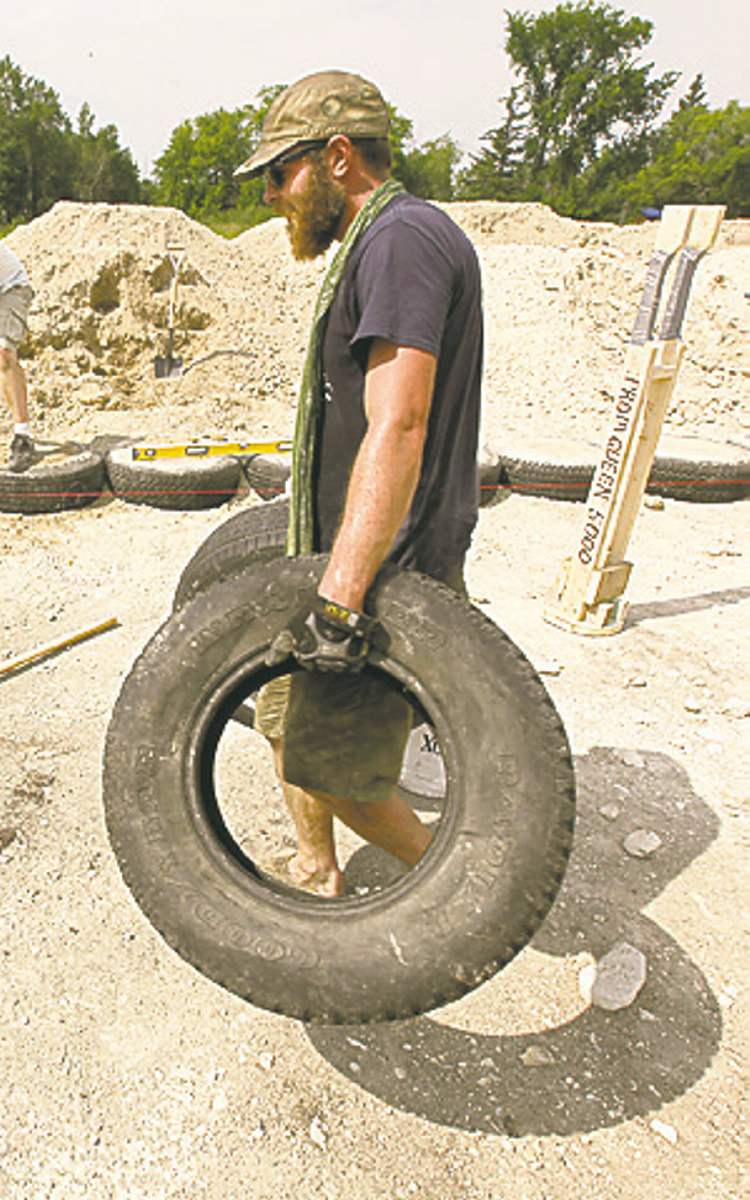
Dirt is being pounded into those tires as we speak. They’ll get stacked like circular bricks to form a dense, load-bearing outer wall that will store heat and release it slowly, keeping the indoor temperature constant regardless of outside conditions.
Inside, the aluminum cans and glass bottles — which Plantz spent months cutting in half and then taping together to form bottle bricks — will be used for partitions and interior walls.
This will be Manitoba’s first earthship, built upon the principles of "biotecture" (biology + architecture) developed by radical American architect Michael Reynolds, a proponent of "radically sustainable" living.
brightcove.createExperiences();
When all is said and done, Bennett and Plantz, both 34, expect to have invested around $285,000 in their Manitoba Earthship Project — a 1,800-square-foot house sitting on a 66-acre former farm lot. They’ll live in a trailer on the property until the cold comes and then bunk with friends in the city.
And if all goes as planned, by the end of next summer, they’ll be living in a home that regulates its own temperature (using the sun and the Earth), generates its own electricity (from sun and wind), harvests its own water (from rain and snow), treats its own sewage and produces most of its own food with minimal to no utility bills.
It might not be easy being this green — they’ll have a garden growing inside the house — but Bennett, a software project manager and lifelong "city girl," says she and her environmental technologist husband won’t exactly be roughing it either.
"I love the way the earthship works with the climate and with the Earth rather than against it, but I also want the Internet," she says, sitting among Apple computer boxes in the living room of her century-old, 1,700-square-foot McMillan Avenue house, where monthly hydro bills have topped $500.
"I have a professional job in the city that I will continue to do. We have friends and family and we still want to participate in society."
Living off the grid: It’s not just for hippies, hermits and the Amish anymore.
People unplug from conventional heat, power and water sources for many reasons, and today you’ll find them living in rustic cabins in the Yukon woods as well as sprawling country homes, floating coastal abodes, Prairie farm co-ops and even in downtown Edmonton.
Canada’s off-gridders are a very diverse bunch, says Phillip Vannini, a Victoria researcher who’s spending two years travelling across the country to study them. He’s visited seven provinces, including Manitoba, since January.
While most of the people he interviewed are seeking independence and self-sufficiency, he says, many are also motivated by concern for the environment, while some unplugged because they found a piece of land they loved and connecting to the electricity grid was cost-prohibitive. Contrary to stereotype, there were also those who have never hugged a tree in their life and rely entirely on fuel generators.
Vannini, 37, a Royal Roads University sociology professor/ethnographer whose research is funded by the Social Sciences and Humanities Research Council of Canada (SSHRC), says regardless of their motivation for disconnecting from the various utilities networks that define modern society, his subjects can teach the rest of us "on the grid" a lesson or two about our mindless dependence on non-renewable resources.
"We’re trying to get a glimpse of the future," Vannini said of his mission during a recent week-long visit to Manitoba, during which he and videographer Jonathan Taggart, 27, visited eight different off-grid, rural residences.
"As a society, we’re constantly being told that we’re going to have to make sacrifices and reduce our comforts and conveniences because of dwindling resources and skyrocketing prices. So we wanted to see what life is like for people living on minimal resources, whether they are making those sacrifices and how they’re adapting."
Quite well, it turns out.
There are "some inconveniences and adaptations," but no one really seemed to be sacrificing comfort, Taggart says. Walking into most of the homes, you couldn’t tell they were off the grid, he says, until you started examining how their washroom facilities and appliances work.
Some people, of course, might see chopping wood to feed wood stoves and boilers as an inconvenience. And no doubt patience is a virtue when adapting to solar energy as your main source of light and power.
"Sometimes children are told not to play video games because it’s not a sunny day," Vannini notes.
Southern Manitoba is an off-grid-friendly province, he says, because we’re one of the sunniest places in the country. While diesel, gas or propane-fueled backup generators are common in unplugged homes, he didn’t come across a single one in his travels.
Our relatively low land prices also make it easier to unplug here, Vannini says, given the old rule of thumb that you need at least 10 acres to live off the land.
"To own 10 acres in some parts of Canada, you need to be wealthy," he says. "Here in Manitoba we visited quarter sections and larger acreages that were bought for very little money by people who have been able to live on them without needing to find much paid labour off their site.
"Off-grid living entails tasks that are time-consuming, and it’s not easy to work 9 to 5 and them come home to grow food or chop wood."
Right. Who needs a day job when you can live on between $2,000 and $3,000 a year?
"Living here is so economical, there’s no point," says Gerhard Dekker, a founding member of the Northern Sun Farm Co-op, who has been living off the grid for 33 years.
The 12-member collective, the members of which live in family groups, sits on 240 acres just south of Steinbach. They raise (chickens, rabbits and pigs) or grow most of their own food, and sell some of their garlic.
When he first bought the land, the city-bred Dekker, 65, says, there was no Hydro service and he decided it would be more "interesting" to try going without.
When you have a Hydro connection, he says, you end up working just to buy all kinds of things to hook up to it. The farm has a phone and Internet, but no TV. Socializing and music are the main forms of entertainment.
Dekker cautions that one has to be self-motivated to be self-sustainable, and that it’s probably not for everybody.
"At this time of year, I don’t buy a lot of cream," he laughs. "We don’t have much refrigeration, just some holes in the ground."
But losing a few creature comforts is nothing compared with the benefits of living off the land — and off the grid, says Dekker, who sums those up in a word: "freedom."
At a time when non-renewable energy resources are becoming increasingly scarce, Canada’s off-gridders are proving that adopting a more energy-efficient lifestyle isn’t as scary or intimidating or Spartan as it might seem, says Vannini, who plans to share what he has learned through an upcoming documentary and book.
"The message is that you can do with less if you choose to," he says.
Meanwhile, the Northern Sun Farm Co-op isn’t actively recruiting members, but it is "in a growth phase," Dekker reports.
"I don’t know if (the off-grid lifestyle) is going to catch on big," he says, "but it’s not going to go away."
carolin.vesely@freepress.mb.ca
Radically sustainable, and then some
— The government of Canada defines "off-the-grid" as a household or community that is not connected to the electricity grid and natural gas pipeline servicing a province or territory.
— The off-grid homes he visited typically use one-tenth or less of the power consumed by a normal urban home, says ethnographer Phillip Vannini, who is visiting off-gridders across the country as part of a two-year, tax-funded research project

— Earthships collect rainwater and reuse it up to four times to flush toilets and feed indoor gardens and outdoor landscaping.
— They also contain and treat household sewage in indoor and outdoor botanical cells that feed food gardens and outdoor landscaping.
— Indoor "wetlands" provide balanced humidity and a constant supply of fresh air.
— Earthship.com
Our newsroom depends on a growing audience of readers to power our journalism. If you are not a paid reader, please consider becoming a subscriber.
Our newsroom depends on its audience of readers to power our journalism. Thank you for your support.