

PM delivers lake cleanup cash
Lake Winnipeg gets $18 million, but ELA, 'that other project,' zilch

Advertisement
Read this article for free:
or
Already have an account? Log in here »
To continue reading, please subscribe:
Digital Subscription
One year of digital access for only $75*
- Enjoy unlimited reading on winnipegfreepress.com
- Read the E-Edition, our digital replica newspaper
- Access News Break, our award-winning app
- Play interactive puzzles
*Billed as $5.77 plus GST every four weeks. After 52 weeks, price increases to the regular rate of $19.95 plus GST every four weeks. Offer available to new and qualified returning subscribers only. Cancel any time.
Monthly Digital Subscription
$4.99/week*
- Enjoy unlimited reading on winnipegfreepress.com
- Read the E-Edition, our digital replica newspaper
- Access News Break, our award-winning app
- Play interactive puzzles
*Billed as $19.95 plus GST every four weeks. Cancel any time.
To continue reading, please subscribe:
Add Free Press access to your Brandon Sun subscription for only an additional
$1 for the first 4 weeks*
- Enjoy unlimited reading on winnipegfreepress.com
- Read the E-Edition, our digital replica newspaper
- Access News Break, our award-winning app
- Play interactive puzzles
*Your next Brandon Sun subscription payment will increase by $1.00 and you will be charged $17.95 plus GST for four weeks. After four weeks, your payment will increase to $24.95 plus GST every four weeks.
Read unlimited articles for free today:
or
Already have an account? Log in here »
Hey there, time traveller!
This article was published 03/08/2012 (5040 days ago), so information in it may no longer be current.
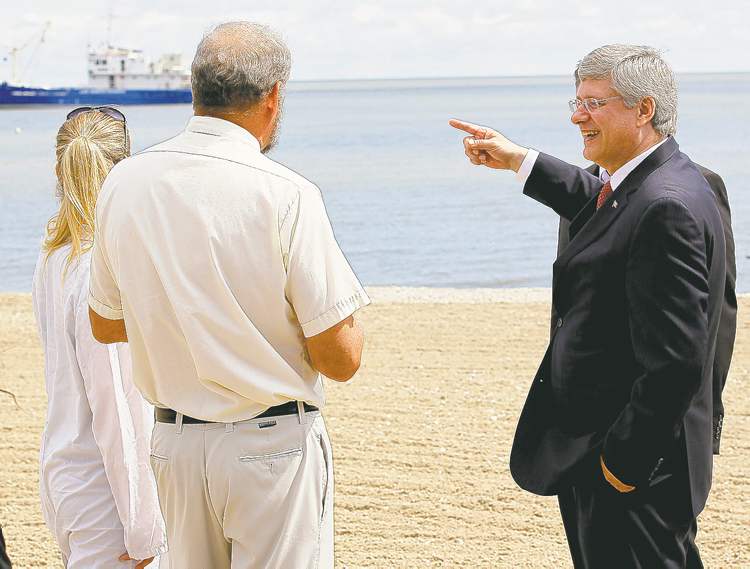
GIMLI — Prime Minister Stephen Harper, with an entourage of MPs, cabinet ministers and senators in tow, pledged $18 million here Thursday to clean up Lake Winnipeg but wouldn’t throw the Experimental Lakes Area a lifeline.
“Our priority in this area is this particular project (Lake Winnipeg), and obviously we are not intending to continue that other project,” Harper told a press conference at a hotel on the lakeshore.
Outside, demonstrators, some wearing bikinis, carried signs protesting his government’s decision to pull the plug on funding for northwestern Ontario’s Experimental Lakes Area.
“The ELA is pivotal to the health of Lake Winnipeg,” Diane Orihel, the leader of the Coalition to Save the ELA, said outside the hotel after the prime minister’s announcement.
The experimental lakes were set up in the 1960s to study algae blooms on Lake Erie, she said. ELA staff were responsible for surveys of Lake Winnipeg in the 1960s and were instrumental in discovering the major changes in Lake Winnipeg after the 1997 Red River flood.
Massive blooms of blue-green algae plague the lake every summer, Orihel said. Algal blooms kill fish, increase the cost of water treatment, devalue shoreline properties and pose health risks to children, pets and livestock, the University of Alberta doctoral student said.
She and Manitoba Liberal Leader Jon Gerrard applauded funds for researching and cleaning up Lake Winnipeg, but want Ottawa to save and support the experimental lakes research as well.
“It’s positive support for Lake Winnipeg, but we also need support for the Experimental Lakes Area,” Gerrard said next to the beach at Gimli.
The ELA’s 58 northwestern Ontario lakes are the site of world-class research at the forefront of understanding algal blooms, and the Conservative government is shutting it down, said Orihel.
But on Thursday, Harper was only promising money for Lake Winnipeg to “turn science into action.”
The funding is for the second phase of the Lake Winnipeg cleanup initiative begun in 2006, when it looked like “it was the beginning of the end for Lake Winnipeg,” the prime minister said.
With half the algae-promoting nutrients in the lake coming from outside Manitoba, co-ordinating the cleanup has been a major undertaking involving four provinces and four U.S. states, he said.
For every dollar Ottawa spends, the province and other partners in the cleanup pitch in $2, Harper said.
“We are leaving our bit of the world a better place,” he said.
The “national treasure” supports $100 million in tourism and a $50-million commercial fishery that produces one-quarter of Canada’s freshwater fish.
The press conference on the eve of Gimli’s Icelandic festival was attended by cabinet ministers Lisa Raitt and Vic Toews and several Manitoba MPs, including Conservative MP James Bezan (Selkirk-Interlake).
Orihel took Bezan to task for comments he reportedly made last week that “research is best served by working on exactly where the problem lies.”
She said Bezan is incorrect. Restoring Lake Winnipeg will require a combination of monitoring the state of the lake and performing controlled experiments in model systems to test hypotheses concerning the causes and solutions to the lake’s poor health, she said. The coalition says the Conservatives are creating a false dichotomy, pitting funding for Lake Winnipeg against funding for the ELA.
“Much of the fundamental understanding of nutrient management in lakes so critical to the recovery of Lake Winnipeg has and is being developed at the ELA,” Ray Hesslein of the Lake Winnipeg Foundation science advisory board said in a prepared statement.
The one-of-a-kind ELA field research station is run by federal government scientists at the Department of Fisheries and Oceans’ Freshwater Institute in Winnipeg.
A spokesman for the Manitoba government said the province is already funding much of the programming to which Ottawa committed money Thursday. “We know Lake Winnipeg is a critical economic and ecological resource in Manitoba and we want to work closely with the federal government as we collectively meet the challenges of cleaning it up,” the spokesman said.

— with file from The Canadian Press
carol.sanders@freepress.mb.ca
Lake Winnipeg Basin Initiative
Phase I (2008-12)
Environment Canada researchers investigated water-quality issues within the lake and its watershed, including the movement of nutrients that contribute to algae growth, and provided support for community-based projects led by communities, conservation authorities, non-profit groups, schools and universities.
Price
$17.7 million committed over four years — $12.1 million for scientific research, $3.7 million for community stewardship programs and $1.9 million for collaboration on watershed governance.
Phase II (2012-17) goals

Build on Phase I and target the stewardship program to areas that need funding the most and on actions that have the best possible effect on water quality; implement greater watershed research and monitoring; increase collaboration between federal, provincial and state partners to develop nutrient-reducing agreements.
Price
$18 million
— source: Prime Minister’s Office
Carol Sanders
Legislature reporter
Carol Sanders is a reporter at the Free Press legislature bureau. The former general assignment reporter and copy editor joined the paper in 1997. Read more about Carol.
Every piece of reporting Carol produces is reviewed by an editing team before it is posted online or published in print — part of the Free Press‘s tradition, since 1872, of producing reliable independent journalism. Read more about Free Press’s history and mandate, and learn how our newsroom operates.
Our newsroom depends on a growing audience of readers to power our journalism. If you are not a paid reader, please consider becoming a subscriber.
Our newsroom depends on its audience of readers to power our journalism. Thank you for your support.
Carol Sanders
Legislature reporter
Carol Sanders is a reporter at the Free Press legislature bureau. The former general assignment reporter and copy editor joined the paper in 1997. Read more about Carol.
Every piece of reporting Carol produces is reviewed by an editing team before it is posted online or published in print — part of the Free Press‘s tradition, since 1872, of producing reliable independent journalism. Read more about Free Press’s history and mandate, and learn how our newsroom operates.
Our newsroom depends on a growing audience of readers to power our journalism. If you are not a paid reader, please consider becoming a subscriber.
Our newsroom depends on its audience of readers to power our journalism. Thank you for your support.

Advertisement Advertise With Us
Advertisement Advertise With Us