

Ghetto gets trendy
Venice's Jewish quarter popular tourist destination
Advertisement
Read this article for free:
or
Already have an account? Log in here »
To continue reading, please subscribe:
Monthly Digital Subscription
$0 for the first 4 weeks*
- Enjoy unlimited reading on winnipegfreepress.com
- Read the E-Edition, our digital replica newspaper
- Access News Break, our award-winning app
- Play interactive puzzles
*No charge for 4 weeks then price increases to the regular rate of $19.00 plus GST every four weeks. Offer available to new and qualified returning subscribers only. Cancel any time.
Monthly Digital Subscription
$4.75/week*
- Enjoy unlimited reading on winnipegfreepress.com
- Read the E-Edition, our digital replica newspaper
- Access News Break, our award-winning app
- Play interactive puzzles
*Billed as $19 plus GST every four weeks. Cancel any time.
To continue reading, please subscribe:
Add Free Press access to your Brandon Sun subscription for only an additional
$1 for the first 4 weeks*
*Your next subscription payment will increase by $1.00 and you will be charged $16.99 plus GST for four weeks. After four weeks, your payment will increase to $23.99 plus GST every four weeks.
Read unlimited articles for free today:
or
Already have an account? Log in here »
Hey there, time traveller!
This article was published 25/08/2012 (4873 days ago), so information in it may no longer be current.
“Hath not a Jew eyes?” asked the most famous Jewish Venetian, Shakespeare’s Shylock. “If you prick us, do we not bleed?”
By the end of the 16th century, when The Merchant of Venice was written, the moneylender’s real-life Venetian brethren had been sequestered in a ghetto for close to a century. In fact, Venice’s Jewish ghetto was the first such confinement of Jews anywhere. The practice, of course, was repeated throughout Europe in the centuries that followed, culminating in the Jewish ghettos of the Nazi era.
And of all of them, Venice’s may be the only one that could ever have been labelled as something approaching charming.

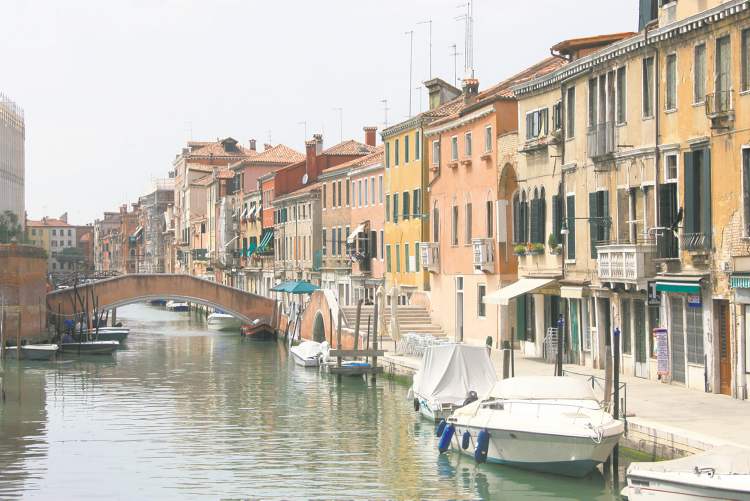
The Ghetto Nuovo (New Ghetto) was established by the doges, Venice’s ruling council, on March 30, 1516 (a date seared into Jewish memories here) on a small, dirty island in the city’s Cannaregio district. Touted in every tourist guide, it is now a trendy destination, especially if you’re in the market for gorgeous, hand-blown Venetian glass candle holders, dreidels or other religious items.
The word itself is uniquely Italian, corrupted from getto, meaning “casting,” or perhaps from the Venetian dialect geto, meaning “foundry,” both originally sounded with a soft “g,” and harking back to the nearby ironworks factories.
The area is accessible either by water-taxi or vaporetti, the public motorboat buses. Just say “ghetto” and the driver will know where to go.
At roughly its original 5,000 square metres, today it consists of a large cobblestoned central square, a jumble of slender alleys, two kosher eateries, shops, tiny apartments and five synagogues that are so old they are no longer perpendicular to the ground. Even if you don’t keep kosher, either restaurant is a must for sampling the great Italian-Jewish specialty: deep-fried, super-crunchy artichokes the size of your head.
Marco, our guide, gets our attention when he tells us Jews wanted to live in the ghetto: “It was like — how do you say in America? — a gated community. The Jews felt safe.”
It’s true they were protected from marauders, but they could not leave from sunset to dawn. The area was shuttered by huge gates manned by Christian guards. The marks of the hinges are still visible.
Jews were permitted only to operate pawn shops, lend money (the Church forbade the profession for Catholics), work the Hebrew printing press, practise medicine (because they were the most equipped to understand the best medical texts of the day, which were in Arabic) and be strazzarioli, rag sellers.
At the height of the Venice ghetto, more than 5,000 people lived in these cramped circumstances. If they had to leave the ghetto, the men were required to sport yellow badges stitched on the left shoulder or sometimes a pointy yellow hat; women wore a yellow scarf.
Some Jews were also tanners and used fire and urine to tan their cattle hides. They “smelled so bad,” Marco relays, “they were not obliged to go to the synagogue.” And in case anyone was wondering, a 500-year-old rabbinical decree from Amsterdam still holds: Rowing is not a form of work and is thus permissible on Jewish holy days (dodging Jewish law, Venetian Jews extend that ruling to the operation of motorboats).
The ghetto was originally set up for Ashkenazic, or European Jews. Following an influx of wealthier Sephardic Jews from Iberia who evidently wanted their own “gated community,” the Ghetto Vecchio (misleadingly, “old ghetto”) was established in 1541 right next door.
The five synagogues (called schole) were built between 1528 and 1580, the European ones teetering on the top floors of existing buildings (anything more than six storeys is called a “skyscraper”), while the two Sephardi houses of worship, located across a lane from each other, are the only synagogues still in use today. Only one is heated, so worshippers alternate them between summer and winter.
A treat is a guided tour of the oldest one, the Great German Schola or Sinagoghe Grande Tedesca, a tiny jewel, dark with mahogany and crimson, creaky and musty. The weight of the imposing pulpit in the middle of the sanctuary eventually made the floor sag, which is why pulpits in other synagogues were henceforth located on the side.
The ghetto’s gates came crashing down when Napoleon’s army entered Venice in 1797, though many Jews chose to stay.
Venice’s Jewish community today numbers about 400, though only about two dozen live in the ghetto. Unlike in Florence or Rome, where expensive ghetto apartments have been renovated, the ones in Venice remain cramped and dingy, with very low ceilings.
Who else lives here? “Very short people,” Marco says.
— Postmedia News