

Pork industry’s muddy image
Austin tragedy didn't help

Advertisement
Read this article for free:
or
Already have an account? Log in here »
To continue reading, please subscribe:
Monthly Digital Subscription
$0 for the first 4 weeks*
- Enjoy unlimited reading on winnipegfreepress.com
- Read the E-Edition, our digital replica newspaper
- Access News Break, our award-winning app
- Play interactive puzzles
*No charge for 4 weeks then price increases to the regular rate of $19.00 plus GST every four weeks. Offer available to new and qualified returning subscribers only. Cancel any time.
Monthly Digital Subscription
$4.75/week*
- Enjoy unlimited reading on winnipegfreepress.com
- Read the E-Edition, our digital replica newspaper
- Access News Break, our award-winning app
- Play interactive puzzles
*Billed as $19 plus GST every four weeks. Cancel any time.
To continue reading, please subscribe:
Add Free Press access to your Brandon Sun subscription for only an additional
$1 for the first 4 weeks*
*Your next subscription payment will increase by $1.00 and you will be charged $16.99 plus GST for four weeks. After four weeks, your payment will increase to $23.99 plus GST every four weeks.
Read unlimited articles for free today:
or
Already have an account? Log in here »
Hey there, time traveller!
This article was published 08/09/2012 (4839 days ago), so information in it may no longer be current.
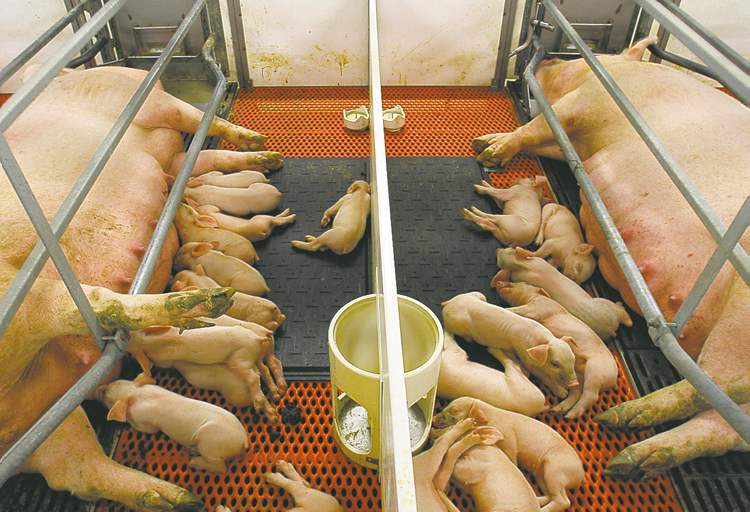
Animal welfare in modern hog production has long been controversial.
On one hand, the pigs in these production systems are well-fed, and protected from disease and predators in climate-controlled housing that boasts fewer drafts than many homes.
On the other, critics argue these animals live in factories, lacking the freedom to exhibit “natural” behaviours, which makes these systems abusive by design.
Those ongoing debates aside, there is little disagreement between industry leaders and the general public that mistreatment, whether it is through neglect or cruel handling, cannot be tolerated. The hog industry, like other livestock sectors, participates fully in establishing nationally recognized standards of care — a process that involves veterinarians as well as humane societies.
But as details emerged from the gruesome scene at an Austin-area hog barn recently, some in the farming community seized the opportunity to highlight for reporters the dismal economic conditions facing hog farmers right now.
Their comments were about hard times befalling the sector as a result of the U.S. drought and its effect on feed costs. Some even expressed sympathy for the producers, now under investigation after provincial authorities euthanized 1,300 young pigs they decided were in “severe distress.”
The public was told weanlings are not only worthless, they have suddenly become a liability that can’t even be given away. Producers are facing losses of up to $52 a pig when a few short months ago, they were hoping to crawl back into profitable times.
There is no denying these are desperate and heartbreaking times for those in the hog business, many of whom are still struggling to recover from the 2008-09 crisis.
However, the Manitoba Pork Council, which alerted authorities to the situation in Austin, was quick to see the folly in linking the two issues.
Officials emphasized the hog-barn tragedy is about animal care. The other — the potential for an industry collapse similar to what occurred four years ago — is economic. Many producers are depopulating their barns to cut their losses; it’s happening in an orderly fashion that doesn’t involve rifles.
It’s an important distinction for a sector that cannot exist without the support of consumers, regulators and right now, taxpayers.
The blunt truth is, when something like this happens, the public doesn’t care whether the producer in charge was solvent. What registers is hundreds of animals died a horrible death because humans messed up.
When incidents like this one are linked to economic conditions in the industry, it sends the wrong message to the non-farming public, which is already skeptical of accepted industry practices such as sow stalls. People wonder whether allowing pigs to suffer because they aren’t worth anything is another one of those practices.
Even when hard times are used as a backdrop to why these kinds of abusive circumstances can unfold, it serves to perpetuate negative perceptions.
The hog industry’s relationship with animal welfare groups in Canada is less than cordial. Many accuse hog producers of being slow to acknowledge production practices like sow stalls need to be phased out.
But the scene north of the border is a far cry from how things are unfolding in the U.S., where an outright war is waging on several fronts.
People for the Ethical Treatment of Animals (PETA) has started targeting 4-H youth with its message, and the Humane Society of the U.S. is buying stock in key livestock industry investment funds to try to influence change at that level.
After damning videos surfaced documenting cruel handling in some livestock operations in Iowa, legislators there took action — to jail the whistleblowers. Applying for a job in an intensive livestock operation with the intent to expose maltreatment is now a serious offence in that state.

In Kansas, state fair officials rented booth space to PETA, but decided the group can only show its videos of animal slaughter on request and out of public view. When the group appealed to the courts arguing freedom of speech, a federal judge backed the fair board.
The livestock industry celebrates winning these battles while slowly losing the war. U.S. meat consumption has dropped 12 per cent between 2007 and 2012. Nearly one-fifth of Americans now claim to participate in Meatless Mondays. People are citing a host of dietary, economic and ethical reasons for cutting back on meat, but animal welfare and concerns about intensive livestock operations rank near the top.
Society’s ongoing love affair with bacon would suggest most consumers would prefer to remain customers of the pork industry. A much better approach is to clean up the industry’s image. That can only happen from the inside out.
Laura Rance is editor of the Manitoba Co-operator. She can be reached at 204-792-4382 or by email: laura@fbcpublishing.com
Laura Rance is editorial director at Farm Business Communications.
Our newsroom depends on a growing audience of readers to power our journalism. If you are not a paid reader, please consider becoming a subscriber.
Our newsroom depends on its audience of readers to power our journalism. Thank you for your support.
Laura Rance is editorial director at Farm Business Communications.
Our newsroom depends on a growing audience of readers to power our journalism. If you are not a paid reader, please consider becoming a subscriber.
Our newsroom depends on its audience of readers to power our journalism. Thank you for your support.
Advertisement Advertise With Us
Advertisement Advertise With Us