

Gohe, Gohe… GONE
Mop up every last drop of the Ethiopian goodness
Advertisement
Read this article for free:
or
Already have an account? Log in here »
To continue reading, please subscribe:
Monthly Digital Subscription
$1 per week for 24 weeks*
- Enjoy unlimited reading on winnipegfreepress.com
- Read the E-Edition, our digital replica newspaper
- Access News Break, our award-winning app
- Play interactive puzzles
*Billed as $4.00 plus GST every four weeks. After 24 weeks, price increases to the regular rate of $19.95 plus GST every four weeks. Offer available to new and qualified returning subscribers only. Cancel any time.
Monthly Digital Subscription
$4.99/week*
- Enjoy unlimited reading on winnipegfreepress.com
- Read the E-Edition, our digital replica newspaper
- Access News Break, our award-winning app
- Play interactive puzzles
*Billed as $19.95 plus GST every four weeks. Cancel any time.
To continue reading, please subscribe:
Add Free Press access to your Brandon Sun subscription for only an additional
$1 for the first 4 weeks*
*Your next subscription payment will increase by $1.00 and you will be charged $16.99 plus GST for four weeks. After four weeks, your payment will increase to $23.99 plus GST every four weeks.
Read unlimited articles for free today:
or
Already have an account? Log in here »
Hey there, time traveller!
This article was published 22/11/2012 (4879 days ago), so information in it may no longer be current.
There’s nothing about Gohe that suggests Ethiopia — no evocative photographs, none of the charming basketry or other artifacts one sees in other Ethiopian restaurants. It’s just a simple but comfortable room done in earth tones of beige, caramel and dark brown, with five television sets — high up on the walls, though, and all mercifully silent.
The menu reads like most other Ethiopian menus and is comparably priced, with entries from $11.99 to $14.99. Of course, there are the usual combos — one with two meats, the other composed mostly of veggies — and although all dishes are reasonably well described on the menu, the combos take the pain out of making decisions.
There can sometimes be another kind of pain for anyone unfamiliar with Ethiopian spicing — I once burned my tongue so badly I kept wrapping it in injera bread, hoping to put out the fire.
There are no such dangers here. You can name your preferred degree of heat, and even though we forgot to mention how spicy we wanted our food, nothing we had was close to incendiary.
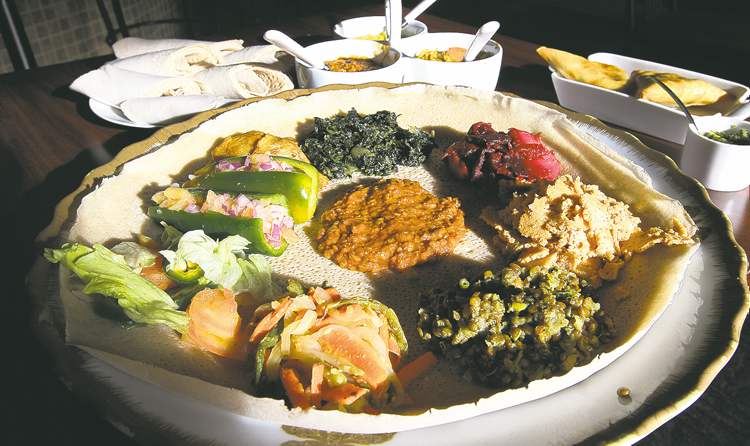
We started with crisp, greaseless samosas, densely filled with lentils with an almost meaty texture, and a slight nip ($2 each). Then came a large circular platter lined with cold injera, a spongy, sour-dough pancake, with more soft folds of it on the side. I prefer my injera warm; on the other hand, it was particularly tasty. Forks are available for the asking, but the traditional way of eating is to tear off swatches and use them to scoop up the food.
Unlike the service in other Ethiopian restaurants, only the perimeter of the platter was dotted with dollops of the combo vegetables. They were milder than the meat dishes, but far from bland, most notable among them the dark lentils, which were soft but not pasty, the collard greens and the cabbage cooked with carrots. The beet and potato salad would have been terrific if the potatoes had been fully cooked. On the other hand, the lovely lettuce salad was marinated in a subtle vinaigrette that would have done any upscale restaurant proud.
The centre of the platter was empty when it arrived, but was soon filled out with some of the sauceless (i.e. not stewed) meats. The superb kitfo alone would make Gohe worth a visit. Think very lean, firm steak tartare bathed in warm clarified butter, zapped by the scotch bonnet-based mitmita that adds heat without masking the flavour. It was the hottest of the dishes sampled but a mouthful of the house-made cottage cheese tempers the flame. Gored gored is a diced raw beef version that you dip in berbere red pepper paste, and although I didn’t ask, I’m sure either version would be lightly cooked on request.
I loved the yebeg chacha — smoky-flavoured lamb cubes sautéed with onions and green peppers — and zilzil tibs, strips of charbroiled rib-eye seasoned with garlic, pepper and sprigs of rosemary, both slightly chewy but not tough.
The other meats were long-simmered tender stews, which came in little pots on the side (actually I prefer the stews served over the injera, which tastes even better once it has absorbed some of the savoury juices). Most were moderately spiced, with varying combinations of (among others) ginger, coriander, cumin and cloves, but each dish had its own distinct flavour. None was searing, but watch out for the little circles of jalapenos that garnish even some of the milder dishes.
One of the best was qeye wot, beef in a dense sauce of onions and tomatoes that was fragrant with ginger and garlic. And the doro tibs was possibly the most delicious of all — small pieces of boneless, marinated chicken in a brick-red sauce, cooked with peppers and onions, as well as tomatoes and sprigs of rosemary, which gave it a wonderfully rich, almost Italian flavour.
I would like to go back for such items as doro wat, curried lamb stew or dried beef stewed in berbere sauce and mixed with bits of injera. Also, on weekends only, there’s beef stewed with collard greens, onions and jalapenos, and (for fans of offal) chopped lamb tripe, liver and beef cooked with mitmita.
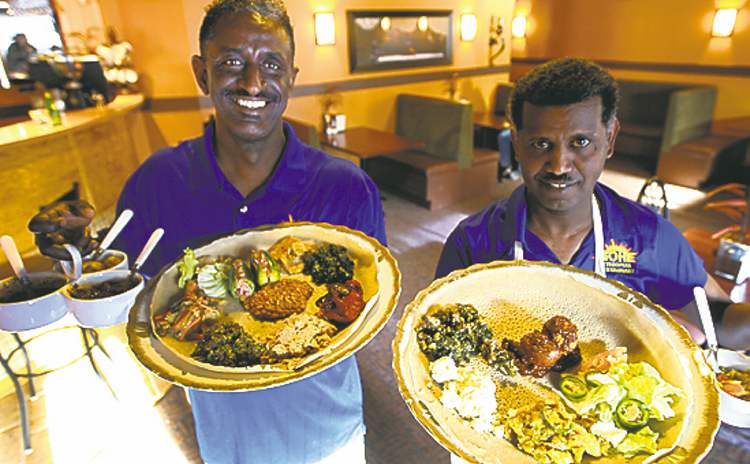
There are no desserts and they don’t have the Ethiopian coffee ceremony, but the espresso-sized dark roast coffee was very good. Although I can’t remember any truly disappointing Ethiopian food, I also can’t remember many that I liked as much as the food at Gohe, or a staff that was nicer, friendlier and more obliging. marion.warhaft@freepress.mb.ca
Dining Out

Gohe
óè 533 Sargent Ave., 204-414-1529
óè Licensed
óè Wheelchair access
‘Ö’Ö’Ö’Ö out of five