

First-rate biography of indigenous culture advocate
Advertisement
Read this article for free:
or
Already have an account? Log in here »
To continue reading, please subscribe:
Monthly Digital Subscription
$0 for the first 4 weeks*
- Enjoy unlimited reading on winnipegfreepress.com
- Read the E-Edition, our digital replica newspaper
- Access News Break, our award-winning app
- Play interactive puzzles
*No charge for 4 weeks then price increases to the regular rate of $19.95 plus GST every four weeks. Offer available to new and qualified returning subscribers only. Cancel any time.
Monthly Digital Subscription
$4.99/week*
- Enjoy unlimited reading on winnipegfreepress.com
- Read the E-Edition, our digital replica newspaper
- Access News Break, our award-winning app
- Play interactive puzzles
*Billed as $19.95 plus GST every four weeks. Cancel any time.
To continue reading, please subscribe:
Add Free Press access to your Brandon Sun subscription for only an additional
$1 for the first 4 weeks*
*Your next subscription payment will increase by $1.00 and you will be charged $16.99 plus GST for four weeks. After four weeks, your payment will increase to $23.99 plus GST every four weeks.
Read unlimited articles for free today:
or
Already have an account? Log in here »
Hey there, time traveller!
This article was published 01/12/2012 (4786 days ago), so information in it may no longer be current.
In Twilight and in Dawn
A Biography of Diamond Jenness
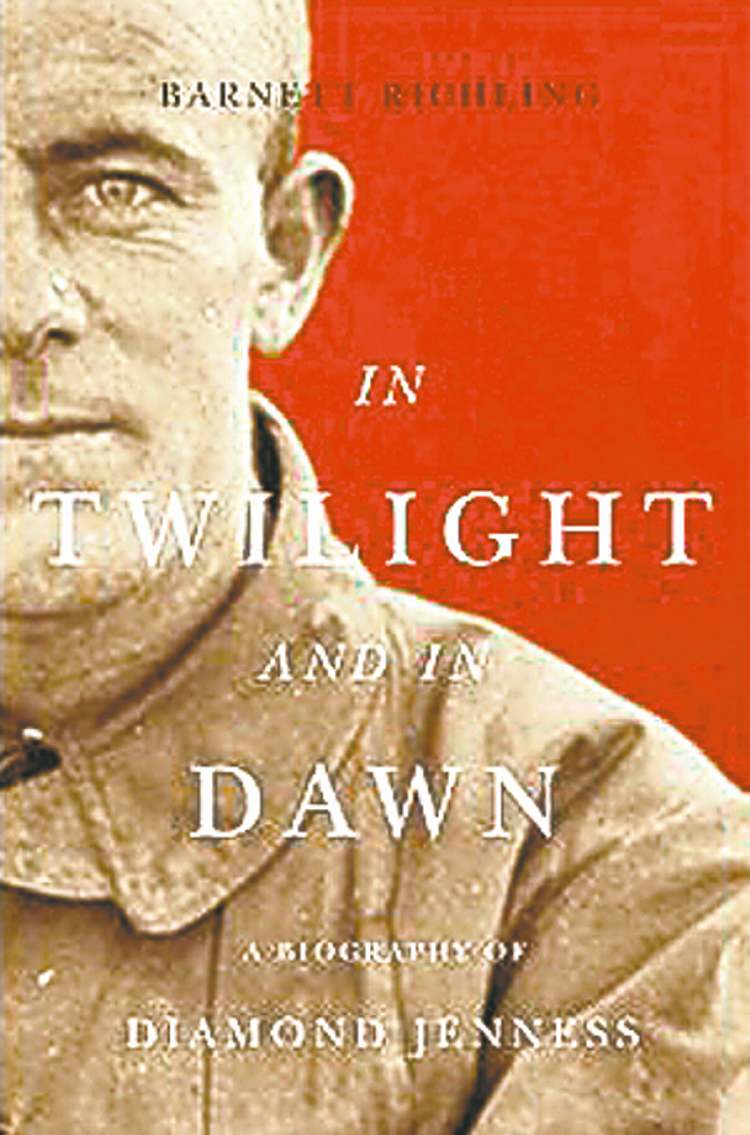
By Barnett Richling
McGill-Queens University Press, 413 pages, $40
DIAMOND Jenness is an important figure both for the development of anthropology in Canada and because of his pioneering studies of indigenous culture and history.
There has never been a full account of Jenness’s life and work, but now, over 40 years after his death, University of Winnipeg senior scholar Barnett Richling has given us a first-rate biography.
Jenness was born and grew up in New Zealand, leaving in 1908 to study classics at Oxford. He soon decided to specialize in the relatively new field of anthropology.
While there he was the classmate of a number of pioneer anthropologists, including the Canadian Marius Barbeau.
In 1912 he began his career doing field work among the indigenous people of New Guinea. While he was visiting in New Zealand after returning from New Guinea he received a telegram from Edward Sapir, the head of the anthropology division of the Geological Survey of Canada, inviting him to join a three-year expedition to the Canadian Arctic to be led by Manitoban Vilhjalmar Stefansson.
He accepted the position and thus began his work in Canada, where he spent the rest of his life. The Arctic expedition employed 70 men and six vessels and was completely funded by the Canadian government. Prime Minister Robert Borden wanted to establish Canadian sovereignty in the Arctic. There was also great interest in the rich natural resources of the region, and many saw Stefansson’s project as a way to accomplish these things.
Jenness was more concerned with the indigenous people of the Arctic. During the years he spent with the expedition, he lived with a number of different Inuit groups and did some archeological investigations.
He was a man of his time and sometimes his attitudes toward the Inuit, as revealed in his writings, would now be considered disrespectful and dismissive. Later in his life, however, he became an advocate for the Inuit in the Ottawa bureaucracy.
Jenness produced numerous reports and monographs on his research, including People of the Twilight and Dawn in Arctic Alaska, which deal with his work during the Stefansson expedition. Indians of Canada, first published in 1932 is still in print.
Jenness served in the Canadian artillery in the Great War, fighting at the front and participating in the major battles of 1918.

In 1920 he was hired by the anthropology branch of the Geological Survey in Ottawa. He became head of the branch in 1925 and that was where he spent the rest of his working life, continuing with his research and battling to keep the branch and the National Museum funded through the depression.
Jenness was always courageous in writing and speaking out about the terrible conditions in which Canada’s indigenous people lived. He criticized the Indian Act and its bureaucratic system, charging that penny-pinching and indifference condemned indigenous people to what he termed “welfare colonialism,” poverty and hopelessness.
He was still fighting a year before his death in 1969, when he was awarded the Order of Canada. He said he hoped that “the honour accorded to me would arouse more public interest in Canada’s Eskimos and Indians, and forever banish the slumber of our languid bureaucracy.”
Richling has done us a great service by bringing the life and work of this great Canadian to life in his very interesting and readable book.
Jim Blanchard is a librarian at the University of Manitoba and a local historian and author.