Child of slaves made name around world, died poor
Advertisement
Read this article for free:
or
Already have an account? Log in here »
To continue reading, please subscribe:
Digital Subscription
One year of digital access for only $1.44 a week*
- Enjoy unlimited reading on winnipegfreepress.com
- Read the E-Edition, our digital replica newspaper
- Access News Break, our award-winning app
- Play interactive puzzles
*Billed as $5.77 plus GST every four weeks. After 52 weeks, price increases to the regular rate of $19.95 plus GST every four weeks. Offer available to new and qualified returning subscribers only. Cancel any time.
To continue reading, please subscribe:
Add Free Press access to your Brandon Sun subscription for only an additional
$1 for the first 4 weeks*
- Enjoy unlimited reading on winnipegfreepress.com
- Read the E-Edition, our digital replica newspaper
- Access News Break, our award-winning app
- Play interactive puzzles
*Your next Brandon Sun subscription payment will increase by $1.00 and you will be charged $17.95 plus GST for four weeks. After four weeks, your payment will increase to $24.95 plus GST every four weeks.
Read unlimited articles for free today:
or
Already have an account? Log in here »
Hey there, time traveller!
This article was published 09/03/2013 (4975 days ago), so information in it may no longer be current.
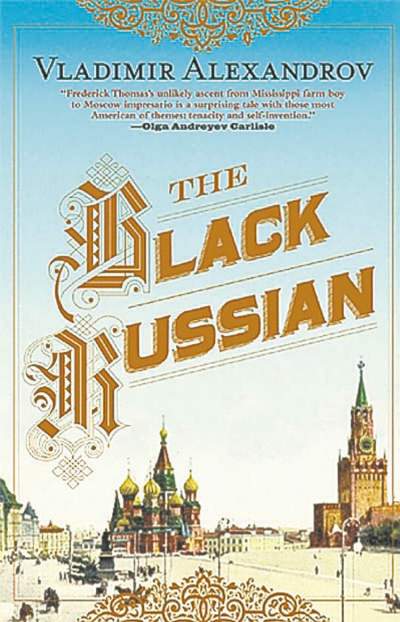
The Black Russian
By Vladimir Alexandrov

Atlantic Monthly Press, 294 pages, $30.50
BIOGRAPHY best captivates when, as here, it emphasizes personality.
It also doesn’t hurt that its subject, turn-of-the-century African American Frederick Thomas, was witness to, and even a minor player in, some of the most dramatic events of early 20th-century history, including the First World War and the Bolshevik Revolution.
Yale professor of Slavic languages and literature Vladimir Alexandrov, author of previous books on Leo Tolstoy and Vladimir Nabokov, repeatedly underlines Thomas’s singular asset, his Southern charm.
Thomas could turn it on at will, and it served him well as he charted a course that saw him move from waiter, to head waiter, to maÆtre d’hotel, and finally proprietor of ritzy foreign establishments.
His vocational progression paralleled his geographic peregrinations.
Born in 1872 to former slaves, he started his career in New York City, moved to London, and then ventured south to the French Riviera.
He subsequently surfaced in each of Milan, Venice, Trieste, Vienna and Budapest, but finally went east to Moscow, in the heart of then still Czarist Russia.
His story could serve as an MBA-program case study of against-all-odds entrepreneurial success.
Not once, but twice, and in two different countries, neither of whose language he spoke, he leveraged small savings from his earnings as a waiter into large loans, and used them to launch successful restaurants and glitzy clubs.
His successes were astonishing.
In Moscow, in 1912, Alexandrov writes, he earned an estimated 150,000 rubles net profit, or the equivalent of about $1 million in today’s money. Later, in Constantinople (now Istanbul), after many setbacks he also netted big dollars, until geopolitical events once again torpedoed his business.
All this accomplished by a semi-literate African-American man from the Mississippi Delta, who floundered in segregated America, but who flourished in the white world beyond the continental United States.
Nor did the collapse of either of his business empires have anything to do with his business acumen, or lack of same. In both cases his enterprises were caught in the current of monumental historical events he never saw coming.
In 1917 the Bolsheviks forced him out of business, and were about to arrest him for being a bourgeois capitalist, before he escaped Moscow for the White Russian enclave of Odessa on the Black Sea.
Fleeing Odessa for Constantinople, he rebuilt his entertainment establishments, only to have them come a cropper due to the resurrection of a particularly xenophobic brand of Turkish nationalism in the mid-1920s.
Thomas reached the apex of his career and wealth as an impresario in Moscow.
But in a supreme irony, his plight in Russia, once the Bolsheviks seized power, mirrored his earlier treatment as a black man in Mississippi. Prejudice of a different but just as virulent sort befell him and his family.

“Frederick’s origins as a black American would have done nothing to mitigate his class ‘sins,'” writes Alexandrov. “Frederick’s past oppression as a black man in the United States was trumped by his having become a rich man in Russia. In the end, he could no more escape how the new regime saw him than he could change the color of his skin.”
By late 1927 his once-flourishing Constantinople ventures also went into a death spiral.
Ultimately his debts were so massive he wound up in a Turkish prison, where he contracted pneumonia. He died in June 1928 in a Constantinople hospital run by nuns, who’d accepted him as a charity case.
But he left behind a remarkable story about a formidable man. A story Alexandrov has uncovered, and masterfully told.
Douglas J. Johnston is a Winnipeg lawyer and writer.