Tory heartland hit the hardest with loss of long-form census data

Advertisement

Advertise with us

OTTAWA - The federal government's decision to axe the long-form census has left parts of the Conservative heartland in western and rural Canada without some of the newest data on how its population is changing.

Read this article for free:


or

Already have an account? Log in here »

To continue reading, please subscribe:

Subscribe and receive a limited-edition Free Press branded hat or tote.

Digital Subscription

One year of digital access for only $205*

  • Enjoy unlimited reading on winnipegfreepress.com
  • Read the E-Edition, our digital replica newspaper
  • Access News Break, our award-winning app
  • Play interactive puzzles

*First annual payment billed as $205.00 + GST for one year. This annual subscription will automatically renew at $233.00 + GST every 52 weeks (10% off the regular annual price of $259.35). Offer available to new and qualified returning subscribers only. Cancel any time.

To continue reading, please subscribe:

Add Free Press access to your Brandon Sun subscription for only an additional

$1 for the first 4 weeks*

  • Enjoy unlimited reading on winnipegfreepress.com
  • Read the E-Edition, our digital replica newspaper
  • Access News Break, our award-winning app
  • Play interactive puzzles
Start now

*Your next Brandon Sun subscription payment will increase by $1.00 and you will be charged $17.95 plus GST for four weeks. After four weeks, your payment will increase to $24.95 plus GST every four weeks.

Hey there, time traveller!
This article was published 08/05/2013 (4902 days ago), so information in it may no longer be current.

OTTAWA – The federal government’s decision to axe the long-form census has left parts of the Conservative heartland in western and rural Canada without some of the newest data on how its population is changing.

Statistics Canada released the first results Wednesday from the 2011 voluntary National Household Survey, the replacement for the long census. The data covered such topics as religion, visible minorities, aboriginals and immigration.

Prime Minister Stephen Harper’s government in 2010 eliminated the mandatory long-form census, citing concerns over personal freedoms.

It boosted the number of households set to receive the new National Household Survey, but the response rate of 68 per cent fell well below the 94 per cent anticipated by Statistics Canada for a mandatory long-form census.

Certain types of Canadians — aboriginals or the poor, for example — are less likely to respond when given the choice, introducing a potential bias in the numbers.

The agency said it achieved a high quality of results at a national level for a voluntary survey. But it cautioned that the numbers were less reliable when zeroing in on areas with fewer than 25,000 people.

Because of low response rates, Statistics Canada chose to withhold all data on a quarter of Canadian municipalities, or 1,128, compared with the 200 that were suppressed after the 2006 long-form census. Most of those are in rural and First Nations communities.

“The estimates for such areas have such a high level of error that they should not be released under most circumstances,” the agency said.

Saskatchewan had the worst results, with information not published on 43 per cent, or more than 500, of its communities. The Conservatives hold all but one of the seats in that province, and have traditionally found support in Canada’s rural areas.

Some of the towns and cities excluded across the country include Bonavista, Nfld., Pictou, N.S., Sackville, N.B., Dauphin, Man., Vulcan, Alta., and Tofino, B.C.

“By not having one quarter of municipalities as part of that database, I think there’s information that’s missing, both for the federal government as well as for the provincial,” said Karen Leibovici, president of the Federation of Canadian Municipalities.

“Canadians live and breathe at the local level. Even if the long-form data wasn’t used to make a decision, it informed a decision,” said Peggy Taillon, CEO of the Canadian Council on Social Development.

“If it was a decision on where to put the next family health team, or fire station, you would look at a number of data to make that decision and one of the greater inputs would always be the long-form.”

Both the NDP and Liberals have called on Harper to bring back the long-form census for 2016, saying the decision to eliminate it was an example of a Conservative disdain for hard evidence.

“It boggles my mind in the data-driven 21st century that we would have a government that would choose to know less about its citizens, and about its needs and about getting good data about what people are struggling with,” said Liberal Leader Justin Trudeau.

Harper defended the census decision, and congratulated Statistics Canada for its work.

“Obviously, going forward we will look for ways to improve things, but always in a way that respects and balances the need for public data with the privacy rights of Canadians,” Harper said in the House of Commons.

Marty Baroni, assistant administrator in Biggar, Sask., said he wasn’t immediately concerned his town wouldn’t be getting the latest data release — it mostly relied on the short-form census population count.

But he noted that a growing Filipino community in his riding would likely not have been properly reflected.

Canada’s Filipino and Chinese populations are two groups that could be facing data flaws. Statistics Canada conceded that information in the NHS about people who emigrated to Canada from the Philippines between 2006 and 2011 didn’t jibe with the numbers gathered by the Citizenship and Immigration Department.

The Chinese Canadian National Council also raised concerns about the data, saying there appeared to be an undercounting when compared with immigration data.

Report Error Submit a Tip

The Free Press acknowledges the financial support it receives from members of the city’s faith community, which makes our coverage of religion possible.
More Stories

PCs renew calls for CFS inquiry

Carol Sanders 6 minute read Preview

PCs renew calls for CFS inquiry

Carol Sanders 6 minute read Updated: 7:54 PM CDT

The Progressive Conservatives renewed calls to put Manitoba’s child and welfare system under the microscope Thursday, tabling a motion that urged the province to appoint a commissioner to lead a public inquiry.

Families critic Jodie Byram’s opposition day motion, which was ultimately defeated by the NDP majority, reiterated demands for an inquiry into the systemic failures of Child and Family Services, more than 20 years after the death of Phoenix Sinclair first prompted demands for answers.

“We have seen far too many children die under the care of CFS, and we need to determine where the gaps are in the system in order to make the system a safer place for children,” Byram told reporters before the motion was defeated in the legislature.

Families Minister Nahanni Fontaine said in an interview that her department, CFS agencies and authorities are “doing good work” and won’t call an inquiry.

Read
Updated: 7:54 PM CDT

Loss of census hits data in Tory heartland

Jennifer Ditchburn, The Canadian Press 4 minute read Thursday, May. 9, 2013

OTTAWA - The federal government's decision to axe the long-form census has left parts of the Conservative heartland in western and rural Canada without some of the newest data on how its population is changing.

Statistics Canada released the first results Wednesday from the 2011 voluntary National Household Survey, the replacement for the long census. The data covered such topics as religion, visible minorities, aboriginals and immigration.

Prime Minister Stephen Harper's government in 2010 eliminated the mandatory long-form census, citing concerns over personal freedoms.

It boosted the number of households set to receive the new National Household Survey, but the response rate of 68 per cent fell well below the 94 per cent anticipated by Statistics Canada for a mandatory long-form census.

Indigenous leaders meet with Governor General during first official visit to Manitoba

Chris Kitching 4 minute read Preview

Indigenous leaders meet with Governor General during first official visit to Manitoba

Chris Kitching 4 minute read Updated: Yesterday at 6:09 PM CDT

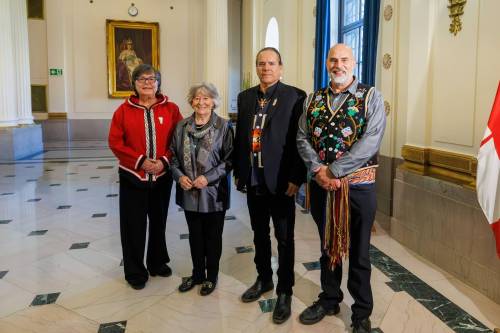
Three Indigenous leaders were encouraged after discussing reconciliation and the need to confront residential school denialism with Gov. Gen. Louise Arbour, while she began her first official visit to Manitoba Wednesday.

Read
Updated: Yesterday at 6:09 PM CDT

Manitoba pharmacists push for increased role in administration of vaccines

Chris Kitching 5 minute read Preview

Manitoba pharmacists push for increased role in administration of vaccines

Chris Kitching 5 minute read Updated: 8:54 PM CDT

Manitoba’s public health officials are preparing for influenza season to peak earlier than usual amid concerns about declining uptake for flu and COVID-19 vaccinations.

While the season started early in some provinces, including Ontario and B.C., Dr. Brent Roussin, Manitoba’s chief public health officer, said it’s too soon to conclusively say if the same will happen here.

“But certainly seeing what’s around us and seeing an uptick (in cases) here, it’s making a concern it might be an early year,” he told the Free Press on Thursday.

Manitoba’s flu season usually peaks in late December, with the vaccination campaign continuing into the new year.

Read
Updated: 8:54 PM CDT

Release police HQ report: Klein

Joyanne Pursaga 5 minute read Preview

Release police HQ report: Klein

Joyanne Pursaga 5 minute read 8:49 PM CDT

Mayoral candidate Kevin Klein is lobbying the province to release the final report from the public inquiry into the Winnipeg Police Service headquarters before the upcoming municipal election.

Klein wrote to the provincial government to request that the information be shared promptly and before Winnipeg voters go to the polls on Oct. 28.

A Thursday CBC report stated the document is finished, “has been sent to the printer” and submitted to the province but isn’t expected to be publicly released until after Winnipeg’s Oct. 28 municipal election.

“It’s all about accountability. The report is done. People have waited (many) years,” said Klein.

Read
8:49 PM CDT

Canadian author Anne Carson wins literature Nobel for ‘bold and inventive’ works that blend genres

Jill Lawless, Hillel Italie And Kostya Manenkov, The Associated Press 6 minute read Preview

Canadian author Anne Carson wins literature Nobel for ‘bold and inventive’ works that blend genres

Jill Lawless, Hillel Italie And Kostya Manenkov, The Associated Press 6 minute read Updated: 5:05 PM CDT

STOCKHOLM (AP) — Canadian poet, essayist and translator Anne Carson won the Nobel Prize in literature Thursday for “bold and inventive” works that fuse the classical and the modern and blur the boundaries of poetry and prose.

The Toronto-born Carson, 76, has drawn on themes from classical Greek and Roman literature, modern influences and personal experience for genre-blending titles that have ranged from translations of ancient Greek poets to collaborations with dancers and musicians, including Laurie Anderson and Lou Reed.

The Swedish Academy that awards the prize said she won “for her bold and inventive oeuvre that, in playful dialogue with the classical tradition, has created new forms for contemporary literature.”

The permanent secretary of the academy said the author was in Iceland “listening to the wind” when the panel reached her to notify her of the honor.

Read
Updated: 5:05 PM CDT