

City’s first urban reserve born
Native leaders hail opening of Polo Park-area property
Advertisement
Read this article for free:
or
Already have an account? Log in here »
To continue reading, please subscribe:

Digital Subscription
One year of digital access for only $205*
- Enjoy unlimited reading on winnipegfreepress.com
- Read the E-Edition, our digital replica newspaper
- Access News Break, our award-winning app
- Play interactive puzzles
*First annual payment billed as $205.00 + GST for one year. This annual subscription will automatically renew at $233.00 + GST every 52 weeks (10% off the regular annual price of $259.35). Offer available to new and qualified returning subscribers only. Cancel any time.
To continue reading, please subscribe:
Add Free Press access to your Brandon Sun subscription for only an additional
$1 for the first 4 weeks*
- Enjoy unlimited reading on winnipegfreepress.com
- Read the E-Edition, our digital replica newspaper
- Access News Break, our award-winning app
- Play interactive puzzles
*Your next Brandon Sun subscription payment will increase by $1.00 and you will be charged $17.95 plus GST for four weeks. After four weeks, your payment will increase to $24.95 plus GST every four weeks.
Read unlimited articles for free today:
or
Already have an account? Log in here »
Hey there, time traveller!
This article was published 24/05/2013 (4843 days ago), so information in it may no longer be current.
At first, there will be a Petro-Canada gas bar and smoke shop.
But to focus on gasoline and cigarettes would miss the significance of Winnipeg’s first urban reserve.
As of Thursday, Long Plain First Nation, 100 kilometres west of Winnipeg, is the first reserve to gain control of a piece of commercial land in Manitoba’s capital.
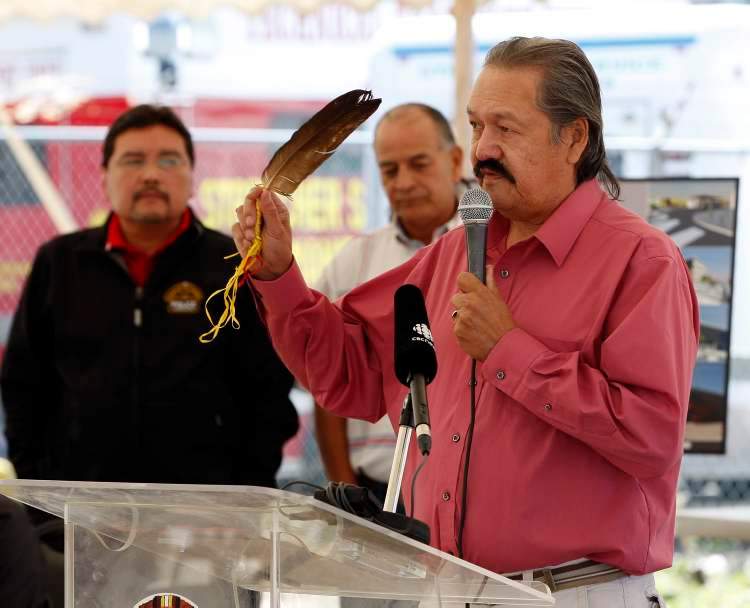
A framed copy of the federal order that officially converted the 1.4-hectare urban property to reserve status was presented to the chief and council at a groundbreaking ceremony on the site at 480 Madison St., two blocks west of Polo Park shopping centre.
“What’s happening here is significant because it’s going to pave the road for First Nations,” Long Plain Chief David Meeches told about 150 community members and invited guests. “Despite the problems we went through, I’m happy to say we are the first First Nation to become an economic development zone, or what everyone else calls an urban reserve.”
Southern Chiefs Grand Chief Murray Clearsky said the urban reserve blazes a trail for other First Nations.
“It’s time we took the bull by the horns and start to have economic businesses ourselves, for ourselves, our youth and our communities,” Clearsky said.
Meeches talked about how long it took to get the piece of paper in the frame federal officials presented Thursday.
“Initially, we would have to go to city hall and knock on the door and make appointments. When we made our services agreement with the city, we agreed to abide by the provisions and bylaws of the City of Winnipeg Act,” Meeches said in an interview after the event.
“However, we’re looking at quite a different situation now. I don’t know if they’ll be knocking on our door and asking what we are doing now.
“But we will drive what happens here and we will also be mindful we are friends and relatives and neighbours. We will acknowledge all the agreements that exist… While I don’t see us posting no-trespassing signs, we certainly ask everyone to respect what we have acknowledged here today.
“The biggest difference is autonomy. For as long as the sun shines, grass grows and rivers flow, we will be here.”
Long Plain purchased the property from Manitoba Hydro in 2006 with a $16-million compensation claim it won in 1994 for land it was owed in 1871 under treaty obligations.
It took seven years to get through the paperwork, first with a services agreement with the city in 2011, then with federal approval for reserve status.
Yellowquill College relocated to the site last year, taking over the former Hydro building. Plans call for a four-storey office building.
A year ago, there was talk of a tax-free distribution zone for First Nations buyers, a possibility now the land officially has reserve status.
Currently, any item delivered to a First Nation is tax-free. Theoretically, with reserve status in hand, any First Nations person or community could arrange to have retailers deliver goods — from furniture to trucks — tax-free to the property on Madison Street. Long Plain would have to approve such a zone and would likely collect fees for the service.
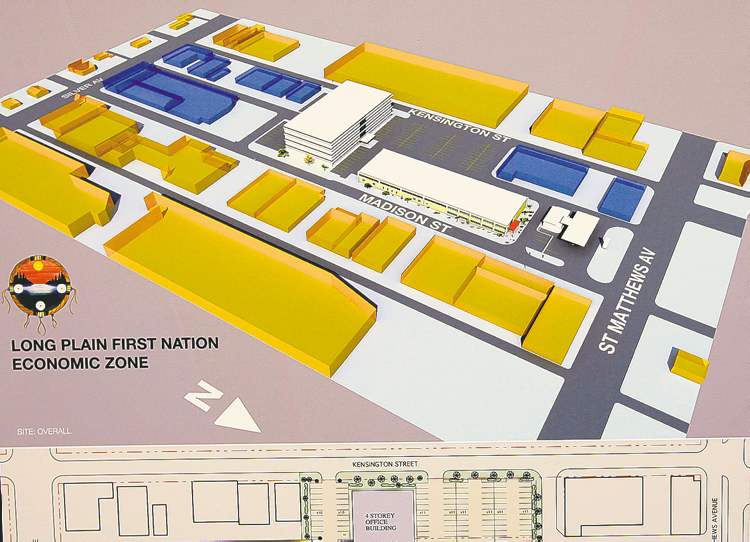
Nothing like that was outlined in plans displayed in a laminated drawing on an easel near a group of traditional singers gathered around a powwow drum Thursday.
Guests gathered before a traditional pipe and a burning smudge of sage for a series of speeches, songs and prayers.
“When I first heard our land was converted to reserve status, I had this mental image of what I would do. But what I felt was a sense of relief because it was such an up-and-down process,” Meeches said.
The second reaction was a sense of accomplishment, he said.
“We finally accomplished something and we did it together as a community.”

He praised former chief Dennis Meeches, who held office when Manitoba Hydro turned the land over.
The former chief, a noted blues musician, was in the crowd and credited former Manitoba grand chief Ron Evans for playing a key role in moving the city into talks for the land’s municipal services agreement.
In 2009, plans called for a $100-million showcase Governance House as the new home for the Assembly of Manitoba Chiefs. That proposal was replaced by commercial development to earn a steady stream of revenue for services at Long Plain.
The groundbreaking ceremony was followed by a signing agreement between Long Plain and Dakota Ojibway Child and Family Services, the community’s regional tribal agency. The signing turned over autonomy for child and family services to the community.
alexandra.paul@freepress.mb.ca
History
Updated on Friday, May 24, 2013 6:22 AM CDT: replaces photo, adds fact box
Updated on Friday, May 24, 2013 12:43 PM CDT: corrects that Long Plain First Nation is 100 km west of WInnipeg
Updated on Sunday, May 26, 2013 6:59 PM CDT: corrects Swan Lake's Arboc gas bar in sidebar