

Winnipeg not immune to railroad disaster
Hazardous materials pass through city on regular basis

Advertisement
Read this article for free:
or
Already have an account? Log in here »
To continue reading, please subscribe:
Digital Subscription
One year of digital access for only $1.44 a week*
- Enjoy unlimited reading on winnipegfreepress.com
- Read the E-Edition, our digital replica newspaper
- Access News Break, our award-winning app
- Play interactive puzzles
*Billed as $5.77 plus GST every four weeks. After 52 weeks, price increases to the regular rate of $19.95 plus GST every four weeks. Offer available to new and qualified returning subscribers only. Cancel any time.
To continue reading, please subscribe:
Add Free Press access to your Brandon Sun subscription for only an additional
$1 for the first 4 weeks*
- Enjoy unlimited reading on winnipegfreepress.com
- Read the E-Edition, our digital replica newspaper
- Access News Break, our award-winning app
- Play interactive puzzles
*Your next Brandon Sun subscription payment will increase by $1.00 and you will be charged $17.95 plus GST for four weeks. After four weeks, your payment will increase to $24.95 plus GST every four weeks.
Read unlimited articles for free today:
or
Already have an account? Log in here »
Hey there, time traveller!
This article was published 09/07/2013 (4705 days ago), so information in it may no longer be current.
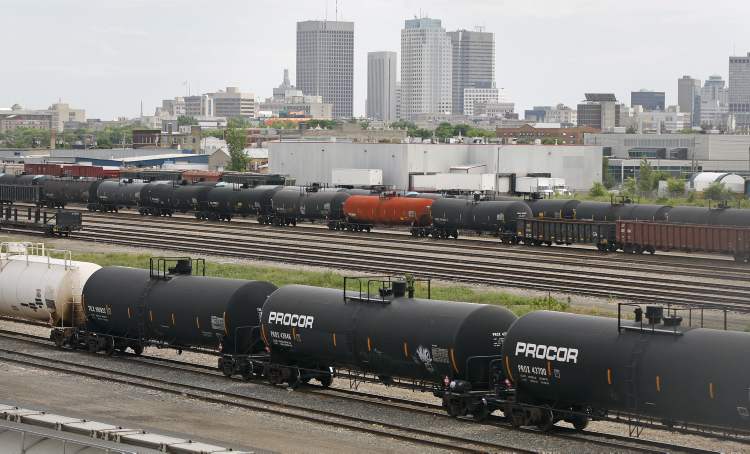
WITH rail cars hauling many kinds of hazardous material through Winnipeg, the Lac-Mégantic, Que., disaster prompted a common question: could it happen here?
“This is a rare circumstance,” said supply chain management Prof. Barry Prentice at the University of Manitoba. “I’ve seen it in a couple of movies but you don’t ever hear of runaway trains in Canada or U.S.”
Early Saturday morning, a runaway train laden with crude oil exploded and killed at least 13 people, decimating Lac-Mégantic’s downtown, where 40 people were still reported missing Monday.
“Railways are viewed as the safest form of transportation,” Prentice said. There’s been a 28,000 per cent increase in the amount of crude oil shipped by rail over the past five years in Canada but the number of derailments has stuck at a little more than one a day, he said.
A spokesman for the Transportation Safety Board in Hull, Que., couldn’t confirm Monday that the rail cars that exploded en route to a refinery in New Brunswick were hauled through the Winnipeg. One Winnipeg MP said the weekend rail catastrophe showed what could happen here.
“This accident serves as a graphic illustration why rail lines should not be run through the heart of urban areas,” said Pat Martin, long a lone advocate of moving Winnipeg’s CP rail yards. “It’s ‘there but for the grace of God’ that we haven’t had a tragic accident.”
Though well-versed on the rail issue, Martin said he has never seen a detailed account of exactly how many dangerous goods such as petroleum products, travel through Winnipeg.
Prentice said crude and many kinds of hazardous materials move safely by rail through Winnipeg frequently.
“It’s not like we can say we don’t want propane or caustic soda or crude (moving by rail),” he said. “If it didn’t go on rail cars, you’d be moving five tractor trailers (for every rail car) instead.”
With two major railways and several smaller companies moving commodities regularly over a massive country, a little more than one derailment a day isn’t much, he said.
If Canadians want to move rail lines away from their cities, there’s legislation to do that, but taxpayers would be on the hook for it, said Prentice.
“We’d have to compensate the railway for that cost,” he said. If Manitobans are already up in arms over a one per cent provincial sales tax increase, he can’t see them lobbying for more government spending to move trains hauling hazardous goods out of the city.
“I don’t think we’re going to get people to pay more taxes to pay for a railway around Winnipeg. But one day it could happen for various reasons, like redevelopment and use of that corridor,” he said. Moving trains away from populated urban areas could be a win-win situation for railway companies and urban residents, he added.
“There would be benefits if they could have a bypass around the city,” Prentice said. “Speed limits are much slower through the city. If you watch trains going past the Goldeyes (Shaw Park downtown), they’re on a curve and have to go even slower,” he said. “If the CP line was relocated, a huge amount of that area would open up for other uses — as a right of way for rapid transit,” he said.
‘This accident serves as a graphic illustration why rail lines should not be run through the heart of urban areas’– Winnipeg MP Pat Martin
Cities used to lobby for railways to run through them, said Prentice. “It’s 100 years later and things have reversed.” Next time onlookers watch a train rumble by downtown, images of the Lac-Mégantic disaster may come to mind.
“It’s always sobering and it reminds us that systems can fail,” said Prentice. “But we should also note… is it’s such a rare occurrence. Seldom do we see a problem with a railway of this nature. It’s safe, environmentally safe and a very efficient means of transport as well.”
The railways are largely self-monitoring, critics say, with companies assessing and managing risk. Prentice said the bottom line forces them to be careful.

“Railways have a huge stake in safety not just because of bad press — they’re self-insured and when an accident like this happens it’s the railways that incur the cost.”
— with file from Mary Agnes Welch
carol.sanders@freepress.mb.ca
Carol Sanders
Legislature reporter
Carol Sanders is a reporter at the Free Press legislature bureau. The former general assignment reporter and copy editor joined the paper in 1997. Read more about Carol.
Every piece of reporting Carol produces is reviewed by an editing team before it is posted online or published in print — part of the Free Press‘s tradition, since 1872, of producing reliable independent journalism. Read more about Free Press’s history and mandate, and learn how our newsroom operates.
Our newsroom depends on a growing audience of readers to power our journalism. If you are not a paid reader, please consider becoming a subscriber.
Our newsroom depends on its audience of readers to power our journalism. Thank you for your support.
Rail-accident stats
- A total of 1,011 rail accidents were reported in 2012, 1,022 in 2011. That’s a 10% decrease from the previous five-year average of 1,128. Of those accidents, the number classified as “fire/explosion” in 2012 was 17, in 2011 it was 23 — the five-year average was 22.
- Accidents involving dangerous goods: 118 in 2012, 118 in 2011, but down from the five-year average of 147.
- Accidents classified as “dangerous goods leaker” — 63 in 2012, 51 in 2011 compared to the average, 64.
- In 2012, there were 48 accidents involving passenger trains, down from 68 in 2011 and the five-year average of 72.
- Rail-related fatalities totalled 82 in 2012 (29 crossing, 49 trespasser, and four others), compared to 71 in 2011 and the five-year average of 76.
— source: Transportation Safety Board of Canada
Carol Sanders
Legislature reporter
Carol Sanders is a reporter at the Free Press legislature bureau. The former general assignment reporter and copy editor joined the paper in 1997. Read more about Carol.
Every piece of reporting Carol produces is reviewed by an editing team before it is posted online or published in print — part of the Free Press‘s tradition, since 1872, of producing reliable independent journalism. Read more about Free Press’s history and mandate, and learn how our newsroom operates.
Our newsroom depends on a growing audience of readers to power our journalism. If you are not a paid reader, please consider becoming a subscriber.
Our newsroom depends on its audience of readers to power our journalism. Thank you for your support.
Related Articles
'About' 40 still missing

Advertisement Advertise With Us
Advertisement Advertise With Us
History
Updated on Tuesday, July 9, 2013 6:41 AM CDT: adds sidebar