Tabata and hit training

Benefits associated with work-to-rest intervals

Advertisement

Advertise with us

Q. For the last year or so, I have heard the term tabata thrown around in the gym and have been told it's the best form of exercise. What exactly does it mean and should I be incorporating it into my fitness routine?

Read this article for free:


By clicking the button above, an account will be created and you will begin to receive some of our recommended newsletters. You may opt out of any newsletter by visiting your Email and Communication Preferences page or by clicking "unsubscribe" at the bottom of any email.

or

Already have an account? Log in here »

To continue reading, please subscribe:

Digital Subscription

One year of digital access for only $1.44 a week*

  • Enjoy unlimited reading on winnipegfreepress.com
  • Read the E-Edition, our digital replica newspaper
  • Access News Break, our award-winning app
  • Play interactive puzzles

*Billed as $5.77 plus GST every four weeks. After 52 weeks, price increases to the regular rate of $19.95 plus GST every four weeks. Offer available to new and qualified returning subscribers only. Cancel any time.

To continue reading, please subscribe:

Add Free Press access to your Brandon Sun subscription for only an additional

$1 for the first 4 weeks*

  • Enjoy unlimited reading on winnipegfreepress.com
  • Read the E-Edition, our digital replica newspaper
  • Access News Break, our award-winning app
  • Play interactive puzzles
Start now

*Your next Brandon Sun subscription payment will increase by $1.00 and you will be charged $17.95 plus GST for four weeks. After four weeks, your payment will increase to $24.95 plus GST every four weeks.

Hey there, time traveller!
This article was published 20/07/2013 (4840 days ago), so information in it may no longer be current.

Q. For the last year or so, I have heard the term tabata thrown around in the gym and have been told it’s the best form of exercise. What exactly does it mean and should I be incorporating it into my fitness routine?

I was inundated with the term tabata two or three years ago and was totally in the dark. As a trainer, I am not usually the first to institute the newest training fad, but I eventually succumbed and did a bit of digging. Here is what I found.

Izumi Tabata is a researcher in Japan who did a study on high intensity interval training (HIIT) and its benefits. His study, performed on speedskaters, determined an interval of 20 seconds of work paired with 10 seconds of rest and repeated eight times over the course of four minutes (take a minute to digest all of those numbers), was the most effective and time-efficient way to improve cardiovascular fitness — both aerobic and anaerobic (we will get into that in a bit). His name and this specific interval have been popularized and are now synonymous with interval training.
TREVOR HAGAN / WINNIPEG FREE PRESS
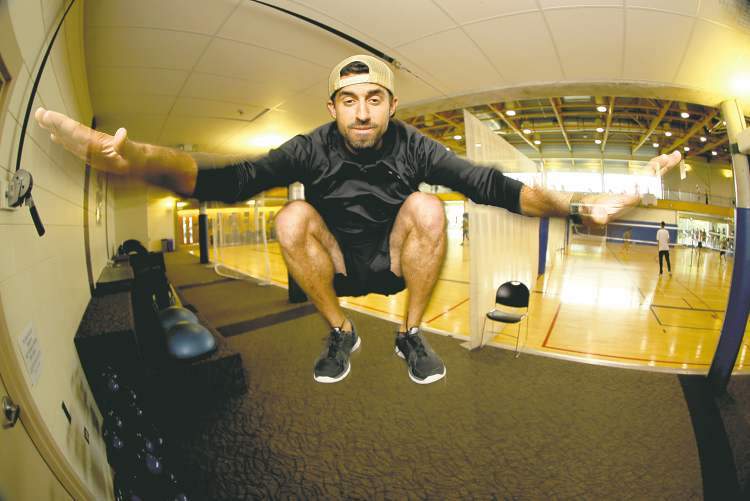
Wes Pomarensky completes a high intensity interval training drill. The burst of intensity is followed by a defined period of rest.
TREVOR HAGAN / WINNIPEG FREE PRESS Wes Pomarensky completes a high intensity interval training drill. The burst of intensity is followed by a defined period of rest.

So tabata training is simply high intensity interval training with a specific work-to-rest interval and length. HIIT training is defined as a period of high-intensity work paired with a period of low-intensity work or rest. This is beneficial, because your body has several systems at work to supply you with energy during exercise. At a lower intensity, your body will use primarily its aerobic system to create a muscle contraction, which uses oxygen and takes considerably longer to complete its pathway. Conversely, when you exercise at a high intensity, your body uses the anaerobic pathway to create a contraction and it does so through a highly expedited process without the immediate use of oxygen. Here is the kicker: When you exercise at high intensity, you get improvements in both systems, while low intensity exercise doesn’t achieve as significant anaerobic improvements.

So why should you care about aerobic and anaerobic improvements? Because it translates into increased fat loss and strength gains; when done properly, it can help train many specific movement patterns, and because you can incorporate almost any movement patterns involving large muscle groups, you can avoid some nasty overuse injuries caused by too much of one repetitive motion.

The caveat is this, and if you read the last piece on the functional movement screen this may already be apparent: Many of us are limited in which large-movement exercises we can perform properly without risking injury. Let’s revisit the burpee. If, as your trainer, I have to modify your burpee to a level that doesn’t challenge your anaerobic system, it’s no longer HIIT or tabata training. Therefore, this type of training is often reserved for fitter individuals.

My other issue with tabata training is the confines of the work-to-rest interval. If your goal is to consistently challenge your body by changing different variables in your exercise routine, why would you limit yourself to one interval length? Eventually, your body will acclimatize to that interval and will no longer be challenged. My approach to HIIT is to treat your interval length like all the other variables in your training routine and continue to modify them.

So approach tabata training with caution and select exercises you can do safely at high intensity while acknowledging HIIT is probably a better term for a broad and effective form of training. If you’ve performed this type of training, you know the feeling you experience when finished, and if you are going to try it — have fun.

We want your questions! Whether you are looking for guidance on a new pair of shoes or have a nagging shoulder injury that just won’t go away, email us at tim@eastmantherapy.ca and you could be featured in the next Q&A article.

Report Error Submit a Tip

More Stories

Tabata and hit training

By Tim Shantz 4 minute read Preview

Tabata and hit training

By Tim Shantz 4 minute read Saturday, Jul. 20, 2013

Q. For the last year or so, I have heard the term tabata thrown around in the gym and have been told it's the best form of exercise. What exactly does it mean and should I be incorporating it into my fitness routine?

I was inundated with the term tabata two or three years ago and was totally in the dark. As a trainer, I am not usually the first to institute the newest training fad, but I eventually succumbed and did a bit of digging. Here is what I found.

Izumi Tabata is a researcher in Japan who did a study on high intensity interval training (HIIT) and its benefits. His study, performed on speedskaters, determined an interval of 20 seconds of work paired with 10 seconds of rest and repeated eight times over the course of four minutes (take a minute to digest all of those numbers), was the most effective and time-efficient way to improve cardiovascular fitness -- both aerobic and anaerobic (we will get into that in a bit). His name and this specific interval have been popularized and are now synonymous with interval training.

So tabata training is simply high intensity interval training with a specific work-to-rest interval and length. HIIT training is defined as a period of high-intensity work paired with a period of low-intensity work or rest. This is beneficial, because your body has several systems at work to supply you with energy during exercise. At a lower intensity, your body will use primarily its aerobic system to create a muscle contraction, which uses oxygen and takes considerably longer to complete its pathway. Conversely, when you exercise at a high intensity, your body uses the anaerobic pathway to create a contraction and it does so through a highly expedited process without the immediate use of oxygen. Here is the kicker: When you exercise at high intensity, you get improvements in both systems, while low intensity exercise doesn't achieve as significant anaerobic improvements.

Read
Saturday, Jul. 20, 2013

Renters get break from proposed hikes

Scott Billeck 4 minute read Preview

Renters get break from proposed hikes

Scott Billeck 4 minute read 3:01 PM CDT

A call from Premier Wab Kinew’s office reduced Aidan Wilson to tears Monday after learning tenants of a West Broadway apartment no longer face hundreds of dollars in rent increases next month.

“It’s been a lot to deal with, it’s a lot to push for, and it’s a lot to speak up. All of these emotions just kind of came flooding out,” Wilson, who lives in the building, said Tuesday afternoon at a news conference alongside Kinew.

The premier announced that renters facing massive hikes on Nov. 1 — some exceeding 100 per cent — will no longer be forced to pay the increases before they are approved by the Residential Tenancies Branch, following a policy change announced by the province.

The move comes after tenants at eight Winnipeg apartment buildings owned by Alberta-based Wingspan Properties pushed back against proposed rent increases of between 54 and 125 per cent, arguing they should have the opportunity to challenge the hikes before being required to pay them.

Read
3:01 PM CDT

Maple leaf love: Albertans vote strongly to stay in Canada

Jack Farrell, The Canadian Press 6 minute read Preview

Maple leaf love: Albertans vote strongly to stay in Canada

Jack Farrell, The Canadian Press 6 minute read Updated: 5:00 AM CDT

EDMONTON - O Canada, Alberta is staying put.

In a historic referendum Monday, voters marked their ballots in overwhelming numbers to remain in the country that made Alberta a province 121 years ago.

In early returns, about 76 per cent of Albertans said yes to Confederation, while 24 per cent said they wanted the province to hold a second, binding referendum on leaving.

Both Alberta Premier Danielle Smith and Prime Minister Mark Carney lauded the result.

Read
Updated: 5:00 AM CDT

Clay Stevenson credits therapeutic side of hockey in learning to live with mother’s suicide

Mike McIntyre 7 minute read Preview

Clay Stevenson credits therapeutic side of hockey in learning to live with mother’s suicide

Mike McIntyre 7 minute read Yesterday at 5:43 PM CDT

Hockey has always been more than just a game to Clay Stevenson. That was especially true after he suffered the biggest loss of his life: his mother, Holly, died by suicide seven years ago.

Read
Yesterday at 5:43 PM CDT

New twist in Hellebuyck saga, suspension ends Friday

Ken Wiebe 7 minute read Preview

New twist in Hellebuyck saga, suspension ends Friday

Ken Wiebe 7 minute read Saturday, Oct. 17, 2026

Connor Hellebuyck has played the reverse Uno card. What we don’t know is if he has any intention of coming back to friendly Manitoba or if this is simply the latest attempt to put the Winnipeg Jets' feet to the flames in an effort to move him to an American market.

Read
Saturday, Oct. 17, 2026

Waters remain murky in uncharted Hellebuyck trade request territory

Ken Wiebe 4 minute read Preview

Waters remain murky in uncharted Hellebuyck trade request territory

Ken Wiebe 4 minute read Updated: 10:14 AM CDT

ST. LOUIS — The thing about being in uncharted waters is that the answer to the next question isn’t always readily apparent either above or below the surface.

Winnipeg Jets head coach Scott Arniel has been doing his best to ensure the upcoming two-game road trip against Central Division opponents doesn’t include a three-ring circus. But with news coming over the weekend that the suspension for goalie Connor Hellebuyck is set to expire on Friday, the club has to prepare for the next step in that process.

The problem, as Arniel conceded during his session on Monday afternoon before the team departed for Missouri, is that some of the hypotheticals need to be eliminated from the equation before the proper response can be determined.

“When it comes to Helly’s scenario, honestly I don’t really have a lot of information,” said Arniel. “I know everybody knows (about) Friday. That’s all we know.”

Read
Updated: 10:14 AM CDT