

Preparing a rescue mission
Researchers brainstorm about saving lakes

Advertisement
Read this article for free:
or
Already have an account? Log in here »
To continue reading, please subscribe:
Monthly Digital Subscription
$1 per week for 24 weeks*
- Enjoy unlimited reading on winnipegfreepress.com
- Read the E-Edition, our digital replica newspaper
- Access News Break, our award-winning app
- Play interactive puzzles
*Billed as $4.00 plus GST every four weeks. After 24 weeks, price increases to the regular rate of $19.95 plus GST every four weeks. Offer available to new and qualified returning subscribers only. Cancel any time.
Monthly Digital Subscription
$4.99/week*
- Enjoy unlimited reading on winnipegfreepress.com
- Read the E-Edition, our digital replica newspaper
- Access News Break, our award-winning app
- Play interactive puzzles
*Billed as $19.95 plus GST every four weeks. Cancel any time.
To continue reading, please subscribe:
Add Free Press access to your Brandon Sun subscription for only an additional
$1 for the first 4 weeks*
*Your next subscription payment will increase by $1.00 and you will be charged $16.99 plus GST for four weeks. After four weeks, your payment will increase to $23.99 plus GST every four weeks.
Read unlimited articles for free today:
or
Already have an account? Log in here »
Hey there, time traveller!
This article was published 12/08/2013 (4628 days ago), so information in it may no longer be current.
While carefree Manitobans splash about in the land of 100,000 lakes this summer, some of the watershed’s smartest minds will be holed up inside the University of Manitoba to find ways to save those bodies of water.
Every summer for the past seven years, researchers from universities in North Dakota and South Dakota have attended the U of M’s International Prairie Student Conference to share ideas and information.
This year, finding a way to make some green from removing algal blooms from Lake Winnipeg is part of the keynote address, an organizer said.

“One of the important things now is to make it profitable to remove these nutrients,” said Nick Svenda, a chemist who is working on his master’s degree in civil engineering. Nutrients such as phosphorus that end up in the troubled freshwater sea are creating giant green growths on its surface.
“It’s in a lot of trouble,” he said.
A lot of research showcased at this week’s conference will deal with eutrophication, which leads to algal blooms on Lake Winnipeg and other lakes, and how to remove the nutrients that cause them, he said.
“Phosphorus is the key culprit,” said Svenda. It’s also the key ingredient in farm fertilizer, and in great demand to feed a growing planet.
“One of the problems we’re facing is phosphorus, in itself, is a limited resource,” he said. “We use a lot as a fertilizer. The supply is not unlimited.”
Removing it from polluted lakes — last Friday, the Manitoba government posted toxic algae advisory signs at Pelican Lake, Killarney Lake and Silver Beach Lake — and turning it into a commodity to use or sell, turns the problem into an opportunity, he said.
Finding an economical way to recycle phosphorus from the lake back to farmers’ fields could speed up the cleanup of the lake, he said.
One graduate student has turned wastewater into fertilizer pellets that slowly dissolve in soil, he said.
He’s working on a way to do it so it’s not costly to make and to sell to farmers.
“It’s sort of like recycling,” Svenda said. “Doing these things for the sake of the environment is all well and good (but) an incentive makes it a more attractive option.”
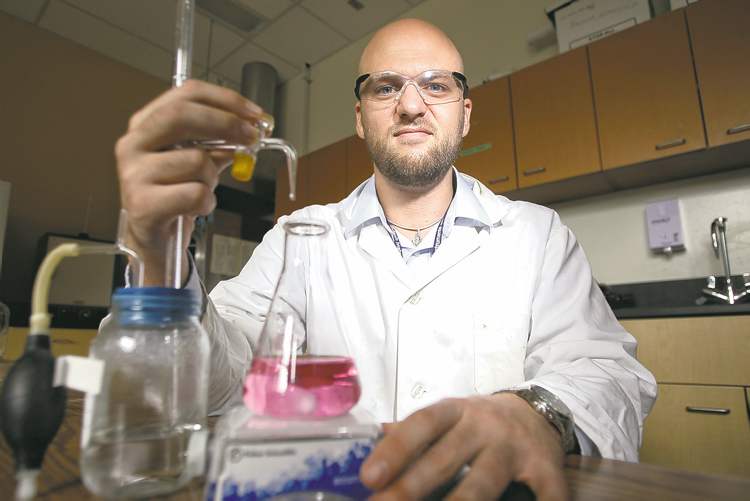
The conference isn’t for the public but the public needs to know more about water and its worth, said Svenda, 27.
“People think their water comes from a tap: ‘So why do I have to worry about funding better water treatment?'” he said.

“It’s a difficult thing and an expensive thing,” said Svenda, who is looking into removing cancer-causing trihalomethanes (THM) from water. The THMs are formed by the interaction of chlorine needed to kill harmful bacteria with organic carbon, he said.
“Our aim is to reduce the formation THMs as much as possible,” he said. “The government of Manitoba is putting out strict regulations essential to the health of inhabitants to reduce THMs,” he said.
“To have easily drinkable and healthy water does take a lot of work and can take a lot of money.”
carol.sanders@freepress.mb.ca
Carol Sanders
Legislature reporter
Carol Sanders is a reporter at the Free Press legislature bureau. The former general assignment reporter and copy editor joined the paper in 1997. Read more about Carol.
Every piece of reporting Carol produces is reviewed by an editing team before it is posted online or published in print — part of the Free Press‘s tradition, since 1872, of producing reliable independent journalism. Read more about Free Press’s history and mandate, and learn how our newsroom operates.
Our newsroom depends on a growing audience of readers to power our journalism. If you are not a paid reader, please consider becoming a subscriber.
Our newsroom depends on its audience of readers to power our journalism. Thank you for your support.
Carol Sanders
Legislature reporter
Carol Sanders is a reporter at the Free Press legislature bureau. The former general assignment reporter and copy editor joined the paper in 1997. Read more about Carol.
Every piece of reporting Carol produces is reviewed by an editing team before it is posted online or published in print — part of the Free Press‘s tradition, since 1872, of producing reliable independent journalism. Read more about Free Press’s history and mandate, and learn how our newsroom operates.
Our newsroom depends on a growing audience of readers to power our journalism. If you are not a paid reader, please consider becoming a subscriber.
Our newsroom depends on its audience of readers to power our journalism. Thank you for your support.
Advertisement Advertise With Us
Advertisement Advertise With Us
History
Updated on Monday, August 12, 2013 6:43 AM CDT: Replaces photo